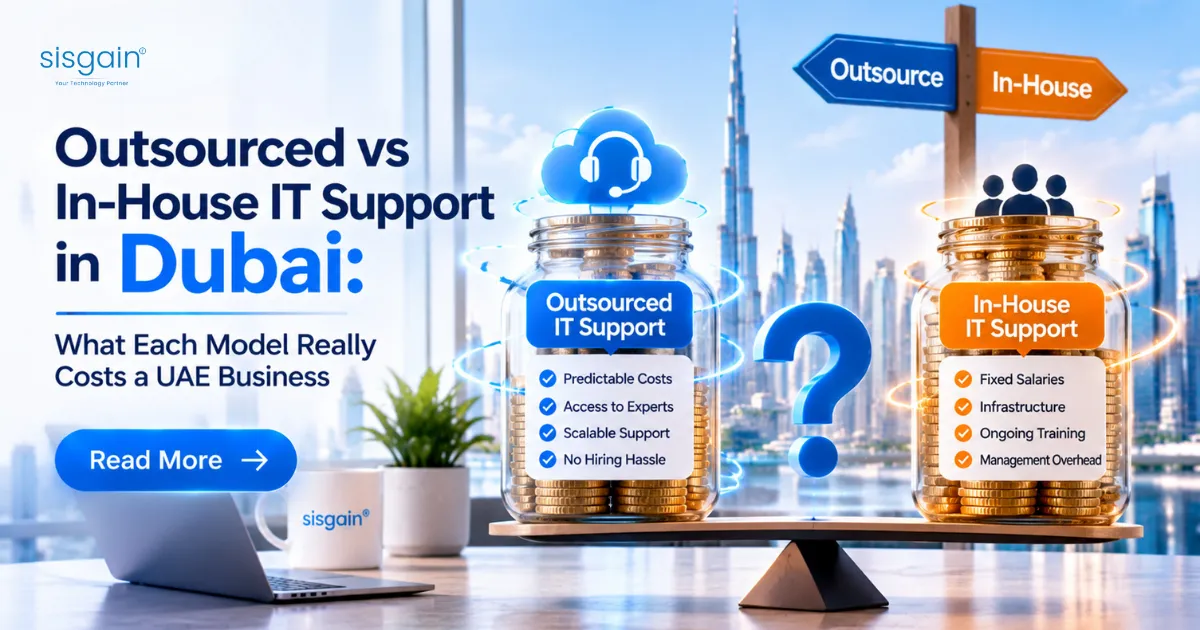

Every Dubai business needs reliable IT, but few owners know what it actually costs to deliver it. A salary is only one line on the bill. Recruitment, visas, insurance, gratuity, tools, training and cover for leave all sit behind it. Outsourced IT has its own fee structure, exclusions and add-ons.
In short: outsourced IT support usually lowers fixed staffing costs and gives you access to a wider range of specialists, while an in-house team gives you direct control and someone physically in the office. Which is cheaper depends on your headcount, systems, coverage hours and growth plans. This guide breaks down the real cost components of three models (outsourced, in-house and co-managed), walks through a transparent three-year AED example, and gives you a framework to test any quotation you receive.
Quick answer: For most Dubai SMEs with 10 to 50 employees and standard systems, outsourced IT support is usually the lower-cost way to get full coverage, because you share specialists across clients instead of employing them. Businesses with complex internal systems or constant on-site needs often justify an in-house team. Growing businesses often do best with a co-managed model that combines both.
What Is the Difference Between Outsourced and In-House IT Support?
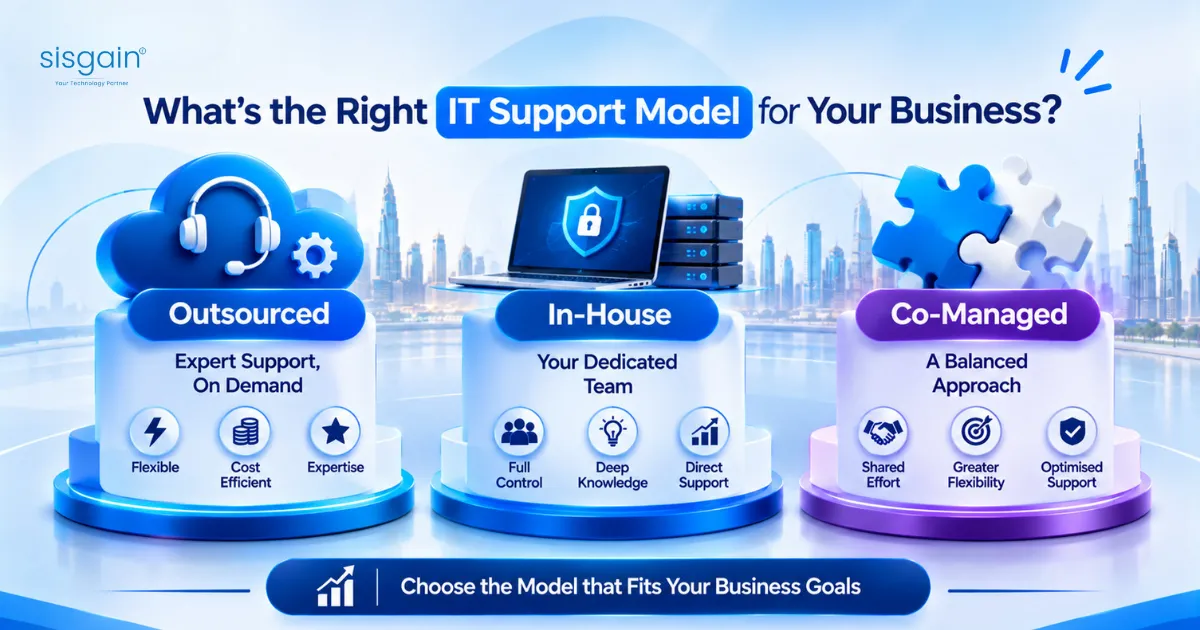
Outsourced IT support means an external provider takes responsibility for agreed IT tasks under a service contract. In-house IT support means your own employee or team handles daily technical operations. Co-managed IT support is a shared model where your internal staff and an external provider split responsibilities. The practical differences come down to who owns the work, who employs the people, what expertise is available and when support is available.
Support Provider | Outsourced | In-house | Co-managed |
Who delivers support | External provider | Your employees | Both |
Cost structure | Monthly service fee | Salaries plus employment costs | Smaller team plus a service fee |
Expertise | Wide, shared across a team | Limited to the people you hire | Internal knowledge plus external specialists |
Control | Shared, set by contract | Direct | Direct for daily work |
Scaling | Contract adjustment | New hires | Flexible |
How Does Outsourced IT Support Work?
With outsourced IT support, specialists handle your IT helpdesk requests, troubleshooting, monitoring, patching and maintenance. Most providers work on a monthly managed-service contract, priced per user, per device or as a fixed fee. A service-level agreement (SLA) defines how quickly the provider must respond and resolve issues by priority. Support is usually delivered remotely, with on-site visits for hardware faults, installations and incidents that cannot be fixed remotely. Many businesses use Outsourced IT Support Dubai services to get a full helpdesk and infrastructure team without building one. Others only need to outsource IT helpdesk services in Dubai while keeping strategic decisions internal.
How Does an In-House IT Team Work?
An in-house team is made up of employees who handle internal requests and know your business systems well. They are supervised directly, can walk to a colleague's desk, and build deep knowledge of your applications and workflows. The limits show up when you need a specialist skill such as cybersecurity or network design, or when you need cover during leave, sickness, resignations or after hours. One person cannot be available all the time, and the one-person team often becomes a single point of failure.
How Much Does In-House IT Support Really Cost in Dubai?
A monthly salary does not represent the full cost of an in-house IT employee. The real cost, often called the fully loaded cost, includes recruitment, visa and employment processing, mandatory health insurance, end-of-service gratuity, annual flight allowance, equipment, software licences and training. It also includes the cost of hiring more people when you need network administration, cybersecurity or infrastructure skills that a single support technician may not have. For a deeper look at pricing models, see our guide to IT Support Cost in Dubai.
What Are the Main Expenses of Hiring an In-House IT Employee?
- Salary package: basic pay plus housing, transport and other allowances.
- Gratuity: under UAE labour law, employers accrue end-of-service gratuity of 21 days of basic salary per year for the first five years of service and 30 days per year after that. Confirm current rules with your legal adviser.
- Health insurance: employers in Dubai must provide medical cover for employees.
- Visa, labour card and Emirates ID processing: an annual average cost across the renewal cycle.
- Recruitment and onboarding: agency fees, advertising, interview time and a ramp-up period.
- Equipment and licences: laptop, helpdesk software, remote monitoring, endpoint protection and backup tools.
- Training and certifications: needed to keep skills current, and often lost when the employee leaves.
- Replacement cost: the same recruitment and ramp-up cycle again if the employee resigns.
How Much Does an IT Support Engineer Earn in Dubai?
Salary depends on experience, certifications and responsibilities. As an independent benchmark, Naukrigulf reports an average of AED 5,529 per month for IT support engineers in Dubai (source: Naukrigulf salary data; add retrieval date before publishing). Averages blend junior and senior roles, so they understate what a mid-level engineer who can manage servers, networks and security will command.
Role level | Typical responsibility | Planning range (AED per month) |
Junior support technician | Helpdesk, user setup, basic troubleshooting | 4,000 to 6,000 |
Mid-level support engineer | Network, server and cloud basics, patching | 6,000 to 10,000 |
Senior engineer or specialist | Infrastructure design, security, escalations | 12,000 and above |
Important: these are illustrative planning ranges, not survey data. Before publishing, replace them with figures and dates from the Charterhouse UAE Salary Guide 2026 and the NADIA UAE Salary Report, and cite the source and date next to each figure.
The number to compare against an outsourced fee is not the salary. It is the salary plus everything in the list above.
How Much Does Outsourced IT Support Cost in Dubai?
Outsourced IT support is priced in several ways, and the right structure depends on how predictable your needs are. There is no single market rate, so treat any advertised starting price as one provider's scope, not a Dubai standard.
Pricing structure | Payment basis | Typically included | Possible extra charges |
Per user | Monthly fee per employee | Helpdesk, remote support, monitoring, patching | Servers, advanced security, projects |
Per device | Monthly fee per endpoint or server | Device monitoring, updates, antivirus | User support outside device scope |
Fixed monthly fee | Flat fee for an agreed scope | Defined services for a defined environment | Anything outside the contract scope |
Hourly or pay-as-you-go | Charged per hour used | Only the work requested | Higher hourly rates, no proactive monitoring |
Project-based | One-off quote | Migration, office move, new network | Ongoing support after the project |
What Factors Affect Outsourced IT Support Pricing?
- Size and spread: the number of employees, devices and office locations.
- Hours and response times: 8x5 support costs less than 24/7 cover with a one-hour response.
- Technical environment: on-premise servers, cloud platforms, networks and security tools each add scope.
- SLA commitments: faster response and resolution targets raise the price.
- Complexity: specialised applications and compliance needs increase effort.
What Is Included in a Monthly IT Support Contract?
A typical contract covers helpdesk and remote troubleshooting, preventive maintenance, patching, system monitoring and basic server and network support. Security monitoring, backup management, reporting and escalation are included where contracted. Always check the written scope, since advanced cybersecurity, hardware, software licences and on-site visits are often priced separately.
Editorial note on indicative examples: the figures used in this article are illustrative. They are not a quotation or a statement of what any specific provider charges.
Compare Your IT Support Costs Before You Commit
Understand your current IT expenses and explore a support model that fits your business requirements and budget. Discuss Your IT Requirements or message us on WhatsApp.
Outsourced vs In-House IT Support in Dubai: Which Costs Less?
The fair comparison is total cost of ownership, not one salary against one monthly invoice. Total cost of ownership includes every cost of delivering the same level of service over the same period. For a typical Dubai SME, outsourcing is often cheaper because you pay for a share of a team instead of employing one person and still needing backup. In-house becomes more attractive as your headcount, system complexity and on-site demands grow. Employee absence, resignations, specialist projects and after-hours incidents all change the maths, so the comparison must cover equivalent service coverage.
Side-by-Side Cost Comparison
Cost factor | In-house IT | Outsourced IT |
Monthly salary | Required | Usually included in the service fee |
Recruitment | Required, repeated on turnover | Provider-managed |
Employee benefits | Visa, insurance, gratuity, flights | Provider-managed |
Technical expertise | Depends on the person hired | Access to contracted specialists |
Holiday and sickness coverage | Needs a backup plan | Depends on the SLA |
Support scalability | Additional hiring | Contract adjustment |
Management | Internal | Shared or provider-managed |
On-site presence | Daily | Scheduled or on request |
Three-Year IT Support Cost Comparison for a Dubai SME
This example assumes a 25-employee company with cloud email, a small office network and one on-premise file server. The service scope is the same under both models: helpdesk, monitoring, patching, endpoint protection, backup and basic security tools.
In-house assumptions: one mid-level IT support engineer on an AED 8,000 per month package (AED 5,000 basic), plus an ad hoc external specialist budget for security and network work the engineer cannot cover.
In-house cost (AED) | Year 1 | Year 2 | Year 3 |
Salary package (8,000 x 12) | 96,000 | 96,000 | 96,000 |
Gratuity accrual (21 days of basic) | 3,500 | 3,500 | 3,500 |
Health insurance | 4,500 | 4,500 | 4,500 |
Visa and permit processing (annual average) | 3,500 | 3,500 | 3,500 |
Annual flight allowance | 2,500 | 2,500 | 2,500 |
Tools and licences (helpdesk, monitoring, endpoint, backup, security) | 30,000 | 30,000 | 30,000 |
Training and certifications | 3,000 | 3,000 | 3,000 |
Ad hoc specialist support | 12,000 | 12,000 | 12,000 |
Laptop (one-off) | 5,000 | 0 | 0 |
Recruitment (one-off) | 8,000 | 0 | 0 |
Total | 168,000 | 155,000 | 155,000 |
Three-year in-house total: AED 478,000.
Outsourced assumptions: a per-user managed service at AED 300 per user per month for 25 users, including tools and security licences, plus an allowance for on-site visits and out-of-scope work, and a one-off onboarding fee.
Outsourced cost (AED) | Year 1 | Year 2 | Year 3 |
Managed service (25 users x 300 x 12) | 90,000 | 90,000 | 90,000 |
On-site visits and out-of-scope allowance | 15,000 | 15,000 | 15,000 |
Onboarding fee (one-off) | 10,000 | 0 | 0 |
Total | 115,000 | 105,000 | 105,000 |
Three-year outsourced total: AED 325,000.
Under these assumptions, outsourcing costs about AED 153,000 less over three years, roughly 32 percent. That is an illustration, not a promise of savings. The result shifts if your provider charges more per user, if you need frequent on-site visits, or if you already own the tools. It also does not price intangible benefits such as having someone physically in the office every day. The in-house figure excludes salary increases and turnover, both of which would raise it.
Methodology note: published salary benchmarks and estimated fully loaded employment costs are different things. The salary figure above is a planning assumption informed by the benchmark discussed earlier. All other figures are stated assumptions you can replace with your own numbers.
What Are the Hidden Costs of In-House and Outsourced IT Support?
Hidden costs are the expenses that never appear in the first quote or job offer but still hit your budget. The biggest one on both sides is downtime. When systems fail and nobody with the right skills can fix them quickly, the cost is lost productivity, missed deadlines and unhappy customers. Contract exclusions, extra support charges and out-of-scope projects are the outsourced equivalent. The way to avoid surprises is to read the full service agreement before you sign.
Hidden Costs of In-House IT Support
- Turnover: replacing an engineer means recruitment fees, a vacancy gap and a ramp-up period.
- Overtime and emergency cover: weekend and evening incidents rarely cost nothing.
- Specialist training: certifications are expensive and leave with the employee.
- Single-person dependency: one employee often holds the only knowledge of critical systems and passwords.
Hidden Costs of Outsourced IT Support
- Out-of-scope work: troubleshooting and projects outside the contract are billed separately.
- Extra on-site visits: many contracts include a limited number.
- Exclusions: security tooling, backup and disaster recovery are sometimes not included.
- Contract terms: automatic renewal, notice periods and early termination fees.
Hidden-cost checklist
In-house | Outsourced |
Replacement recruitment budgeted? | Are on-site visits capped? |
Backup person during leave? | Is backup monitoring included? |
Documented admin credentials and processes? | What counts as a project? |
Training budget per year? | Renewal and exit terms clear? |
Real-world scenario: Imagine your only IT engineer is on annual leave when the file server fails on a Sunday evening. Under the in-house model, nobody is on call, so staff lose Monday morning, and you may pay an emergency contractor a premium rate. Under an outsourced contract with a 24/7 SLA, an engineer responds remotely within the agreed window. If the contract is 8x5 only, the server stays down until Monday, so the same incident costs you a day. The model matters less than whether the coverage matches your risk. This is an illustrative scenario, not a customer case.
When Should a Dubai Business Choose Outsourced IT Support?
Outsourcing suits businesses that need professional IT support but do not have enough work to keep a full department busy. SMEs, startups and growing companies benefit most, because they get access to helpdesk, network, cloud and security specialists they could never hire individually. Outsourced support also scales: adding ten staff means adjusting a contract, not recruiting.
Is Outsourced IT Support Suitable for Small Businesses in Dubai?
Yes, in most cases. IT support for small business Dubai teams typically works well when:
- You have roughly 5 to 50 employees.
- Nobody manages IT as a full-time job.
- You want predictable monthly costs.
- You need helpdesk, maintenance and infrastructure support in one package.
If your company is still comparing providers, our overview of IT Outsourcing Companies in UAE shows what the market offers.
Example: A 15-person startup using cloud tools needs fast helpdesk response, device setup and security basics, which a per-user managed plan covers well. A 40-person professional services firm with a file server, confidential client data and compliance requirements needs more: structured backups, access controls and stricter SLAs. Both can outsource, but the scope and price are different.
Business-size and complexity decision matrix
| Low IT complexity | Medium complexity | High complexity |
1 to 25 staff | Outsourced | Outsourced | Co-managed |
26 to 75 staff | Outsourced | Co-managed | Co-managed or in-house |
76 or more staff | Co-managed | Co-managed or in-house | In-house with specialist partner |
Headcount alone is a poor guide. A 20-person trading firm with a custom ERP can need more IT than a 60-person consultancy running on cloud software.
When Does an In-House IT Team Make More Financial Sense?
An in-house team makes sense when IT work is constant, deeply tied to your operations, or sensitive enough that you want direct ownership. Larger organisations, businesses running custom internal applications and companies with strict governance requirements often fall into this group. When there is enough daily work to keep an engineer fully busy, the cost per hour of in-house support drops and the value of instant, on-site response rises.
Signs Your Business Needs Dedicated Internal IT Staff
- Daily requests need constant attention. Tickets arrive all day and cannot wait for a remote queue.
- Business-critical systems need immediate intervention. Downtime of minutes is expensive.
- Several departments rely on specialised internal applications. Deep system knowledge matters.
- Governance and technical ownership must stay internal. Regulation or policy requires your own people to hold control.
If you tick three or four of these, an internal team, possibly supported by a specialist partner, is likely worth the cost. If you tick one or none, outsourcing or co-managed is usually the better value.
Is Co-Managed IT Support a Better Option for Growing UAE Businesses?
Co-managed IT support combines internal IT employees with an external provider, who shares helpdesk, network management, cybersecurity and infrastructure responsibilities. You keep control and local knowledge without hiring a complete team. It often suits a business that has outgrown outsourcing alone but cannot yet justify, or cannot recruit, the full range of specialists.
How Does Co-Managed IT Support Reduce Operational Costs?
- Your internal employee handles everyday requests and knows your people and processes.
- The provider handles complex work such as server monitoring, security and escalations.
- Responsibilities are shared, so you are not dependent on one individual.
- You access advanced expertise without recruiting full-time specialists.
If you are planning growth, our it infrastructure management dubai service shows what the external side of a co-managed arrangement can cover.
Practical hybrid example: One internal IT administrator handles daily employee requests, onboarding, hardware and vendor coordination. The external provider handles server monitoring, cybersecurity, patching and escalation, and is on call out of hours. The administrator is never alone with a critical incident, and you do not pay for a security engineer you only need part-time.
Outsourced vs In-House vs Co-Managed IT Support
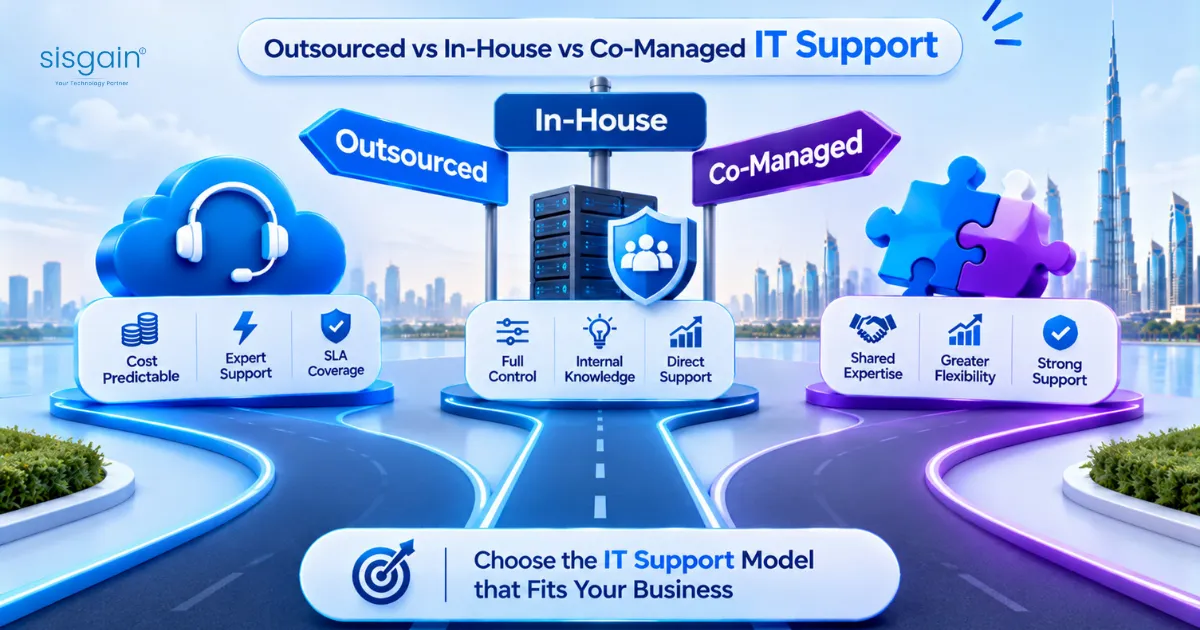
Factor | Outsourced | In-house | Co-managed |
Cost structure | Predictable monthly fee | Salaries and overheads | Smaller payroll plus fee |
Internal control | Moderate | High | High |
Technical expertise | Broad | Limited to hires | Broad and company-specific |
Support coverage | Set by SLA | Business hours, gaps in leave | Strongest overall |
Scalability | High | Slow, hire-dependent | High |
Best fit | SMEs, startups | Complex or large organisations | Growing mid-sized companies |
Need More IT Expertise Without Expanding Your Team?
Explore flexible IT support solutions that help your business access technical expertise while maintaining control over daily operations. Talk to an IT Specialist or start a WhatsApp conversation.
What Should Dubai Businesses Check Before Choosing an IT Support Provider?
Look beyond the monthly price. The cheapest quote often has the narrowest scope. Compare service-level agreements, response times, escalation steps, coverage hours, data security responsibilities, backup ownership and access controls, and ask for clear lists of inclusions and exclusions. If you are shortlisting an IT Support Company in Dubai, request the same information from each so the proposals are comparable.
Which SLA Terms Should Businesses Review?
An SLA is the part of the contract that defines how quickly the provider must respond and fix problems. Review:
- First-response and resolution targets by priority (for example critical, high, normal).
- Remote and on-site coverage: which hours, and how quickly someone attends.
- Escalation procedures and reporting: who is contacted, and how often you receive reports.
- Exclusions, penalties and exit terms: what is not covered, what happens if targets are missed, and how you leave.
For servers in particular, read our guide to a Server Support SLA in Dubai before signing.
Provider scorecard (suggested weights)
Criterion | Weight | What to look for |
Cost transparency | 20% | Itemised pricing, no vague extras |
SLA coverage | 25% | Clear response and resolution targets |
Cybersecurity | 20% | Monitoring, backup, access controls |
Infrastructure expertise | 20% | Certified staff, relevant references |
Scalability | 15% | Easy to add users and sites |
Score each provider from 1 to 5 on each criterion, multiply by the weight and add up. The highest score is the best fit for your priorities, not necessarily the cheapest.
How Can Your Business Calculate the Right IT Support Budget?
Start by listing what you need to support: users, endpoints, servers, locations and required hours. Then request itemised proposals and compare total annual costs across all three models using the same scope.
A Simple IT Support Budget Calculation
- Annual employee costs: salary package, gratuity, insurance, visa, flights and recruitment, spread over the period.
- Add tools and training: software, hardware, licences and certifications.
- Outsourced annual cost: the provider's contract total, using the quotation.
- Add extras: on-site visits, security add-ons, out-of-scope projects and onboarding fees.
- Compare three-year totals and coverage: use the same scope, and note what each option does not cover.
You can reuse this framework on any UAE provider quotation. Copy each line into the table in the three-year example above and replace our assumptions with the figures in the quote. A downloadable checklist or interactive calculator can be added here.
Which IT Support Model Should Your Dubai Business Choose?
Outsourced support is the right fit when you want flexible external expertise and predictable monthly costs. In-house support is right where continuous internal ownership is essential. Co-managed support works best when you want internal control plus specialist capability. Choose the model that delivers the coverage, expertise and long-term value you need, not simply the lowest quotation.
If you... | Choose |
Have 5 to 50 staff, standard systems, no IT manager | Outsourced |
Have constant IT demand and critical internal systems | In-house |
Are growing and need internal control plus specialists | Co-managed |
Find the Right IT Support Model for Your Dubai Business
Discuss your IT infrastructure, support requirements and operational costs with our team to identify a practical solution for your business. Get an IT Support Consultation or message us on WhatsApp.

Conclusion
Choosing between outsourced and in-house IT support in Dubai is not a question of which model is cheaper in general. It is a question of which model delivers the coverage, expertise and control your business needs at a cost you can predict. A salary is only part of the in-house bill, and a monthly fee is only part of the outsourced one, so always compare the full cost of ownership over at least three years.
Here is what to take away:
- Outsourced IT support usually suits SMEs and startups that want predictable monthly costs and access to a broad team of specialists without building a department.
- In-house IT support makes sense when IT demand is constant, internal systems are complex or critical, and direct ownership matters.
- Co-managed IT support is often the strongest fit for growing businesses that want an internal contact for daily needs and external specialists for security, servers and escalation.
- Hidden costs such as turnover, downtime, out-of-scope charges and contract exclusions can change the result, so read every proposal and SLA in full.
Before you decide, list your users, devices, servers and coverage hours, request itemised quotations, and run them through the budget framework and provider scorecard in this guide. If you would like help comparing your options, speak to our team and we will walk you through a practical, itemised comparison for your business.