
Most government digital projects still start with the wrong question. A department asks "which portal should we build?" when the real question is "what digital foundation lets us connect every service, system, and dataset we'll ever need to touch?"
That distinction is the difference between a website refresh and actual digital government.
Public services today aren't judged by whether a form exists online. They're judged by whether a resident can renew a licence, get a permit approved, or resolve a complaint without re-entering the same data three times across three departments. That requires connected workflows, trusted data, secure system integrations, digital identity, automated decisioning, and consistent experiences across every channel a citizen or business might use.
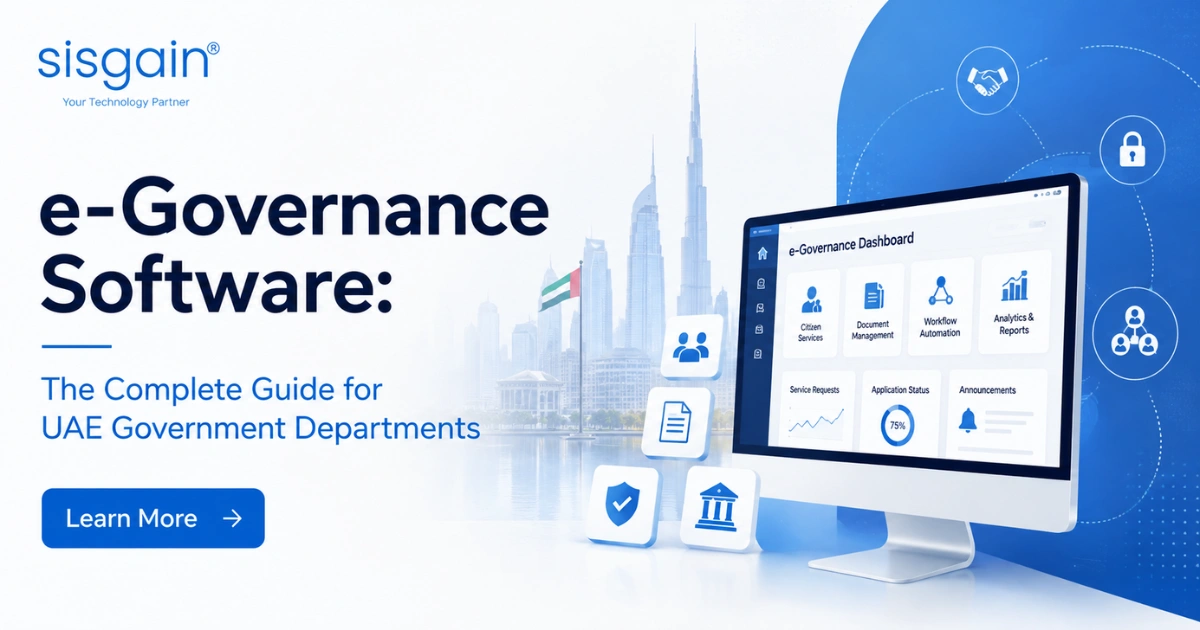
e-Governance software is the digital operating layer that connects public services, workflows, data, systems, and stakeholders to deliver secure, faster, and more citizen-centred government experiences.
The UAE's push toward digital-by-design services, connected government, and AI-assisted decision-making has made this operating layer non-negotiable. That push shows up concretely in how UAE Government AI Solutions are being scoped today — less as isolated pilots, more as capabilities meant to plug straight into the wider service stack. The same logic runs through Smart City AI Applications, which increasingly share infrastructure with the government platforms sitting behind them, and it's part of a broader shift captured well in current thinking on Artificial Intelligence in Public Sector delivery. Departments that treat e-governance software as a website project fall behind. Departments that treat it as infrastructure — the same way they'd treat a network or a data centre — build something that compounds in value with every new service added to it.
This guide covers what e-governance software actually is, the modules a modern platform needs, how to architect it, what UAE-specific compliance and localisation demand, and a practical path from pilot to platform. It's built for CIOs, CTOs, and digital transformation leads who need to make a real decision, not read a marketing brochure.
Quick Answer: What Is e-Governance Software?
e-Governance software is a secure digital platform that lets government departments design, manage, automate, and improve public services and internal operations from a single connected environment. A modern platform ties together citizen and business portals, digital forms, workflow automation, case management, document handling, identity services, payments, notifications, APIs, analytics, and increasingly, AI.
The point isn't to digitise a paper process and call it done. It's to build end-to-end service journeys that work across departments, not just within one.
What Is e-Governance Software, Really?
A definition that holds up in practice
Strip away the vendor language and e-governance software is a configurable, secure technology environment that does seven things:
- Delivers digital government services to citizens, businesses, and other agencies
- Automates internal and external workflows
- Manages cases and service requests from intake to resolution
- Connects government systems and shares data securely
- Enables secure communication and transactions
- Monitors service performance in real time
- Supports decisions with actual evidence, not guesswork
Notice what's missing from that list: "publishes information." A brochure website does that too. It's not the same thing.
e-Governance software vs. a government portal
This is where a lot of departments get tripped up. A portal is a front door. A platform is the building behind it.
|
Capability |
Government Website/Portal |
Modern e-Governance Platform |
|
Information publishing |
Yes |
Yes |
|
Digital forms |
Limited |
Advanced, rules-driven |
|
Workflow automation |
Limited |
Yes |
|
Cross-system integration |
Limited |
API-based |
|
Case management |
Usually external |
Integrated |
|
Data analytics |
Basic |
Advanced |
|
AI capabilities |
Optional add-on |
Extensible, built-in |
|
Cross-department services |
Difficult |
Designed for interoperability |
|
Audit and governance |
Limited |
Built into daily operations |
A portal can look polished and still leave a department with three disconnected systems behind it. That's the trap.
Software alone doesn't create digital government
Buying a platform is not the transformation. It's one input among several:
- Service design that reflects how residents actually behave, not how the org chart is structured
- Policies and processes that match the new workflow, not the old one
- Data governance — who owns what, and who's accountable when it's wrong
- Technology architecture that scales past the first use case
- People with the operational skills to run the thing after launch
- Security and compliance woven in, not bolted on
- A habit of measuring and improving, quarter over quarter
Skip any of these and the software becomes expensive shelfware with a login page.
From Digitisation to Proactive Digital Government
Here's a maturity framework worth keeping on the wall of every transformation office. Most UAE departments sit somewhere between stage two and three right now — knowing which stage you're actually in changes what you should build next.
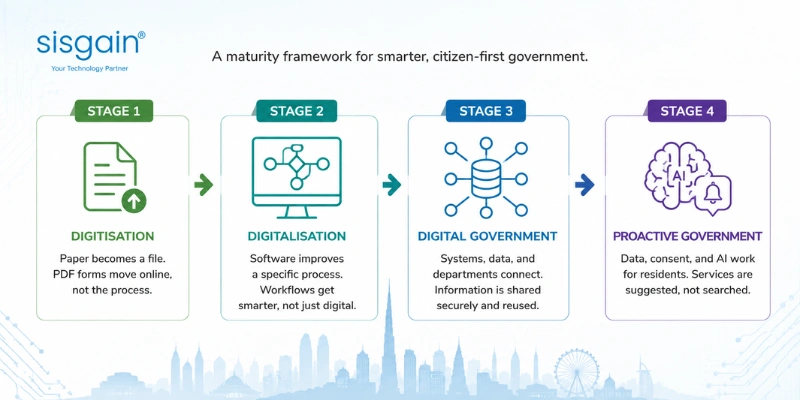
Stage 1: Digitisation
Paper becomes a file. That's it. A PDF application form gets uploaded to a website instead of handed across a counter. Useful, but it's the floor, not the ceiling.
Stage 2: Digitalisation
Software starts improving a specific process rather than just hosting it. An online permit application with automated routing to the right reviewer is digitalisation — the workflow itself got better, not just the medium.
Stage 3: Digital Government
Systems, data, departments, and channels start talking to each other. A resident submits their information once, and every authorised system downstream reuses it. No re-typing an Emirates ID number for the fifth time this year.
Stage 4: Proactive Government
This is where trusted data, consent-aware logic, and AI start working for the resident instead of waiting for them to come looking. A system notices someone is eligible for a service and tells them — rather than requiring them to stumble onto it through a search bar. Departments furthest along this curve tend to have invested early in serious Citizen Service Platform Development, because proactive notifications are only as good as the underlying journey they're plugged into.
Most departments try to jump straight from stage 1 to stage 4. It rarely works. The data trust and system connections stage 3 builds are what make stage 4 possible at all — and stage 4 itself increasingly leans on generative AI for government to turn raw eligibility data into a plain-language nudge a resident can actually act on.
Why UAE Government Departments Need Modern e-Governance Software Now
Expectations have moved, permanently
Residents compare a government renewal to whatever app they used that morning — a banking app, a delivery app, a ride-hailing app. They expect mobile-first access, real-time status updates, minimal document re-submission, and a consistent experience whether they're on a phone at midnight or at a service centre at noon. A government service that requires three physical visits reads as broken, not just old-fashioned.
Disconnected systems create a coordination tax
When departments run on separate, unconnected systems, the cost doesn't show up as a single line item — it shows up everywhere:
- Duplicate data entry across every touchpoint
- The same document verified two or three times by different teams
- Case handoffs that stall because nobody owns the middle step
- Leadership with no real-time visibility into where cases are stuck
- A citizen experience that feels fragmented because, structurally, it is
None of this is a training problem. It's an architecture problem, and it only gets solved with connected systems.
AI-native, connected government is the direction — not every process needs AI
The UAE's broader push is toward AI, cloud, automation, and data working as one connected capability, not as isolated pilot projects that never scale — the same direction driving much of the current UAE Government AI Solutions roadmap across federal and emirate-level entities. That said, not every process deserves an AI layer on day one. The departments getting this right start by identifying a handful of high-value, measurable, governable use cases, usually with Enterprise AI governance frameworks agreed before the first model goes into production — not by bolting a chatbot onto every form and hoping oversight catches up later. Getting this sequencing right also depends on having a working government performance management baseline in place, so a department can actually tell whether an AI-assisted process outperformed the manual one it replaced.
The Four Interaction Models an e-Governance Platform Should Support
A platform built for only one of these models will hit a wall the moment a second use case shows up. Design for all four from the start, even if you launch with just one.
Government to Citizen (G2C)
Licences and renewals, permit applications, certificates, complaints, application tracking, payments, and notifications. The design priorities here are user experience, accessibility, and transparency — a resident should always know where their case stands without calling anyone.
Government to Business (G2B)
Business registrations, regulatory approvals, compliance filings, tender and procurement workflows, commercial permits. The priority shifts toward reducing administrative friction — every extra document or duplicate step here has a real cost to a business trying to operate.
Government to Government (G2G)
Secure data exchange, shared registries, case handoffs between agencies, inter-agency approvals, cross-department workflows. This is where interoperability and data governance matter most, because the "user" is another system, not a person reading a screen.
Government to Employee (G2E)
Internal requests, approvals, HR workflows, knowledge management, operational dashboards. Often overlooked, but a department's internal operations run on the same platform logic as its public-facing services — and a clunky internal tool slows down every external service it touches.
Core Modules of a Modern GovTech Platform for the Government Sector
This is the part vendors love to gloss over with feature lists. Here's what each module actually needs to do.
1. Citizen and business service portal
Personalised dashboards, service discovery that doesn't require knowing which department to look under, application tracking, multi-language support, and a mobile experience that isn't an afterthought bolted onto a desktop design.
2. Digital service catalogue and smart forms
Services organised by what the resident is trying to do, not by internal department names. Dynamic forms that adjust based on eligibility rules, pre-fill information where the resident has already authorised it, validate entries before submission, and track status afterward.
3. Workflow and case management
Configurable workflows that handle routing, escalations, approvals, SLA tracking, exception handling, and status visibility. This is the engine room — if it's rigid, every future service change becomes a development ticket instead of a configuration change.
4. Document management and e-signature integration
Secure storage, version control, a defined document lifecycle, fast retrieval, electronic signatures, and an audit trail on every document touched.
5. Identity, access, and role management
Authentication, role-based access, least-privilege as a default rather than an exception, delegated administration, and integration with national identity systems where applicable.
6. Payments, notifications, and appointment integrations
These should be reusable components, not one-off integrations built fresh for every new service. Build the notification engine once; every future service plugs into it.
7. API and interoperability layer
This is the single most important architectural decision a department will make. Get the API layer right and every future system connects cleanly. Get it wrong and the platform itself becomes the next silo — just a more expensive one.
8. Data dashboards and performance analytics
Service demand patterns, processing bottlenecks, SLA performance, backlog visibility, completion rates. Leadership shouldn't need a quarterly report to know where a service is breaking down — this is exactly what a proper government performance management layer is built to surface in real time, not in a slide deck three months after the fact.
9. AI-assisted government services
Realistic, near-term use cases include intelligent service search, virtual assistance for common queries, document classification, information extraction from submitted files, knowledge retrieval for staff, service guidance, and demand forecasting. A growing share of this work now falls under generative AI for government, where large language models draft and summarise so staff can review and approve rather than write from scratch.
Every one of these needs human oversight designed in from the start — a model flagging a document for review is useful; a model silently approving or rejecting a case with no human in the loop is a liability waiting to surface. That's the gap a solid Enterprise AI governance programme exists to close, and it's one of the more consequential shifts happening across Artificial Intelligence in Public Sector adoption right now — governance is no longer a nice-to-have bolted on after launch.
10. Security, audit, backup, and disaster recovery
Not optional add-ons purchased later. These need to be platform requirements from procurement day one, because retrofitting security into a live government system is far riskier than designing it in.
What Does a Modern e-Governance Software Architecture Look Like?
Quick answer: A modern platform is built in five layers — experience, service/workflow, integration, data/intelligence, and trust/security — so that any new service or system can plug in without rebuilding what already exists.
Experience layer
Citizen portals, business portals, employee portals, mobile apps, and assisted-service channels for residents who need in-person or phone support.
Service and workflow layer
The service catalogue, business rules engine, workflow automation, case management, and notifications.
Integration layer
APIs, API management tooling, connectors, legacy system integration, and secure data exchange between agencies.
Data and intelligence layer
Data governance policies, analytics, dashboards, AI services, and reporting.
Trust and security layer
Identity, access control, encryption, audit logs, continuous monitoring, backup, and recovery.
The question that actually matters: before signing off on a new platform, ask whether it will connect to the systems already in place — or simply become another disconnected application sitting next to them. That single question predicts more project failures than any technical spec.
This layered approach isn't unique to citizen-facing services. The same data-and-intelligence layer underpins Smart City AI Applications, where traffic, utilities, and public safety systems all draw on shared infrastructure rather than running as isolated deployments. It's the same architectural pattern behind emerging decision intelligence platforms for police investigations, where case data, evidence records, and analytics need to move securely between agencies without duplicating the trust and security layer for every new tool. Departments evaluating either path are increasingly looking at the same class of UAE Government AI Solutions to avoid building two parallel technology stacks that never talk to each other.
Security, Privacy, and Compliance Requirements for e-Governance Software in the UAE
Think of this section as compliance by design, not compliance as a final checklist before launch.
Data classification and ownership. Know what data exists, where it's stored, who owns it, who can access it, and how long it's retained — before writing a single line of integration code.
Identity and least-privilege access. Role-based access and separation of duties, applied consistently, not just for the "sensitive" systems.
Encryption and secure data exchange. Data encrypted in transit and at rest, without turning every conversation about it into a cryptography lecture.
Audit trails and accountability. Full visibility into who accessed what, what changed, who approved it, what decisions were made, and where exceptions occurred.
Secure API governance. Authentication, authorisation, rate controls, monitoring, and version management for every API exposed — internally or externally.
Vendor and third-party risk. Evaluate technology partners on security practices, data handling, support models, incident response capability, and integration risk — not just price and feature checklists.
Data residency and cloud assessment. Requirements here vary by department, data classification, applicable regulation, and approved infrastructure policy. There's no single blanket answer that applies to every dataset a department holds — each classification needs its own assessment.
None of this is separable from AI adoption. Any department layering AI into its services needs an Enterprise AI governance framework that sits on top of these same controls, rather than a parallel set of rules written specifically for AI and forgotten everywhere else. It's a lesson showing up repeatedly across current UAE Government AI Solutions deployments — the platforms that scale cleanly are the ones where security and AI governance were designed by the same team, not two teams working from different documents.
Assess Your Department's Digital Service Maturity
Are your government services connected end to end — or are digital channels still operating as separate systems patched together at the edges? A structured assessment of service journeys, workflows, integrations, data readiness, security controls, and automation opportunities is the fastest way to find out before committing budget to the wrong fix.
Get a Digital Service Maturity Assessment
How to Implement e-Governance Software: A Practical 7-Phase Approach
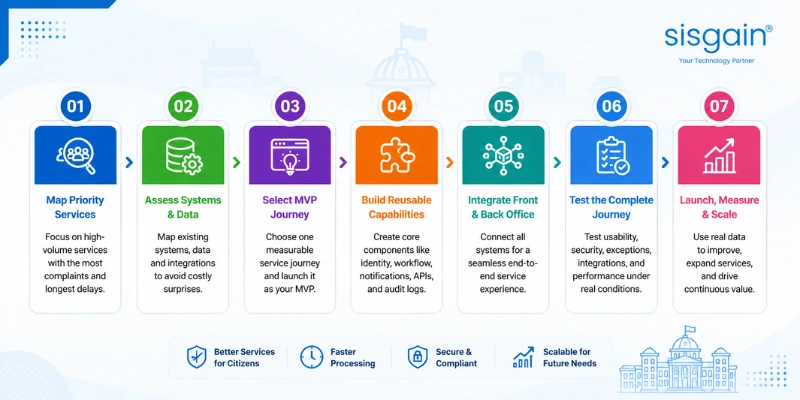
Phase 1: Map priority services and user pain points
Start with the services generating the most volume, the most friction, the longest processing times, and the most complaints. This isn't guesswork — pull the complaint logs and the call centre data before assuming which service is worst.
Phase 2: Assess existing systems, data, and integrations
Build an honest application and data landscape map before a single line of new code gets written. Skipping this step is the single most common cause of integration surprises six months into a project.
Phase 3: Select an MVP service journey
Pick one journey that's measurable end to end. Resist the instinct to digitise the entire department in one release — that path has a well-documented failure rate across public-sector IT.
Phase 4: Build reusable platform capabilities
Prioritise the components that every future service will need anyway: identity, workflow engine, notifications, APIs, audit logging. Build these once, well, and every subsequent service ships faster.
Phase 5: Integrate front-office and back-office systems
A beautiful interface sitting on top of disconnected back-office systems is still a broken service from the resident's perspective. Focus on the complete journey, not just the part people see.
Phase 6: Test the complete service journey
Test accessibility, usability, security, integration reliability, workflow exceptions, and performance under real load — not just the happy path a demo script follows.
Phase 7: Launch, measure, and scale
Use real operational data, not assumptions, to decide what to fix and what to expand next.
Build, Buy, or Use a Hybrid GovTech Platform?
|
Approach |
Best For |
Advantages |
Limitations |
|
Buy |
Standard, commodity capabilities |
Faster deployment |
Less flexibility |
|
Build |
Unique workflows and requirements |
High control |
More delivery responsibility |
|
Hybrid |
Complex government environments |
Balance of speed and flexibility |
Requires strong architecture discipline |
When to buy: commodity capabilities where there's no real advantage to building it yourself — identity verification, payment gateways, notification infrastructure.
When to build: complex policy rules, genuinely unique workflows, legacy technology constraints, or highly specialised integrations that off-the-shelf products simply weren't designed for.
Why hybrid usually wins in practice: configurable platforms, third-party products, reusable components, and custom development can all coexist — provided the architecture was designed to let them. Most successful UAE government platforms aren't purely built or purely bought. They're assembled with intent.
Discuss a secure e-governance software architecture for your department.
How to Measure the ROI of e-Governance Software
Government transformation shouldn't be measured by how many applications launched. It should be measured by whether service outcomes and operational performance actually improved.
Service experience metrics
- Service completion rate
- First-time-right submission rate
- Digital adoption rate
- Citizen or business satisfaction
- Repeat contact rate (how often someone has to come back or call again)
Operational metrics
- Average processing time
- Backlog reduction
- SLA compliance
- Cross-department handoff time
- Cost per completed transaction
Governance and security metrics
- Audit exceptions
- Access-policy violations
- Security incidents
- System availability
- Recovery performance after an incident
AI-specific metrics, where AI is in use
- Accuracy against a defined baseline
- Escalation rates to human review
- Human review rates overall
- Processing time actually saved
- User satisfaction with AI-assisted interactions
Common e-Governance Implementation Mistakes to Avoid
Building separate portals for every department
Problem: fragmented experiences, duplicate technology spend, and residents who have to learn a new interface for every interaction with government.
Better approach: reuse shared platform capabilities across departments instead of rebuilding the same components repeatedly.
Copying offline bureaucracy into online forms
Problem: a 12-field paper form becomes a 12-field digital form. It's still a bad service — just a faster way to deliver a bad experience.
Better approach: redesign the service journey around what the resident actually needs to provide, not what the old process required.
Ignoring data ownership
Problem: unreliable information, unclear accountability, and governance gaps nobody notices until something goes wrong.
Better approach: define data owners explicitly, in writing, before the platform goes live.
Weak API governance
Problem: integrations multiply faster than anyone can secure or manage them.
Better approach: establish reusable API standards early, and enforce them on every new connection.
Treating accessibility as a final design step
Problem: expensive rework, and residents who simply can't use the service that was supposedly built for them.
Better approach: build accessibility into service and UX design from the first sketch, not the final QA pass.
Selecting technology before defining outcomes
Problem: the technology becomes the project's actual objective, and the original problem gets lost.
Better approach: start with user, operational, and policy outcomes — let the technology choice follow from those.
Launching without success metrics
Problem: no way to demonstrate the transformation actually worked, which makes the next budget request harder.
Better approach: define baseline and target KPIs before a single feature ships.
UAE Localisation Requirements for e-Governance Software
Arabic and English service experiences
This goes beyond translation. Content, navigation, and interaction patterns need to feel native in both languages, not like one language was designed first and the other bolted on afterward.
Accessibility by design
Accessibility should shape content, forms, navigation, input methods, and actions — across every channel, not just the desktop version.
Mobile-first public service delivery
Mobile access needs to be considered throughout service design, not tested as an afterthought once the desktop version is finished.
Interoperability across government systems
Federal, emirate-level, and departmental systems all need to interact in some scenarios. Planning for that interaction early avoids a costly integration retrofit later.
Trusted identity, payment, and notification integration
These integration requirements need to be identified during the architecture phase — not discovered during user acceptance testing.
How AI Is Changing e-Governance and Public-Service Delivery
AI is an enabler here, not a replacement for accountable government decision-making. That distinction matters more in the public sector than almost anywhere else.
AI-powered service discovery
Helping residents find the right service without needing to understand how the department is internally structured.
Generative AI for government knowledge access
Practical uses include policy knowledge assistance, employee support, service guidance, and document summarisation — always with a human able to verify the output before it's acted on. This is the core of what most departments now mean when they talk about generative AI for government: a drafting and retrieval layer that speeds staff up without handing them an answer they can't check.
Intelligent document processing
Classification, extraction, and validation support — with human review built into the workflow, not treated as optional.
Decision intelligence
Data can support operational prioritisation and investigation workflows while keeping appropriate governance and oversight in place. This applies well beyond service delivery — into areas like public safety operations, where the stakes of an unchecked automated decision are considerably higher. It's why some of the most carefully governed decision intelligence platforms for police investigations treat every model output as an investigative lead for a human to verify, never as a conclusion on its own.
AI governance is not optional
Human oversight, data controls, transparency, ongoing monitoring, model risk management, and access governance all need to be established before an AI feature goes live — not added after an incident forces the issue. This is the practical substance of Enterprise AI governance, and it's fast becoming the defining line between departments that scale AI responsibly and those still figuring it out in production. It's a distinction worth watching across the wider trajectory of Artificial Intelligence in Public Sector work generally, not just within any one department's programme.
e-Governance Software Readiness Checklist for UAE Government Departments
Service Readiness
- Have we identified our highest-friction public services?
- Have we mapped the end-to-end service journey, not just the digital touchpoint?
- Do we know where users abandon the process or need assisted support?
Technology Readiness
- Have we documented our existing systems honestly, including the ones nobody wants to touch?
- Have we identified every required integration?
- Do we have an API and interoperability approach agreed before development starts?
Data Readiness
- Is data ownership clearly defined and documented?
- Are priority datasets identified?
- Do we understand our data quality and duplication issues?
Security and Compliance Readiness
- Are access controls and roles defined?
- Are audit requirements documented?
- Have privacy, retention, and data-residency considerations been assessed per data classification?
Experience Readiness
- Are Arabic and English journeys planned as equals, not sequentially?
- Has accessibility been included from the beginning?
- Are mobile users considered throughout the service journey, not just at the end?
Measurement Readiness
- Do we have baseline KPIs before launch?
- Are service and operational outcomes actually measurable?
- Is there a defined process for continuous improvement after go-live?
Download the UAE Government Department Digital Service Readiness Checklist — a full 25–30 point evaluation you can run against your own department before the next procurement cycle.
Summary Box: Choosing the Right e-Governance Software Strategy
A UAE government department should prioritise:
- Connected services — avoid isolated portals and applications that solve one problem and create the next silo.
- Interoperability — build APIs and integration capabilities early, not as an afterthought.
- Reusable components — identity, workflow, notifications, security, and analytics shouldn't be rebuilt for every new service.
- Security by design — privacy and governance shape the architecture from day one, not after an audit finding.
- User-centred delivery — simplify the journey; don't just digitise the bureaucracy that already existed.
- Phased transformation — start with a measurable, high-impact service and scale from proven results.
- Governed AI — apply it where it demonstrably improves outcomes, and only where it can be monitored responsibly.
Building Connected Government Services, Not Just Digital Forms
The most effective e-governance software doesn't just move paperwork online. It creates a connected operating environment where services, workflows, data, systems, employees, citizens, businesses, and partner agencies can interact more efficiently and securely than they could before.
For UAE government departments, the real question was never "which portal should we build?" It's this: what digital foundation will let our department connect services, data, workflows, AI, and governance capabilities over the years ahead — not just the next release cycle?
That's a foundation built in phases, with reusable components, real interoperability, and measurable outcomes at every stage — with AI adopted responsibly where it earns its place, not because a roadmap slide demanded it.
Plan a Connected e-Governance Platform for Your Department
Design a phased digital government strategy that connects public services, workflows, legacy systems, data, AI capabilities, and security controls — without creating another isolated technology stack next to the ones you already have.
Discuss Your GovTech Platform Requirements
Assess Your Department's Digital Service Readiness