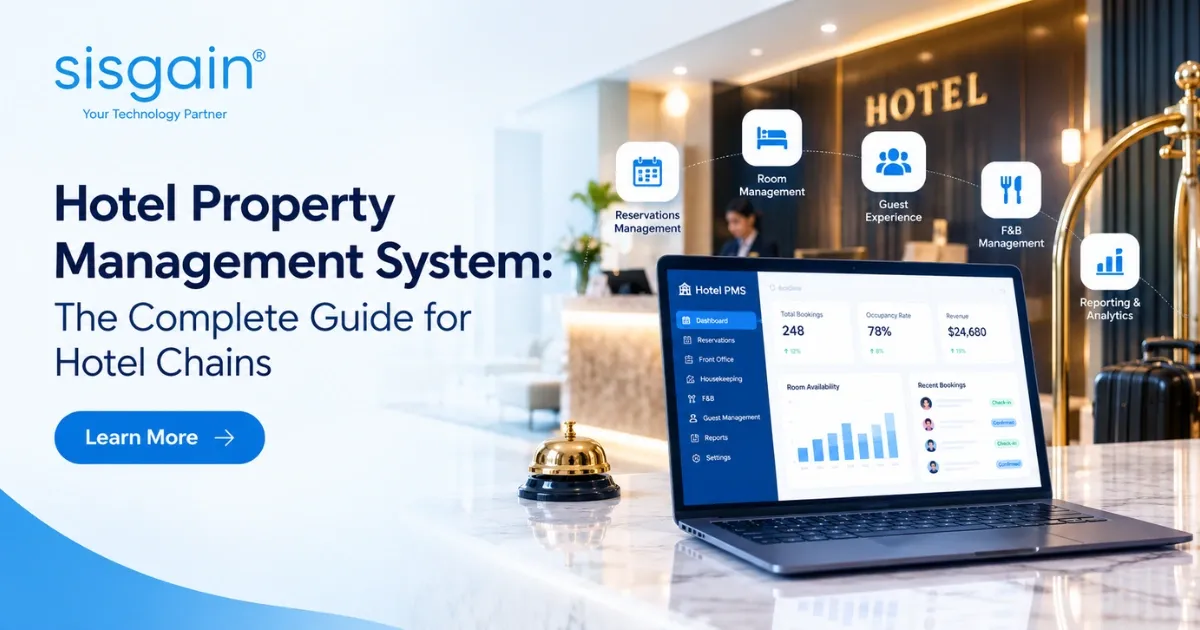

A hotel property management system is centralized software that helps hotels manage reservations, guest information, room allocation, check-in and check-out, billing, housekeeping, payments, reporting, and other daily operational workflows. For hotel chains, that same system also carries the weight of centralized guest profiles, multi-property reporting, corporate controls, and standardized workflows across every location in the portfolio.
That's the part single-property software was never built for.
Why hotel chains need a modern PMS
Run one hotel, and a front-desk system with a booking calendar might genuinely be enough. Run twelve — spread across three emirates, two brands, and a mix of leisure and business travelers — and the same setup starts working against you. Reservations sit in one place. Guest data sits in another. Revenue numbers get stitched together in a spreadsheet nobody fully trusts by the time the GM presents them.
That's the cost of fragmented operations: not one big failure, but dozens of small ones that compound. A returning guest gets treated like a stranger at your second property. A corporate rate gets applied inconsistently across the group. A finance team spends the third week of every month reconciling numbers that should have matched from day one.
The UAE hospitality market makes this more urgent, not less. Room inventory keeps expanding across Dubai, Abu Dhabi, and the northern emirates, and international brands keep raising the operational bar. A PMS that only handles bookings can't keep pace with a market this competitive.
The best hotel PMS for hospitality groups today does one thing well: it gives corporate leadership one reliable view of rooms, guests, revenue, and workflows across every property — while still letting individual hotels run the way their market demands.
What is a hotel property management system, really?
The core role of hotel PMS software
Strip away the marketing language and a PMS handles a fairly specific list of jobs: reservations, room inventory, guest profiles, check-in and check-out, room allocation, folios and billing, payments, housekeeping status, maintenance coordination, night audit, and operational reporting. Miss any one of these and staff end up bridging the gap manually — with a sticky note, a second spreadsheet, or a phone call between departments that should have been automatic.
More than hotel booking software
Reservations get most of the attention because they're guest-facing, but they're really just the entry point. Once a guest checks in, the PMS becomes the system of record for everything that happens during the stay — service requests, room changes, billing adjustments, housekeeping updates. Treat it as booking software and you'll under-use most of what you paid for.
How PMS software has evolved
The path looks something like this: manual operations, then standalone hotel software, then integrated PMS, then cloud PMS, and now intelligent, AI-enabled hospitality platforms. Each stage solved a real problem from the one before it — paper logs gave way to digital records, isolated systems gave way to integrations, on-site servers gave way to remote access.
The current stage adds predictive operational insights, automated workflow recommendations, AI-powered guest communication, demand and occupancy analysis, and intelligent task prioritization. None of this replaces the fundamentals above — it sits on top of them. For a broader look at where hospitality technology investment is heading, the Hospitality Software Market is worth a closer read.
How does a hotel property management system actually work?
Picture the guest journey as a single thread running through the PMS: reservation, guest profile, room assignment, check-in, stay operations, POS and service posting, billing, check-out, then reporting and analytics.
Before the guest arrives, the system handles reservation creation, availability management, guest information capture, pre-arrival communication, and room preparation.
During the stay, it covers front-desk operations, room changes, housekeeping coordination, service requests, POS postings, and guest preferences.
At check-out, the focus shifts to folio review, payment processing, invoice generation, audit records, and updating the guest profile for next time.
After the stay, reporting kicks in — guest history, CRM synchronization, and loyalty or repeat-stay insights that feed straight back into how the next reservation gets handled.
Break any link in that chain and the guest notices. A folio that doesn't sync with housekeeping means a room gets marked ready before it actually is. A guest profile that doesn't update after check-out means the front desk asks a returning guest the same questions they answered last visit.
Why hotel chains need a multi-property hotel PMS
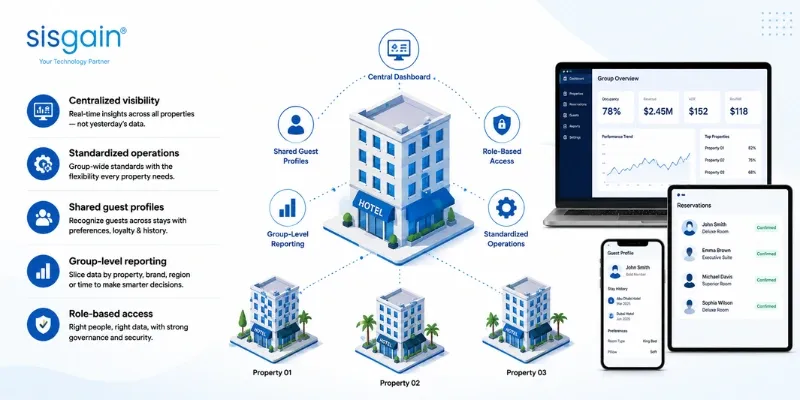
This is where the case for a real, group-level system gets made.
Centralized visibility across properties
Corporate teams need to see occupancy, booking activity, revenue performance, and operational exceptions across the whole portfolio — not property by property, pieced together after the fact. A general manager checking numbers at 9 a.m. shouldn't be working from data that's a day old.
Standardized operations without removing property flexibility
Centralized standards and property-level flexibility aren't opposites — they need to coexist. A resort property and a business-district hotel under the same brand will run different rate strategies and different housekeeping schedules. The PMS should enforce group-wide standards where it matters (billing rules, guest-data handling, reporting formats) while leaving room for each property to operate the way its market actually demands.
Shared guest profiles
A guest who stays at your Abu Dhabi property in March and books your Dubai property in June should be recognized, not re-onboarded. Shared profiles carry preferences, loyalty status, and service history across the group — with role-based access controls so that front-desk staff at one property aren't browsing unrestricted guest data from every other location.
Group-level reporting and decision-making
Being able to slice data by property, brand, region, portfolio, or time period turns reporting from a monthly scramble into something leadership can actually use to make decisions mid-quarter, not after it.
Role-based access and corporate governance
Front-office staff, property managers, finance teams, IT administrators, and corporate operations leaders all need different windows into the same system. Getting these permissions right is less about restriction and more about making sure the right person sees the right data without wading through everything else.
Core features of a hotel property management system
Central reservations and room inventory management — one source of truth for availability, reducing the double-bookings and stale inventory that come from disconnected systems.
Multi-property management — handling multiple hotels, brands, room types, locations, user roles, and corporate standards from a single platform.
Guest profile management — centralized data, preferences, and stay history that actually support personalization instead of just storing it.
Front-desk management — check-in, check-out, room assignment, room moves, deposits, folios, and billing adjustments, all in one workflow.
Housekeeping and room-status management — real-time coordination so a cleaned room shows as ready the moment it actually is, not twenty minutes later.
Maintenance and operational task management — better visibility into what's broken, what's pending, and what's blocking a room from being sold.
Billing, payments, and financial controls — folios, invoices, taxes, deposits, refunds, audit trails, and reconciliation that finance teams can trust without a manual cross-check.
Dashboards and hotel reporting — occupancy, revenue, arrivals, departures, exceptions, and operational performance, viewable at whatever level the reader needs.
Mobile access and role-based controls — staff making decisions from the floor, not tied to a desktop terminal.
API and integration capabilities — increasingly the deciding factor for hotel groups whose technology stack keeps growing.
Cloud PMS vs. on-premise PMS for hotel chains
|
Factor |
Cloud PMS |
On-Premise PMS |
|
Access |
Remote and browser-based |
Usually tied to local infrastructure |
|
Scalability |
Easier to expand across properties |
May require additional infrastructure per site |
|
Updates |
Often vendor-managed |
Can require internal upgrade planning |
|
Integration |
Commonly API-oriented |
Varies by system architecture |
|
Infrastructure |
Reduced property-level server dependency |
Greater local infrastructure responsibility |
|
Customization |
Depends on vendor platform |
Can allow deeper local customization |
|
Maintenance |
Often shared with the vendor |
Greater internal maintenance burden |
Why hotel chains are moving toward cloud PMS
Central access, faster portfolio expansion, quicker updates, richer integration ecosystems, and less dependency on local infrastructure — these are the reasons cloud has become the default conversation for growing hotel groups, not just a trend to follow.
Cloud doesn't automatically fix operational problems
Here's the part vendors don't lead with: a cloud PMS won't fix poor workflows, duplicate data, weak training, thin integrations, or unclear ownership. It moves the software to a better foundation — it doesn't redesign your operations for you. Hotels that go into a cloud migration expecting the software alone to solve process problems are usually disappointed within the first quarter.
What to validate before choosing a cloud PMS
Uptime commitments, SLAs, data backup practices, incident response procedures, access controls, audit logs, data location, and exit procedures. That last one matters more than most buyers realize — know how you'd get your data out before you need to.
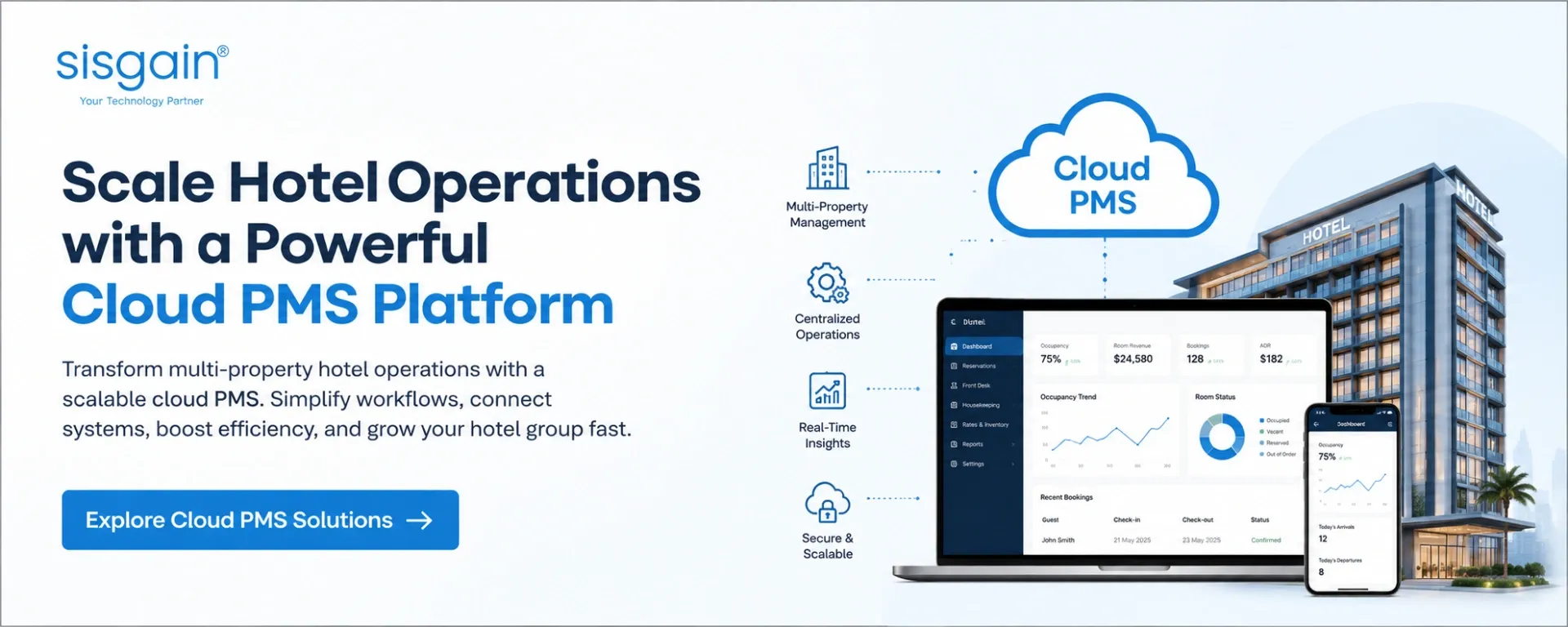
Hotel PMS integrations: how the hospitality technology ecosystem works
PMS vs. channel manager. The PMS manages internal property operations. The channel manager synchronizes rates and availability across OTAs and other distribution channels.
PMS vs. CRS. A central reservations system manages centralized bookings across the whole hotel group. The PMS manages the operational execution of those bookings at the property level.
PMS vs. CRM. The PMS holds operational guest and stay data. The CRM handles guest engagement, marketing, segmentation, and relationship management.
PMS vs. RMS. The PMS carries operational and reservation data. The revenue management system turns that into demand and pricing intelligence.
PMS and hotel POS integration. Restaurants, bars, spas, events, and room service all generate non-room revenue that needs to land on the right folio without a manual entry. This is one of the more common gaps in hotels running legacy systems, and it's a big part of the broader conversation around Property Management Systems and how they connect to the rest of a hotel's technology stack.
How a hotel PMS improves guest experience and operational control
Faster, more consistent check-in. Better room-ready visibility so front desk isn't guessing. More personalized service because staff actually have the guest's history in front of them. Fewer manual adjustments and fewer errors because data isn't being re-entered across three systems.
The department coordination piece matters more than it gets credit for. Housekeeping, front office, and maintenance working from the same live data means a corporate decision-maker isn't waiting until month-end to spot a pattern — a run of billing errors, a spike in OTA discrepancies, a housekeeping bottleneck at a specific property. Disconnected systems create duplicate guest records, delayed room updates, billing errors, OTA mismatches, and reporting that's manually assembled and therefore always a little behind.
AI and automation in hotel PMS for hospitality
AI belongs in the conversation as an enhancement to existing workflows, not as a headline feature bolted onto a sales deck.
AI-powered guest communication can handle pre-arrival questions, FAQs, service requests, and multilingual communication — genuinely useful in a market like the UAE, where guest bases span dozens of languages and time zones. For hotels exploring this further, AI chatbot development solutions built specifically for guest communication tend to outperform generic chat widgets.
Predictive operational insights cover demand forecasting, staffing requirements, housekeeping prioritization, and occupancy patterns.
Intelligent workflow automation routes and prioritizes operational tasks without a manager having to assign every single one manually.
AI governance and human oversight is the section most guides skip. Human review, data quality, access controls, model limitations, and responsible use all need attention before AI touches guest-facing workflows. AI won't automatically improve every hotel operation it's applied to — it improves the ones where the underlying process was already sound.
UAE data protection, billing, and compliance considerations
Hotel operators should validate their specific regulatory, privacy, tax, financial, and operational obligations with qualified legal, compliance, tax, and technology advisers. Nothing here should be read as legal advice.
Guest data and privacy governance
A PMS typically processes identity information, contact details, stay history, preferences, and payment-related data. Before signing with a vendor, hotels should get clear answers on data access, permissions, cross-border transfers, retention periods, auditability, and the vendor's own security practices.
Billing and tax configurability
VAT rules, service charges, tourism-related charges, municipality or emirate-specific fees, invoice formatting, and financial audit trails all need to be configurable — not hardcoded to a single jurisdiction's assumptions. A system built for one market and adapted for the UAE tends to show its seams here first.
Security and audit requirements
Role-based access, multi-factor authentication where appropriate, audit logs, backup procedures, incident-response processes, and vendor accountability. These aren't checkbox items — they're the difference between a system you can defend in an audit and one you're hoping never gets scrutinized.
How to choose a hotel property management system for a hotel chain
- Define your operational requirements. How many properties? How many brands? Which workflows actually need standardizing, and which processes are still manual today?
- Evaluate multi-property capabilities. Central dashboards, shared profiles, property-level controls, group reporting, role management.
- Review the integration ecosystem. POS, CRM, RMS, CRS, channel manager, booking engine, accounting software, payment gateways, digital-key systems.
- Assess data and security controls. Data storage, access permissions, audit logs, backups, incident response.
- Check reporting and analytics capabilities. Property level, brand level, regional level, group level — can the system actually answer the questions leadership asks?
- Understand implementation and migration requirements. Data migration, integration work, staff training, testing, cutover planning.
- Review vendor support and long-term scalability. SLAs, support availability, product roadmap, upgrade process, exit options, data portability.
What should a hotel PMS vendor demonstrate? A hotel PMS vendor should be able to show multi-property management, real operational workflows, integration capabilities, reporting depth, security controls, data migration processes, role-based access, support arrangements, and the ability to scale with where the hotel group is headed — not just where it is today.
Hotel PMS implementation and data migration checklist
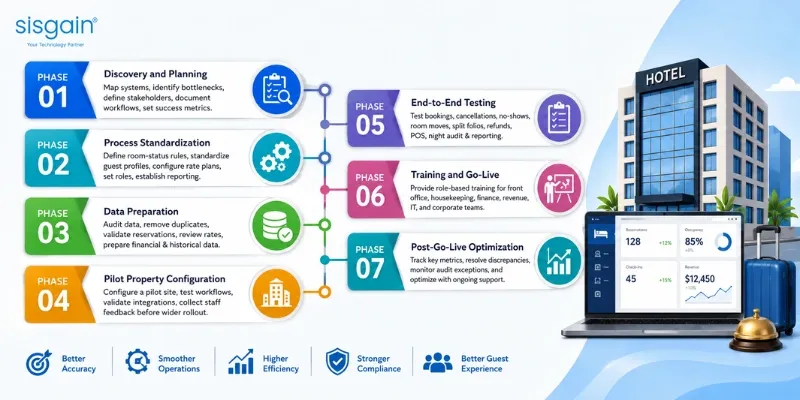
Phase 1 — Discovery and planning: map existing systems and integrations, identify bottlenecks, define stakeholders, document current workflows, set success metrics.
Phase 2 — Process standardization: define room-status rules, standardize guest-profile structures, configure rate plans, define user roles, establish reporting requirements.
Phase 3 — Data preparation: audit existing data, remove duplicates, validate reservations, review rate information, prepare financial and historical reporting data.
Phase 4 — Pilot property configuration: configure a manageable pilot site, test real workflows, validate integrations, collect staff feedback before rolling out further.
Phase 5 — End-to-end testing: direct bookings, OTA bookings, cancellations, no-shows, room moves, split folios, refunds, POS postings, night audit, reporting.
Phase 6 — Training and go-live: separate training tracks for front office, housekeeping, finance, revenue, IT, and corporate teams.
Phase 7 — Post-go-live optimization: track check-in time, room-ready accuracy, manual adjustments, OTA discrepancies, audit exceptions, and support tickets for at least a full quarter.
Common hotel PMS challenges and how to avoid them
Choosing software purely on feature-list length is one of the more common mistakes — operational fit and integration depth matter far more than how many boxes a spec sheet ticks. Underestimating data migration is another; unclean data going in produces unreliable reporting coming out, no matter how good the new system is. Ignoring integration complexity shows up later, usually during the first month-end close when POS and PMS numbers don't reconcile. Insufficient staff training slows adoption regardless of how intuitive the interface is. Over-customization drives up cost and complicates every future upgrade. And without clear post-go-live ownership across IT, operations, finance, and the vendor, small issues sit unresolved because nobody's officially responsible for them.
When should hotel chains consider custom hospitality software development?
Off-the-shelf PMS platforms cover most needs well, but they don't cover everything. Hotel groups with proprietary workflows, complex legacy integrations, custom executive dashboards, specialized guest experiences, multi-system orchestration needs, or a need for AI-powered operational tools built around their exact process often hit a ceiling with standard configurations.
Custom development doesn't necessarily mean replacing the whole PMS. More often, it means building integration layers, guest-facing portals, analytics platforms, mobile applications, or AI tools around a system that already works well for the fundamentals. Hotel groups exploring this path are usually best served by working with established Hospitality Software Development solutions in Dubai, or more broadly, one of the software development companies in Dubai with genuine hospitality-sector experience — since general enterprise developers often underestimate how operationally specific hotel workflows really are. For ongoing support once a custom build is live, dedicated IT services tend to matter as much as the initial development work.
Hotel PMS cost considerations and total cost of ownership
Common cost factors
Number of properties, number of rooms, number of users, deployment model, required modules, integrations, migration, training, support, and any custom development on top of the base platform.
Why the subscription price isn't the full cost
The listed subscription fee is often the smallest line item in a real PMS budget. Integration work, internal IT resources, data cleanup, staff training, process redesign, and ongoing support all add up — and hotel chains that budget only for the license tend to be caught off guard by everything else. For a broader look at how these numbers are trending, software development cost in 2026 is a useful reference point for budgeting technology investment beyond just the PMS itself.
The future of hotel property management systems
A few directions are becoming harder to ignore: AI-assisted operations moving from experimental to routine, composable and API-first platforms replacing monolithic all-in-one systems, deeper automation spreading across departments beyond just the front desk, unified data and analytics replacing siloed reporting, mobile-first operations becoming the norm rather than the exception, and tighter integration between the PMS and guest-experience systems like digital key and in-stay messaging.
Not every emerging technology here will become standard practice — some will stay niche, others will consolidate into a handful of dominant approaches. Hotel chains are better served planning for flexibility than betting on any single trend becoming universal.
Final thoughts
A hotel property management system shouldn't be evaluated as front-desk or booking software anymore. For a hotel chain, it's closer to the operational foundation that connects properties, departments, guest data, billing, reporting, and the wider hospitality technology ecosystem around it.
The right hotel PMS for hospitality groups supports centralized control and property-level flexibility at the same time. It integrates cleanly with the systems hotels already depend on, and it gives the group room to grow into cloud, automation, analytics, and AI-enabled operations without another disruptive migration in three years.
Before selecting a platform, define your workflows, your integration requirements, your data-governance needs, your reporting expectations, your implementation capacity, and where your technology strategy needs to be in three to five years — not just where it needs to be at go-live.
Build a connected hospitality technology ecosystem
Need a hotel PMS integrated with your existing hospitality ecosystem? Whether that means custom PMS capabilities, legacy-system integration, AI-powered guest engagement, operational dashboards, or a complete hospitality software solution, our team can help assess your requirements and design the right architecture for it. This kind of integration work sits alongside the broader tech solutions for many industries our team builds, and draws on the same high demanding technologies — AI, cloud, APIs, and automation — shaping hospitality more broadly.