

Sports organizations are generating more data than ever before — from athlete performance and wearable devices to ticketing, fan engagement, venue operations, video, and commercial partnerships. Every department, from the coaching staff to the commercial team, now runs on some form of digital system.
The challenge is no longer simply choosing another app.
The real challenge is deciding which technology should be built, bought, or integrated, and how every system can support better decisions without creating another disconnected data silo.
This is where a capable sports technology development company earns its value: not by shipping more software, but by helping organizations connect the systems that already exist and build the ones that genuinely matter.
Sports technology development is becoming a strategic operating capability for teams, leagues, venues, and startups. The right technology ecosystem can improve athlete intelligence, strengthen fan relationships, streamline competition operations, support commercial growth, and create a scalable foundation for AI-driven decision-making.
This guide is written as a decision-making resource — not a list of trending sports apps. It is meant to give VPs of Technology, CTOs, CIOs, innovation leaders, and sportstech founders a practical framework for evaluating sports technology development services before they speak to a vendor.
Quick Answers
What is sports technology development?
Sports technology development is the process of designing, building, integrating, and improving digital products and platforms for athlete performance, fan engagement, venue operations, league management, sports media, data analytics, and commercial operations.
Who needs sports technology solutions?
Professional teams, leagues, sports venues, academies, broadcasters, federations, event organizers, and sportstech startups can all benefit from connected sports technology solutions.
When should you build custom sports technology?
Custom development makes the most sense when your workflow, data, rules, fan experience, or integration requirements create a strategic advantage that off-the-shelf software cannot support.
How is AI used in sports technology?
AI can support video analysis, forecasting, personalization, automated content tagging, operational alerts, workflow automation, and data-driven recommendations.
What should sports organizations prioritize first?
Start with a specific decision, workflow, or operational problem with measurable business impact rather than attempting to build an all-in-one sports platform.
What Is Sports Technology Development?
Sports technology development involves creating and connecting digital systems that help sports organizations make better decisions, deliver stronger experiences, and operate more efficiently. It includes far more than consumer-facing applications — it spans the entire operating stack of a modern sports organization.
Core Areas of Sports Technology Development
A mature technology ecosystem typically spans:
- Athlete performance analytics platforms
- Wearables and biometric-data integrations
- AI-powered video analysis
- Computer vision systems
- Fan engagement applications
- Loyalty and membership platforms
- Ticketing and CRM integrations
- Sports merchandising and digital commerce
- Smart stadium and venue platforms
- League and competition management systems
- Registration and scheduling software
- Officiating and compliance tools
- Streaming and content platforms
- Second-screen experiences
- Sports data platforms
- AI-powered operational intelligence
- Sports betting-adjacent data products, where legally applicable
Organizations building fan, athlete, or team-focused products can also explore Sports Application Development in Dubai for custom mobile experiences designed around real sporting workflows rather than generic app templates.
Why Sports Technology Development Is Now a Strategic Operating Decision
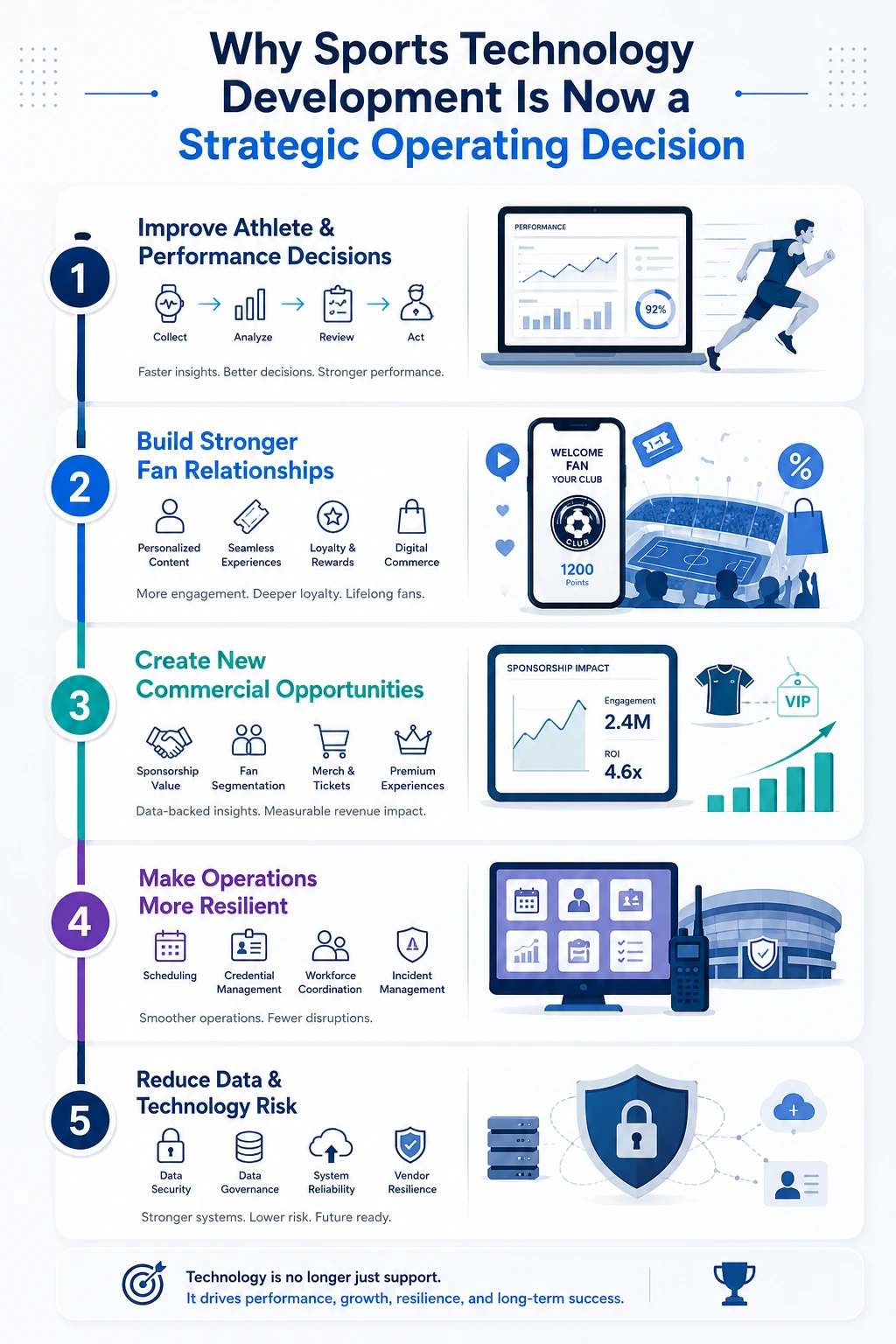
Before comparing platforms or vendors, it's worth establishing why this has become a board-level conversation rather than an IT line item.
1. Improving Athlete and Performance Decisions
Connected data reduces the delay between data collection, analysis, coaching review, training decisions, and recovery planning. When performance data lives in five disconnected systems, coaches lose hours reconciling numbers instead of acting on them.
It's important to be clear about what technology should not do here: it supports coaches, analysts, and medical experts — it does not replace their judgment. The value of a well-built performance platform is speed and clarity, not automated decision-making.
2. Building Stronger Fan Relationships
Modern fan engagement spans personalized content, membership journeys, loyalty programs, digital commerce, targeted communication, ticketing experiences, and in-venue engagement. Fans increasingly expect the same personalization from a football club or a league that they get from a retail brand.
Organizations building multi-platform fan experiences — mobile, web, and in-venue — often benefit from working with a partner offering Mobile App solutions in UAE that can unify these touchpoints under one product strategy.
3. Creating New Commercial Opportunities
Technology increasingly underpins commercial growth through sponsorship inventory management, fan segmentation, merchandise conversion, premium hospitality, ticketing, digital memberships, and media experiences. A connected data layer makes it possible to prove sponsorship value with real engagement data rather than estimated reach.
4. Making Sports Operations More Resilient
Behind the scenes, technology supports scheduling, credential management, competition administration, venue communication, incident management, workforce coordination, and automated reporting. These are unglamorous systems, but they are often where the biggest efficiency gains are found.
5. Reducing Data and Technology Risk
Fragmented systems, duplicate records, unclear data ownership, unauthorized access, vendor dependencies, peak event traffic, and legacy technology all create risk that compounds over time.
The goal of sports technology development should not be more software. The goal should be better-connected decisions.
The Main Types of Sports Technology Solutions
| Solution Area | Typical Users | Primary Business Value | Example Capabilities |
|---|---|---|---|
| Performance and athlete intelligence | Coaches, analysts, medical teams | Faster insights and workload visibility | Wearables, analytics, video analysis |
| Fan engagement and commerce | Marketing, CRM, commercial teams | Retention and conversion | Apps, loyalty, personalization |
| Smart venue technology | Venue operations, IT, security teams | Event-day efficiency | Real-time monitoring, connected services |
| League management | League operations, clubs, officials | Reduced administration | Scheduling, registration, compliance |
| Media and content technology | Digital and broadcast teams | Faster content production | Content tagging, streaming, discovery |
| Data and AI platforms | Technology and executive teams | Connected intelligence | Data integration, forecasting, automation |
AI in Sports Technology: From Isolated Tools to an Intelligence Layer
Short answer: AI creates the most value when it is embedded into an existing sports workflow, where it can help people analyze information, identify patterns, automate repetitive tasks, or respond faster — not when it's bolted on as a standalone feature.
Practical AI Use Cases in Sports
Automated video analysis — video tagging, event detection, pattern identification, and searchable match libraries that cut analyst review time significantly.
Athlete intelligence — data pattern analysis, workload insights, training trends, and decision-support systems that surface risk before it becomes injury.
Fan personalization — content recommendations, offers, membership experiences, and audience segmentation built from real behavioral data, not guesswork.
Operational AI — service automation, demand forecasting, incident alerts, and workflow assistance across venue and league operations.
Content intelligence — automated metadata, content discovery, highlight identification, and multi-platform publishing support for media teams under constant deadline pressure.
Teams exploring these capabilities are increasingly turning to specialized partners for Machine Learning Development Solutions in Dubai, while broader organizational use cases — from chat-based fan support to internal analyst tools — often start with a general set of AI Apps before expanding into sport-specific models. For organizations building this capability internally, understanding the landscape of AI software development in UAE is a useful first step before committing to an architecture.
Build vs. Buy vs. Integrate: Which Approach Is Right?
The most important sports technology decision is often not what to build, but whether new software needs to be built at all.
When to Build Custom Sports Technology
Build when the workflow is genuinely unique, proprietary data creates strategic value, existing software cannot support critical requirements, product ownership is strategically important, the organization requires specialized integrations, or the fan or athlete experience is a direct competitive differentiator.
When to Buy Sports Technology Software
Buy when the requirement is standardized, speed matters more than customization, a specialist platform already meets the requirement, or internal development would not create strategic value. This typically covers standard help desks, commodity collaboration platforms, basic finance systems, and established CRM requirements.
When Integration Is the Best Option
Integrate when valuable systems already exist, data is fragmented across platforms, replacing software would cause unnecessary disruption, or the core requirement is unified reporting or shared identity across systems.
Decision Table
| Decision Factor | Build | Buy | Integrate |
|---|---|---|---|
| Strategic differentiation | High | Low to medium | Medium to high |
| Speed to launch | Lower | High | Medium |
| Customization | Very high | Limited | Medium to high |
| Long-term control | High | Lower | Shared |
| Existing system reuse | Low | Low | High |
| Initial complexity | High | Lower | Medium |
Expert insight: Many sports organizations do not need a full technology transformation. Their highest-value first step may simply be an integration layer that creates a trusted, single view of athlete, fan, competition, and operational data — without touching a single existing system's front end.
A 5-Phase Sports Technology Development Framework
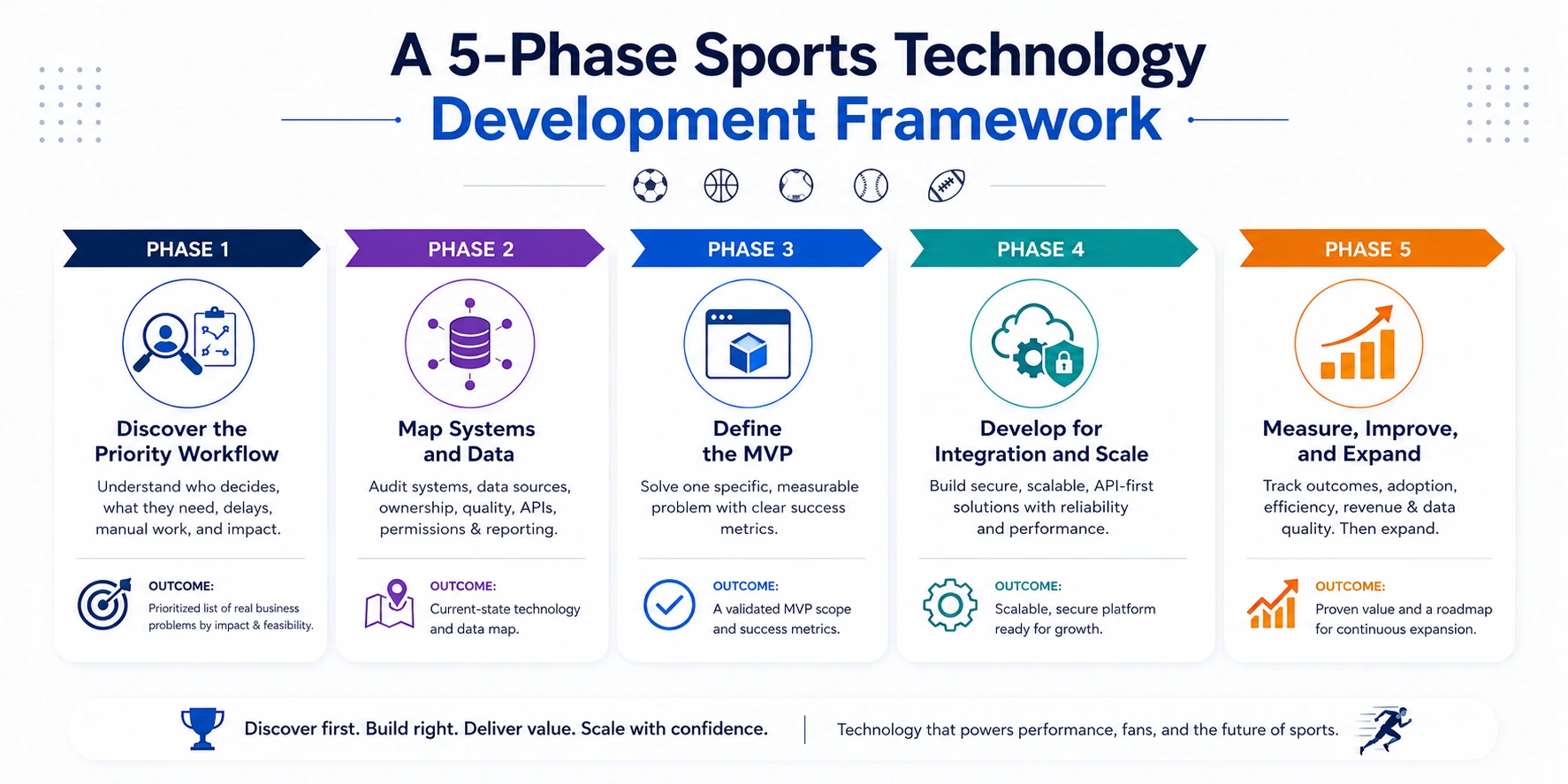
A mature sports technology development company doesn't start with a build. It starts with discovery.
Phase 1 — Discover the Priority Workflow
Identify who makes the decision, what information they need, where delays are occurring, what manual work exists, and what the business impact actually is. This means interviewing coaches, analysts, medical teams, commercial teams, venue staff, league operations, and IT and security teams directly — not relying on assumptions from a single stakeholder.
Outcome: A prioritized list of real business problems, ranked by impact and feasibility.
Phase 2 — Map Systems and Data
Audit existing platforms, data sources, data owners, APIs, data quality, permissions, identity matching, vendor dependencies, and reporting requirements.
Outcome: A current-state technology and data map that shows exactly where the fragmentation lives.
Phase 3 — Define the MVP
The MVP should solve one specific, measurable problem — for example, reducing analyst reporting time, improving fan registration completion, automating competition scheduling, creating unified reporting, or improving content discovery.
Early budgeting matters here. Understanding software development cost in 2026 benchmarks helps technology leaders set realistic expectations before scoping the first release, rather than discovering budget gaps midway through development.
Phase 4 — Develop for Integration and Scale
This phase covers the technical foundation: API-first architecture, secure integrations, role-based access, audit logs, cloud infrastructure, observability, automated testing, peak-load testing, and backup and recovery.
Getting the architecture right at this stage is where a strategic partner adds the most value. Many organizations bring in Technology Consulting Services in Dubai specifically to validate roadmap decisions and architecture choices before development scales beyond the MVP.
Phase 5 — Measure, Improve, and Expand
Measure adoption, business outcomes, operational efficiency, revenue impact, data quality, and user feedback. Only expand the platform once the original use case has demonstrated real value — not before.
Sports Data Architecture: Building a Connected Technology Ecosystem
For most organizations, the biggest long-term challenge isn't application development — it's fragmentation.
The Typical Sports Data Problem
Data commonly sits across wearable platforms, video systems, CRM, ticketing, e-commerce, membership systems, venue systems, competition platforms, spreadsheets, and a long tail of third-party SaaS tools that were each adopted independently, by different departments, at different times.
What a Connected Architecture Should Include
A resilient architecture typically includes source-system integrations, well-documented APIs, identity and access management, data governance, data quality processes, an analytics environment, monitoring, and auditability.
The goal is a trusted data layer — a single place where teams can reliably access clean, current, permissioned data — without overpromising a single universal architecture that solves everything at once. No organization achieves that in one project; it's built incrementally, workflow by workflow.
Data Privacy, Athlete Biometric Data, and Sports Technology Governance
Sports technology can involve some of an organization's most sensitive information, making privacy and governance design decisions — not legal afterthoughts.
Types of Sensitive Data
Sports organizations routinely handle biometric data, health-related information, athlete performance data, location information, video and image data, data involving minors, and fan identity and payment-related information. Each category carries different regulatory obligations depending on jurisdiction.
A Practical Governance Checklist
- Create a complete data inventory
- Define data ownership clearly across departments
- Classify sensitive information by risk level
- Document access permissions for every system
- Apply least-privilege access as a default
- Encrypt data in transit and at rest
- Review third-party vendors for compliance posture
- Maintain audit logs across all sensitive systems
- Define retention rules for every data category
- Establish incident-response procedures in advance
- Build appropriate consent and user-rights workflows
- Define how access is revoked when roles or relationships change
A note on scope: This checklist is a practical starting point, not legal advice. Data protection requirements differ significantly by jurisdiction and by the type of data involved — organizations should validate specific obligations with qualified legal counsel before finalizing governance policy.
How to Evaluate Wearables, Computer Vision, and Real-Time Analytics
Evaluating Sports Wearable Technology
Before adopting any wearable platform, ask: What data is collected? Who owns the data? How accurate and reliable is it? Can it integrate with existing systems? Who can access the data? And critically — what happens when the device is unavailable during a match or training session?
Evaluating Computer Vision
Computer vision decisions should weigh video quality, processing requirements, latency, model accuracy, the level of human review required, privacy requirements, and integration with existing workflows. A highly accurate model that can't integrate into an analyst's existing review process delivers little real value.
Evaluating Real-Time Analytics
Real-time systems live or die on data latency, system reliability, peak event load, alert fatigue, decision usefulness, and failover planning. A dashboard that's accurate but three minutes behind live play is not a real-time system in any meaningful sense.
Smart Stadium and Connected Venue Technology
Modern venues should be treated as year-round digital platforms, not event-day infrastructure that sits idle between fixtures.
This includes connected guest experiences, mobile services, operational visibility, digital wayfinding, queue management, incident response, IoT integrations, workforce coordination, and venue analytics that inform everything from staffing to concessions planning.
Venues exploring immersive, next-generation experiences are increasingly working with an AR/VR Development Company for fan-facing activations and venue tours, while high-traffic digital touchpoints — kiosks, wayfinding apps, ticket scanning flows — depend heavily on UI/UX Design Services built specifically for fast, high-pressure environments rather than standard consumer app design patterns.
Sports Technology KPIs: How to Measure Real Business Value
Downloads, dashboard logins, and raw data volume are not enough to prove that a sports technology initiative is successful.
Performance Platforms
Analyst time saved, data completeness, decision turnaround time, and coaching adoption.
Fan Products
Registration completion, monthly active users, engagement frequency, conversion rate, churn, and customer lifetime value.
Venue Systems
Queue time, incident response time, cost per event, and system uptime.
League Management
Scheduling cycle time, manual administrative effort, error rate, club adoption, and official adoption.
Data Platforms
Percentage of integrated sources, data-quality score, report-generation time, and time required to access trusted data.
AI Initiatives
Accuracy, human-review rate, automation time saved, error monitoring, bias monitoring where relevant, and financial impact.
Common Sports Technology Development Mistakes to Avoid
Building an all-in-one platform too early. Broad platforms often fail before any individual workflow has been properly validated.
Choosing technology before defining the problem. This reverses the core principle of this entire guide — technology should follow a defined decision or workflow, never the other way around.
Ignoring integration requirements. A new application built in isolation simply creates another silo.
Treating AI as a standalone feature. AI delivers value only when it supports a meaningful, existing workflow.
Underestimating event-day scale. Systems must be stress-tested for peak demand, not average traffic — a platform that works fine on a Tuesday afternoon can collapse during a sold-out Saturday fixture.
Leaving data governance until after development. Privacy and access decisions should influence architecture from day one, not get retrofitted after launch.
Measuring vanity metrics. Every KPI should tie back to a real business outcome, not just activity volume.
How to Choose a Sports Technology Development Company
A strong partner should provide more than development resources — they should function as a genuine strategic partner across the entire product lifecycle.
Product strategy — Can the team help prioritize the right use case before development even begins?
UX/UI design — Can they design for athletes, fans, staff, and high-pressure operational environments, not just generic consumer apps?
Mobile and web development — Can they build reliable, cross-platform experiences that hold up under real-world load?
AI and data engineering — Can they integrate analytics, machine learning, and AI into real workflows rather than isolated demos?
API and third-party integration — Can they connect existing systems without forcing unnecessary replacement?
Cloud architecture — Can the infrastructure scale reliably during peak traffic, such as matchday or ticket on-sale moments?
Cybersecurity and governance — Can security and privacy requirements be built into the development lifecycle from the start, rather than bolted on afterward?
QA and performance engineering — Can the platform be tested for reliability, accessibility, and high-demand events before it ever reaches production?
Ongoing product support — Will the partner continue improving the platform after launch, or disappear once the contract ends?
When evaluating potential partners, it's worth comparing a shortlist of established IT software companies in Dubai against these specific capabilities rather than general portfolio quality alone — sports technology has enough operational nuance that generalist experience isn't always sufficient.

Sports Technology Solutions for Startups: How to Build an MVP Without Overbuilding
While professional teams and leagues remain the primary audience for this guide, sportstech founders face a closely related — if more resource-constrained — version of the same decisions.
Recommended MVP Approach
- Define one high-value problem.
- Validate the workflow with real users.
- Identify available data and integrations.
- Build only essential features.
- Measure adoption and business impact.
- Improve before expanding.
Questions Founders Should Answer Before Development
Who is the paying customer? Who is the daily user — and are they the same person? What existing workflow is being replaced or improved? What data is required, and where will it come from? Is the product dependent on third-party APIs that could change terms or pricing? What actually creates defensibility here? And what will need to scale first — the product, the data pipeline, or the team?
For founders building in regulated, data-intensive categories — particularly sports-adjacent data products with a wagering or gaming component — it's worth understanding the Cost of iGaming Software Development in UAE early, since compliance requirements in this space directly shape both architecture and budget from day one.
The Future of Sports Technology Development in 2026 and Beyond
AI becomes part of the operating model. Rather than sitting in a separate "innovation" bucket, AI increasingly supports workflows across analysis, content, fan experiences, forecasting, and operations as a default layer, not an add-on.
Connected data becomes more valuable than isolated applications. Organizations will increasingly prioritize integration, data quality, and trusted access over acquiring yet another standalone tool.
Digital venues become always-on platforms. Technology increasingly supports fan engagement before, during, and after events — not just on matchday.
Privacy and governance become product requirements. Sensitive data governance will increasingly shape architecture and vendor selection decisions from the outset, not as a compliance checkbox at the end.
Modular platforms will often beat large transformations. Organizations will continue to find more success starting with one high-value workflow and expanding through integration, rather than committing to sweeping, multi-year transformation programs.
Sports Technology Readiness Checklist
Before starting a project, work through these questions:
- What business decision or workflow are we improving?
- Who are the primary users?
- What measurable outcome defines success?
- Which existing systems are involved?
- What data is required?
- Who owns and governs that data?
- Should we build, buy, or integrate?
- What is the smallest valuable MVP?
- How will the platform handle peak event demand?
- What security and privacy requirements apply?
- Which APIs and vendors are required?
- How will we measure adoption?
- What happens if a critical system fails?
- Who will own the product after launch?
Final Summary — Build Connected Sports Technology Around Important Decisions
The strongest sports technology strategy is not about collecting the largest number of applications. It is about creating a connected technology ecosystem around the decisions that matter most.
For teams, that may mean athlete intelligence and performance workflows. For leagues, it may mean competition operations, club communication, and trusted data. For venues, it may mean operational resilience and connected fan experiences. For sportstech startups, it may mean validating one valuable workflow before investing in a broad platform.
The best sports technology solutions start with a clear operational problem, use technology only where it creates measurable value, and are designed for integration, governance, and long-term scale. Choosing the right sports technology development company — one that treats strategy, design, AI, data, security, and long-term support as a single connected discipline — is what separates organizations that build lasting technology value from those that simply accumulate more software.
Planning a Sports Technology Product or Platform?
Assess your current systems, integration gaps, data risks, highest-value use cases, MVP scope, and delivery options before committing to a large technology investment. From product strategy and UX/UI to AI, cloud architecture, API integration, cybersecurity, QA, and long-term support, a structured approach to sports technology development services can help you move from disconnected tools to a scalable sports technology ecosystem.