
Quick Answers
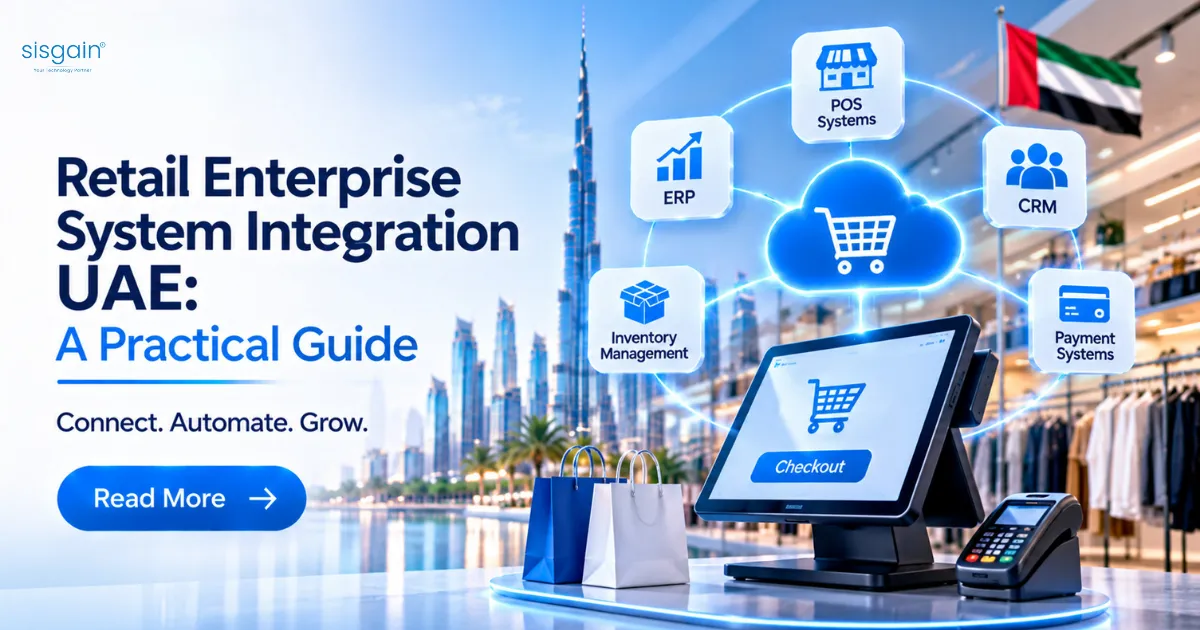
What is retail enterprise system integration? It is the process of connecting ERP, POS, e-commerce, warehouse, CRM and compliance systems so data flows automatically between them in near real time.
Why does it matter in the UAE? Retail groups here often run several brands, malls, emirates and sales channels, while also meeting VAT and upcoming e-invoicing requirements. Connected systems reduce manual work and compliance risk.
What should we connect first? Start with inventory sync, end-of-day POS-to-ERP financial posting and order routing. These deliver visible results fastest.
Do we need to replace our legacy POS? Not necessarily. Modern integration platforms can bridge on-premise systems with cloud applications without an immediate rip-and-replace.
Why UAE Retail Groups Need Connected Enterprise Systems
The UAE retail market is competitive, tourism-driven and highly seasonal. Ramadan, Eid, Dubai Shopping Festival and summer promotions all create sharp demand swings. Shoppers expect to browse online, collect in store, pay through buy-now-pay-later and receive same-day delivery, all with consistent prices and loyalty benefits.
Meeting those expectations requires every system to work from the same version of the truth. When inventory, pricing, customer and financial data sit in separate tools, teams compensate with spreadsheets, manual uploads and phone calls. That slows decisions and increases errors.
Connected enterprise systems help retail groups to:
- See real-time stock across stores, warehouses and online channels
- Close financial periods faster with automated POS-to-ERP posting
- Offer consistent pricing, promotions and loyalty across every touchpoint
- Reduce overselling, stock-outs and markdowns
- Stay audit-ready for VAT and e-invoicing requirements
This is a core part of wider digital transformation services in the UAE, where technology is aligned with business outcomes rather than adopted tool by tool.
Common Technology Challenges Facing Multi-Branch Retail Businesses
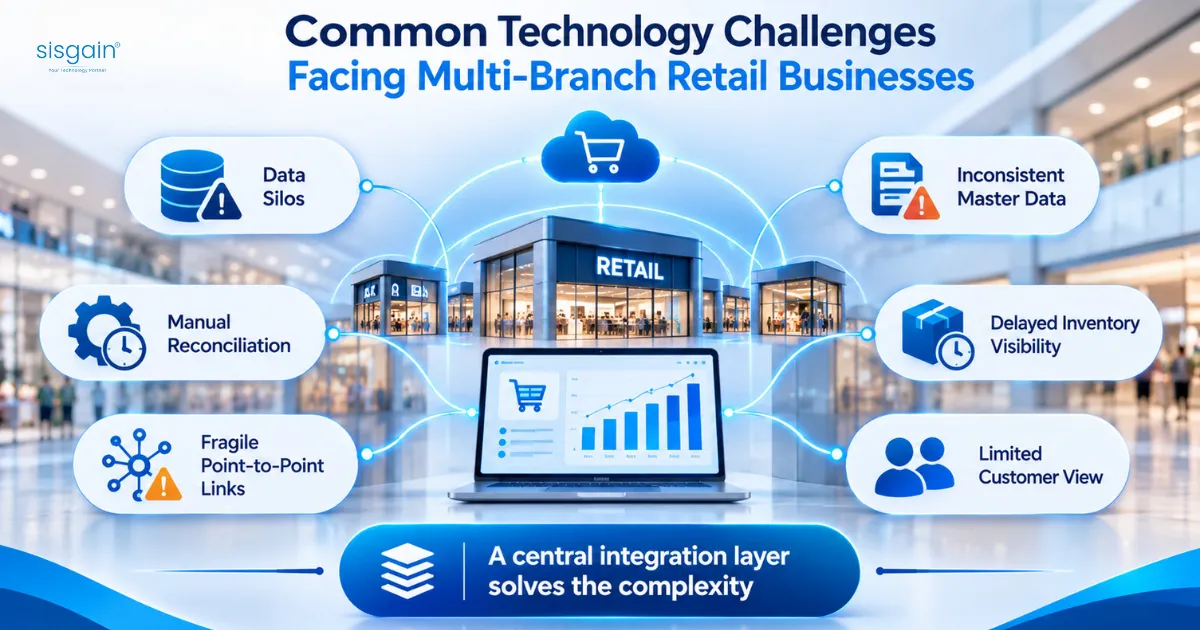
Most retail groups did not choose a fragmented stack. It grew through acquisitions, new brand launches, franchise partnerships and quick fixes during expansion. The usual symptoms are:
- Data silos: Each brand or subsidiary maintains its own product, supplier and customer records.
- Inconsistent master data: The same product has different SKUs, barcodes or tax categories in different systems.
- Manual reconciliation: Finance teams export sales data from stores and re-key it into the ERP.
- Delayed inventory visibility: Stock updates in batches overnight, so online channels sell items already gone.
- Fragile point-to-point links: One plugin or POS update breaks several downstream connections.
- Limited customer view: Mall purchases, app orders and online baskets sit in separate profiles.
Point-to-point custom integrations deserve special attention. They create "spaghetti architecture" where every new connection multiplies complexity. A central integration layer isolates changes, so upgrading one system does not break five others.
Connecting ERP, CRM and Enterprise Applications
Your ERP, whether SAP S/4HANA, Oracle NetSuite or Microsoft Dynamics 365, is the financial and master-data backbone. Everything else should feed it or draw from it. For a wider view of what ERP delivers, see our guide to ERP software benefits for UAE businesses.
Retail ERP and CRM integration is where the commercial value becomes visible. When purchase history from stores and online channels flows into the CRM, marketing teams can segment customers accurately and trigger personalised WhatsApp, SMS or app-based loyalty campaigns. In return, order and return data flow back to finance and inventory without manual intervention.
The approach you choose shapes cost, flexibility and long-term maintenance:
Integration method | Best for | Key advantages | Trade-offs |
Cloud iPaaS (e.g. MuleSoft, Boomi, Celigo, Workato) | Multi-brand, multi-emirate groups with complex stacks | Pre-built connectors for major ERPs and POS systems, central monitoring, fast deployment | Ongoing subscription fees tied to data volume or endpoints |
API-led, event-driven microservices | High-volume enterprises building proprietary apps or super-apps | Real-time streaming (via Kafka or webhooks), high scalability, minimal vendor lock-in | Needs strong in-house or partner engineering capability |
Native ERP connectors | Mid-sized retailers committed to one ecosystem (all-Microsoft or all-SAP) | Lower upfront cost, tight data consistency within one suite | Limited flexibility when adding third-party delivery or payment partners |
There is no single right answer. Many groups combine approaches, using an iPaaS for standard connections and custom APIs for differentiating customer experiences. Working with specialists in software integration services in Dubai can help you choose the right mix for your stack and growth plans.
Integrating Store Operations with Warehouse and Supply Chain Systems
Store and warehouse systems determine whether your promises to customers can actually be kept. Warehouse management and order management systems (WMS and OMS) should connect dark stores, regional distribution centres (such as those in JAFZA or KEZAD) and store backrooms so that:
- Click-and-collect (BOPIS) orders reserve stock instantly
- Orders route automatically to the nearest location with availability
- Replenishment is triggered by actual sell-through, not guesswork
- Returns re-enter sellable stock quickly
Local payment and logistics partners belong in this picture too. Connect regional payment gateways such as Network International and Telr, BNPL providers such as Tabby and Tamara, and couriers such as Aramex directly into your OMS. Doing so removes manual status updates and gives customers accurate delivery tracking.
If your group is also modernising store-level POS and inventory tools, a trusted retail software development firm in Dubai can ensure POS, inventory and fulfilment workflows fit into the wider architecture rather than becoming another silo.
Building a Unified Customer Data and Analytics Environment
A connected retail ecosystem gives every customer one profile, regardless of where they shop. That requires:
- Identity resolution: Matching mobile numbers, emails, loyalty IDs and app logins across channels.
- Consent management: Recording marketing permissions so campaigns respect customer choices.
- A central data layer: A warehouse or lakehouse that combines sales, inventory, CRM and web data.
- Governed access: Role-based permissions so teams see only what they need.
Once built, this environment powers loyalty programmes, targeted offers, store-level performance reporting and customer lifetime value analysis. It also reduces dependence on one-off reports built by hand.
Using AI and Business Intelligence for Retail Decision-Making
AI is only as good as the data behind it. After systems are connected and master data is clean, retail groups can use business intelligence tools such as Power BI or Tableau, together with machine learning, to:
- Forecast demand by store, category and season
- Plan stock for Ramadan, Eid and Dubai Shopping Festival
- Track margin by store, brand and product
- Detect shrinkage, pricing anomalies or unusual returns
- Recommend personalised offers based on behaviour
Smart analytics should start with a few high-value questions rather than a long wish list. A partner offering AI development services in Dubai can help identify where predictive models will deliver measurable returns, such as reduced stock-outs or lower markdown losses.
Cloud Infrastructure and Cybersecurity for Connected Retail Operations
Integration multiplies the number of connections between systems, which means security must be designed in. Key practices include:
- UAE-hosted integration nodes: Use cloud regions in the UAE, such as AWS Middle East (UAE), Microsoft Azure UAE North or Oracle Cloud in Dubai and Abu Dhabi, to support data residency and sovereignty requirements.
- API security: Enforce authentication, encryption, rate limiting and monitoring on every interface.
- PCI DSS alignment: Keep payment data handling within certified environments.
- Least-privilege access: Limit who and what can read or change sensitive records.
- Resilience: Build failover and backup into integration flows so a single outage does not stop trading.
A structured move to the cloud also makes it easier to scale during peak seasons. Retail groups planning this shift can explore cloud transformation services in Dubai to align infrastructure, security and integration strategy.
UAE-Specific Considerations: VAT, Data Protection and E-Invoicing
Compliance should be a design requirement, not a retrofit.
VAT and Corporate Tax. Accurate tax categories at product level, consistent across all systems, are essential for correct VAT treatment and reliable reporting. Integrated POS and ERP flows reduce reconciliation errors and make audits simpler.
Data protection. The UAE's Federal Decree-Law No. 45 of 2021 on personal data protection sets expectations for how customer data is collected, processed, stored and transferred. Retail groups handling loyalty and CRM data should map where personal data flows across systems and who can access it. Free-zone and sector-specific rules may also apply, so confirm requirements with your legal advisers.
E-invoicing. The UAE Ministry of Finance is rolling out a national e-invoicing framework based on a Peppol-style, decentralised continuous transaction control model. Businesses will exchange structured invoice data through Accredited Service Providers (ASPs). Connecting your POS and ERP to an ASP can automate invoice validation, structured XML generation and digital archiving. Implementation timelines are phased and depend on business size, so check the latest guidance from the Ministry of Finance and the Federal Tax Authority before finalising your plan. For a closer look, read our guide on preparing POS and accounting systems for e-invoicing in Dubai.
How to Choose a Retail Technology Integration Partner in the UAE
The right partner matters as much as the right platform. When evaluating vendors, look for:
- Retail domain experience: Familiarity with multi-brand operations, malls, franchises and seasonal peaks.
- Platform breadth: Proven delivery across your ERP, POS, e-commerce and CRM tools.
- UAE compliance knowledge: Practical experience with VAT, data residency and e-invoicing readiness.
- Architecture approach: A clear view on iPaaS versus API-led design, and why.
- Security and governance: Documented practices for access control, monitoring and incident response.
- Phased delivery: A roadmap that shows early wins instead of a single big-bang go-live.
- Post-launch support: Monitoring, optimisation and SLA-backed maintenance.
Ask for references from similar retail environments and request a short discovery workshop before committing to a full programme.
Implementation Roadmap for Enterprise Retail Transformation
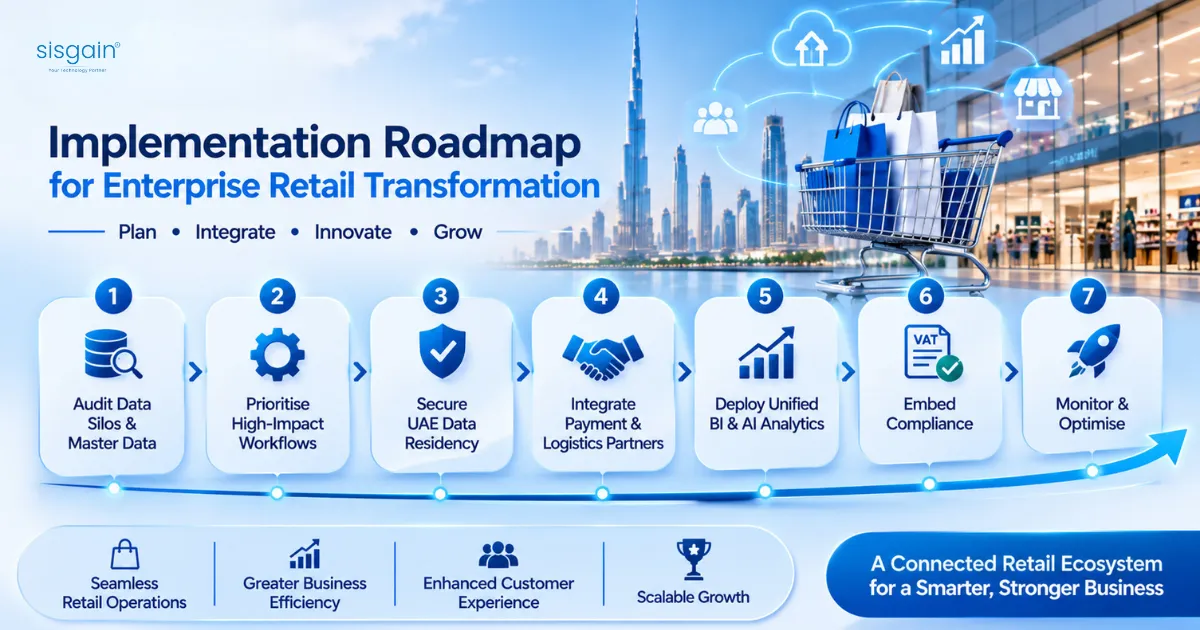
A practical roadmap breaks the journey into manageable stages:
- Audit data silos and master data. Standardise SKUs, barcodes, supplier codes and tax categories across all subsidiaries before connecting anything.
- Prioritise high-impact workflows. Begin with real-time inventory sync, end-of-day POS-to-ERP financial posting and automated order routing.
- Secure UAE data residency. Select integration and hosting nodes in UAE data centres to meet local sovereignty and cybersecurity expectations.
- Integrate payment and logistics partners. Connect gateways, BNPL providers and couriers into your OMS.
- Deploy unified BI and AI analytics. Feed clean data into dashboards and forecasting models for demand planning, seasonal stocking and store-level margin tracking.
- Embed compliance. Connect to an ASP for e-invoicing and automate VAT reporting.
- Monitor and optimise. Track integration health, data quality and business KPIs, then expand to new brands or GCC markets.
A phased integration of core ERP, POS and e-commerce systems usually takes 8 to 16 weeks, depending on the number of brands, store locations and custom data transformations.
Final Thoughts
Connected systems turn a collection of stores, brands and channels into a single, responsive retail business. For UAE retail groups, the opportunity is clear: faster closes, accurate stock, personalised customer journeys and compliance that runs in the background.
The most successful programmes start small, fix master data first, choose the right integration architecture and scale in phases. If your group is planning to connect its ERP, POS, e-commerce and compliance systems, speak with the SISGain team to map your current landscape and build a practical roadmap.