
Quick Answer
The main medical information platforms in the UAE are the government HIEs, NABIDH (Dubai), Malaffi (Abu Dhabi) and Riayati (Northern Emirates and federal), plus commercial EMR/HIS systems such as Oracle Health (Cerner), Epic, MEDAS EMR, PappyJoe, Healthray and MediSmart. Your licensing authority decides which exchange your facility must connect to.
Introduction: Finding Reliable Medical Information in the UAE
The UAE has one of the most digitised healthcare systems in the region, but that also makes it confusing to navigate. Health services are regulated by different authorities depending on the emirate, providers range from solo clinics to hospital networks, and patients, doctors and administrators all need different things from a "medical information platform."
The simplest way to make sense of it is to see the market as two layers:
- Government-mandated Health Information Exchanges (HIEs) that unify patient data across facilities.
- Commercial EMR and Hospital Information Systems (HIS) that clinics and hospitals use to run daily clinical, billing and scheduling workflows.
This guide compares six platform groups across both layers. For each one, you will see what it does, how support works, and the main advantages and limitations. We also keep medical content quality separate from customer service responsiveness, and we do not claim any platform has the fastest response time without verified response-time evidence.
Note: Facility counts and record figures below reflect publicly reported numbers and change frequently. Always confirm current figures on the official DHA, DoH and MoHAP websites.
What Makes a Medical Information Platform Reliable?
Before comparing options, it helps to know what "reliable" means in a healthcare setting. Use these criteria:
|
Criteria |
What to look for |
|
Regulatory backing |
Mandated by, or certified with, DHA, DoH or MoHAP |
|
Data security |
Encryption, role-based access controls, audit trails |
|
Interoperability |
Support for HL7 and FHIR R4 data exchange |
|
Data accuracy |
Standardised terminology such as LOINC and SNOMED |
|
Support model |
Onboarding, helpdesk, SLA terms, regulatory update policy |
|
Patient access |
A mobile app or portal for viewing records |
Important: Reliable medical content and responsive customer support are not the same thing. When you evaluate a platform, score them separately.
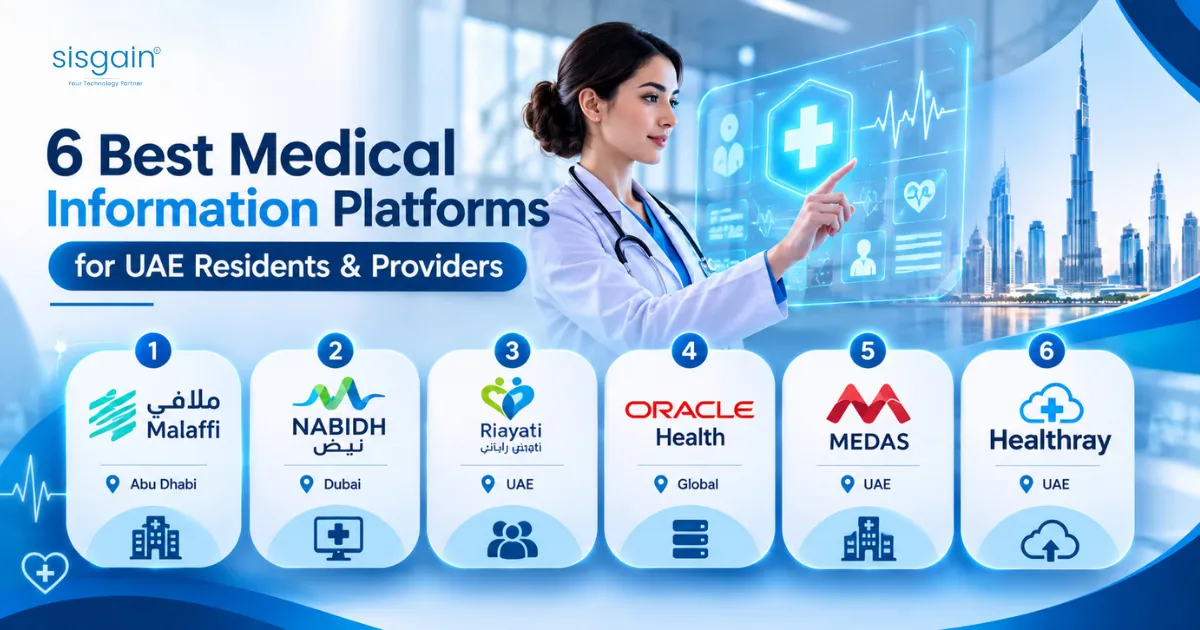
6 Best Medical Information Platforms Available to UAE Residents and Providers
|
S no. |
Platform |
Type |
Authority / Vendor |
Best for |
|
1 |
Malaffi |
Government HIE |
Department of Health, Abu Dhabi |
Abu Dhabi and Al Ain facilities |
|
2 |
NABIDH |
Government HIE |
Dubai Health Authority |
Dubai facilities |
|
3 |
Riayati |
Government HIE (NUMR) |
Ministry of Health and Prevention |
Northern Emirates and federal backbone |
|
4 |
Oracle Health (Cerner) and Epic |
Enterprise HIS/EMR |
Global vendors |
Large hospital networks |
|
5 |
MEDAS EMR and PappyJoe |
Mid-market EMR |
Regional vendors |
Clinics, polyclinics, specialty centres |
|
6 |
Healthray and MediSmart |
All-in-one cloud suites |
Cloud vendors |
Growing medical centres |
Part A: Official Government Health Information Exchanges
Every licensed healthcare facility in the UAE must connect to its respective emirate or federal HIE. The three platforms are interconnected, so patient records can follow individuals across the country.
1. Malaffi (Abu Dhabi)
What it is: Abu Dhabi's HIE, governed by the Department of Health (DoH). It covers Abu Dhabi and Al Ain.
Key features:
- Connects 3,144+ facilities and over 4 billion clinical records
- AI Physician Assistant
- Predictive chronic disease risk profiles
- Radiology image sharing
- Patient access through the Sahatna app
Pros: Large scale, advanced analytics features, and direct patient access to unified records.
Cons: Strict technical prerequisites, such as SD-WAN infrastructure and standardised terminology mapping (LOINC/SNOMED), plus regulatory deadlines.
Customer support: Onboarding portals, vendor certification lists and compliance helpdesks are provided by the authority, but practical implementation relies heavily on your chosen EMR vendor.
Best for: DoH-licensed facilities in Abu Dhabi and Al Ain, and residents who want to view records via Sahatna.
2. NABIDH (Dubai)
What it is: Dubai's HIE, run by the Dubai Health Authority (DHA).
Key features:
- Unifies over 10.4 million patient files
- Covers 1,888+ licensed facilities and 91 approved EMR systems
- Real-time HL7 and FHIR R4 clinical data exchange
Pros: Strong interoperability standards and a clear list of approved EMR systems, which simplifies vendor selection.
Cons: Mandatory compliance means your EMR must meet DHA technical requirements before you can go live.
Customer support: Technical onboarding resources and compliance support come from the authority. Day-to-day issues usually go through your EMR vendor.
Best for: DHA-licensed facilities in Dubai.
3. Riayati (Northern Emirates and Federal)
What it is: The Ministry of Health and Prevention's (MoHAP) platform, serving as the National Unified Medical Record (NUMR).
Key features:
- Links 4,952+ facilities and 14 million unique patients
- Built-in e-Claims Post Office for insurance processing
Pros: Combines clinical record exchange and insurance claim handling in one federal framework.
Cons: Compliance prerequisites and deadlines apply, and the experience depends on how well your EMR integrates.
Customer support: Onboarding and compliance support are provided by the authority, with vendor-dependent implementation.
Best for: MoHAP-licensed facilities in the Northern Emirates.
HIE Pros, Cons and Support at a Glance
|
Pros/Cons/Support |
Summary |
|
Pros |
Eliminates duplicate lab tests and radiology scans, gives instant longitudinal patient histories in emergencies, and enforces strict data encryption |
|
Cons |
Strict technical prerequisites (SD-WAN for Malaffi, LOINC/SNOMED mapping) and regulatory deadlines |
|
Support |
Onboarding portals, vendor certification lists and compliance helpdesks, with implementation relying on your EMR vendor |
Part B: Top Commercial EMR and Clinic Management Platforms
To connect to NABIDH, Malaffi or Riayati, and to handle appointments, billing and e-claims, providers use compliant clinical software.
4. Enterprise Hospital Systems: Oracle Health (Cerner) and Epic
What they are: Enterprise-grade hospital systems that are dominant across large hospital networks and public health entities in Abu Dhabi and Dubai.
Key features: Deep multi-department integration across inpatient (IPD), outpatient (OPD), ICU, labs and pharmacy.
Customer support: 24/7 enterprise SLA support.
Pros: Unmatched clinical depth and scalability.
Cons: High capital investment, a dedicated internal IT team requirement, and lengthy deployment timelines.
Best for: Large hospitals and multi-facility networks with strong IT resources.
5. Regional Mid-Market Platforms: MEDAS EMR and PappyJoe
What they are: Platforms tailored for outpatient clinics, polyclinics and specialty centres across Dubai, Abu Dhabi and the Northern Emirates.
Key features: Pre-built connectors for NABIDH, Malaffi and Riayati, plus regional e-claims portals (eClaimLink and Shafafiya).
Customer support: Local UAE implementation and training teams.
Pros: Faster go-live times and lower upfront costs than hospital-grade systems.
Cons: Multi-specialty customisation can vary by vendor.
Best for: Clinics and polyclinics that need quick, compliant deployment.
6. All-in-One Hospital and Clinic Suites: Healthray and MediSmart
What they are: Cloud-based platforms popular with growing medical centres that want integrated scheduling, inventory and financial analytics.
Key features: Automated WhatsApp and SMS patient reminders, digital prescription pads and insurance claim tracking.
Customer support: Remote technical support.
Pros: Strong automation and user-friendly interfaces.
Cons: Smaller clinics may find enterprise modules overly complex if they only need basic charting.
Best for: Medical centres that are scaling and want one connected system.
Not sure how these categories differ? Read our guide on HIMS vs EMR vs EHR.
Customer Support Comparison: Response Channels and Availability
Support is where many buyers get surprised. The table below summarises the support model for each platform group based on the information available. It deliberately avoids ranking anyone as "fastest," because verified response-time data is not publicly available for these platforms.
|
Platform |
Support model |
What to confirm before relying on it |
|
Malaffi |
Authority onboarding portal and compliance helpdesk; vendor-dependent implementation |
Current contact channels and hours on the official DoH/Malaffi site |
|
NABIDH |
Authority onboarding resources and certified vendor list; vendor-dependent implementation |
Current contact channels and hours on the official DHA site |
|
Riayati |
Authority onboarding and compliance support; vendor-dependent implementation |
Current contact channels and hours on the official MoHAP site |
|
Oracle Health / Epic |
24/7 enterprise SLA support |
SLA tiers, escalation paths, on-site presence in the UAE |
|
MEDAS EMR / PappyJoe |
Local UAE implementation and training teams |
SLA response times, language support, update policy |
|
Healthray / MediSmart |
Remote technical support |
Support hours, channels (phone, chat, email), escalation process |
Medical Content Quality vs. Customer Service Responsiveness
These are two separate scorecards:
- Medical content quality asks: Is the data accurate, standardised, secure and complete?
- Customer service responsiveness asks: When something breaks, how quickly and how clearly does a human help?
A national HIE can be excellent at the first and still require you to go through your EMR vendor for the second. Likewise, a friendly cloud vendor may respond quickly but offer less clinical depth. Evaluate both before you decide.
Pros and Cons of Each Medical Information Platform
|
Platform |
Pros |
Cons |
|
Malaffi, NABIDH, Riayati (HIEs) |
Fewer duplicate tests, instant longitudinal histories, strict encryption |
Mandatory compliance, technical prerequisites, regulatory deadlines |
|
Oracle Health (Cerner) and Epic |
Unmatched clinical depth, scalability, 24/7 enterprise SLA |
High capital investment, internal IT team needed, lengthy deployment |
|
MEDAS EMR and PappyJoe |
Faster go-live, lower upfront cost, local training, pre-built HIE and e-claims connectors |
Multi-specialty customisation varies by vendor |
|
Healthray and MediSmart |
Strong automation, user-friendly, WhatsApp/SMS reminders, remote support |
Enterprise modules may feel complex for very small clinics |
Government vs Private Healthcare Information Platforms
|
Factor |
Government HIEs |
Commercial EMR/HIS |
|
Main purpose |
Unify patient data nationally |
Manage daily clinical and administrative workflow |
|
Mandatory? |
Yes, determined by your licensing authority |
No, but the system must be compliant and able to connect to the HIE |
|
Primary users |
Facilities, authorities, patients via apps |
Doctors, nurses, front desk, billing teams |
|
Customisation |
Low, standardised by regulation |
Higher, depends on vendor |
|
Insurance claims |
Handled on dedicated rails (for example Riayati's e-Claims Post Office) |
Integrated with eClaimLink and Shafafiya |
|
Support |
Authority portals and helpdesks |
Vendor SLAs and implementation teams |
How they work together: Your EMR or HIS records what happens in your facility, then exchanges that data with the HIE so it appears in the patient's unified record. Most UAE-certified EMRs integrate clinical reporting and e-claims in one interface.
For a deeper look at how hospitals are modernising these systems, see our overview of modern hospital information systems.
How to Choose the Right Medical Information Platform
Step 1: Confirm your licensing authority
|
If you are licensed by |
You must connect to |
|
DHA (Dubai) |
NABIDH |
|
DoH (Abu Dhabi) |
Malaffi |
|
MoHAP (Northern Emirates) |
Riayati |
Step 2: Match the platform to your facility
|
If you are... |
Consider... |
|
A patient who wants your records |
The authority-linked app (Sahatna, or the DHA and MoHAP apps) |
|
A solo clinic or polyclinic |
A mid-market EMR with pre-built HIE and e-claims connectors |
|
A large hospital |
An enterprise HIS, if you have in-house IT capacity |
|
A growing medical centre |
A cloud-based all-in-one suite |
Step 3: Check the vendor's support contract
Before buying, verify:
- Whether the vendor provides on-site go-live training in the UAE
- Guaranteed SLA response times for e-claim or HIE sync failures
- Free regulatory updates whenever DHA, DoH or MoHAP release new data circulars
- Which support channels are included (phone, chat, email, WhatsApp) and during which hours
Step 4: Ask better demo questions
- Which HIE and e-claims portals are already integrated, and are they certified?
- How are sync failures reported and who fixes them?
- What happens to support when regulations change?
- Can the system support Arabic and English for staff and patients?
Beyond Off-the-Shelf Software: Building Your Own Patient-Facing Platform
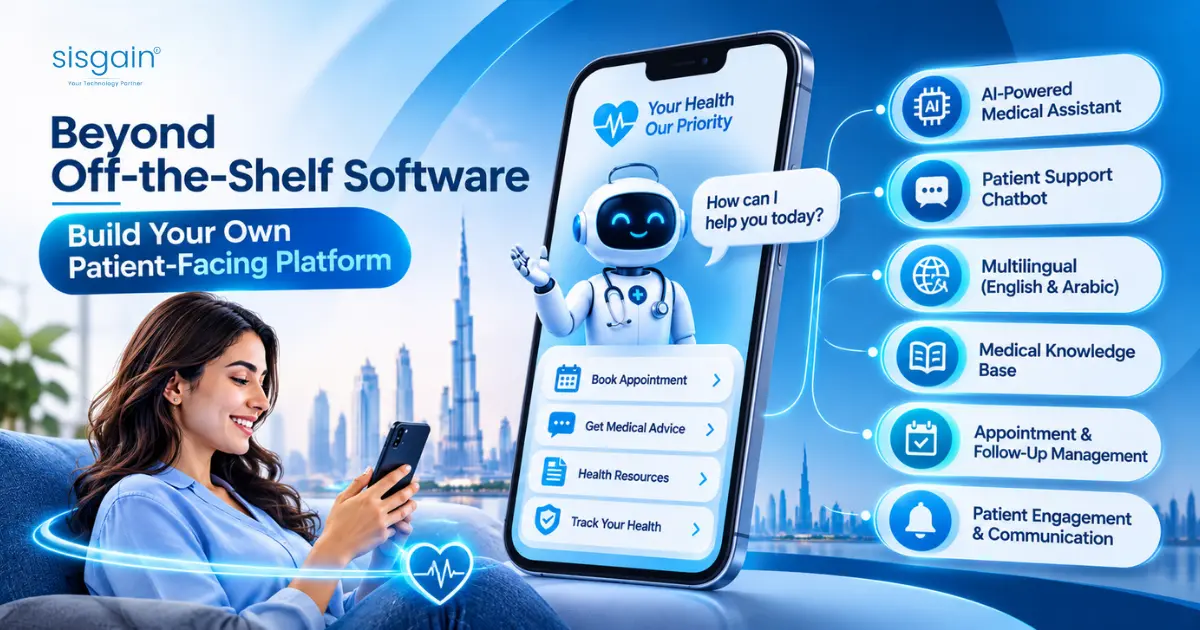
Standard EMRs handle compliance and clinical workflow well, but many providers want something more: a branded, patient-friendly layer that answers questions, supports patients and keeps them engaged between visits. This is where custom healthcare technology comes in.
Healthcare providers in the UAE can build platforms that offer:
|
Capability |
What it does for patients and staff |
|
AI-powered medical information assistant |
Gives instant, guided answers drawn from approved medical content |
|
Patient support chatbot |
Handles common questions and reduces call-centre load |
|
Multilingual English and Arabic assistance |
Serves the UAE's diverse patient population in their language |
|
Medical knowledge base |
Keeps clinical information consistent and easy to update |
|
Appointment and follow-up management |
Reduces no-shows and improves continuity of care |
|
Patient engagement and communication systems |
Keeps patients informed through reminders, updates and secure messaging |
These tools should sit alongside, not replace, your HIE-compliant EMR, and they should provide information and support rather than replace clinicians.
If you are exploring this, a few resources can help:
- Our team builds healthcare app development solutions in Dubai tailored to UAE regulations.
- For intelligent assistants, explore our AI development services in UAE.
- See how an Arabic medical AI assistant can serve bilingual patients.
- Budgeting? Read the cost of building an AI chatbot in the UAE.
- Looking at features that keep patients coming back? See the top hospital app features for patient engagement.
- Need a full back-office backbone? Learn about our hospital management system development service.
Conclusion
Medical information in the UAE runs on two connected layers: government HIEs that keep patient records unified, and commercial EMR/HIS platforms that power day-to-day care. Start with your licensing authority to know which HIE applies, then choose software that matches your facility size, budget and support needs. Above all, judge medical content quality and customer support separately, and get support terms in writing.
If you want a patient-facing layer on top of your compliant systems, such as an AI medical information assistant, a bilingual chatbot or appointment and follow-up tools, SISGAIN can help you plan and build it.
Need help shortlisting a platform? Share these details and we can narrow down compliant options and key demo questions:
- Your emirate and licensing authority (DHA, DoH or MoHAP)
- Your facility size and specialty (solo clinic, polyclinic or hospital)
- Whether you need patient-facing access or provider EMR software.