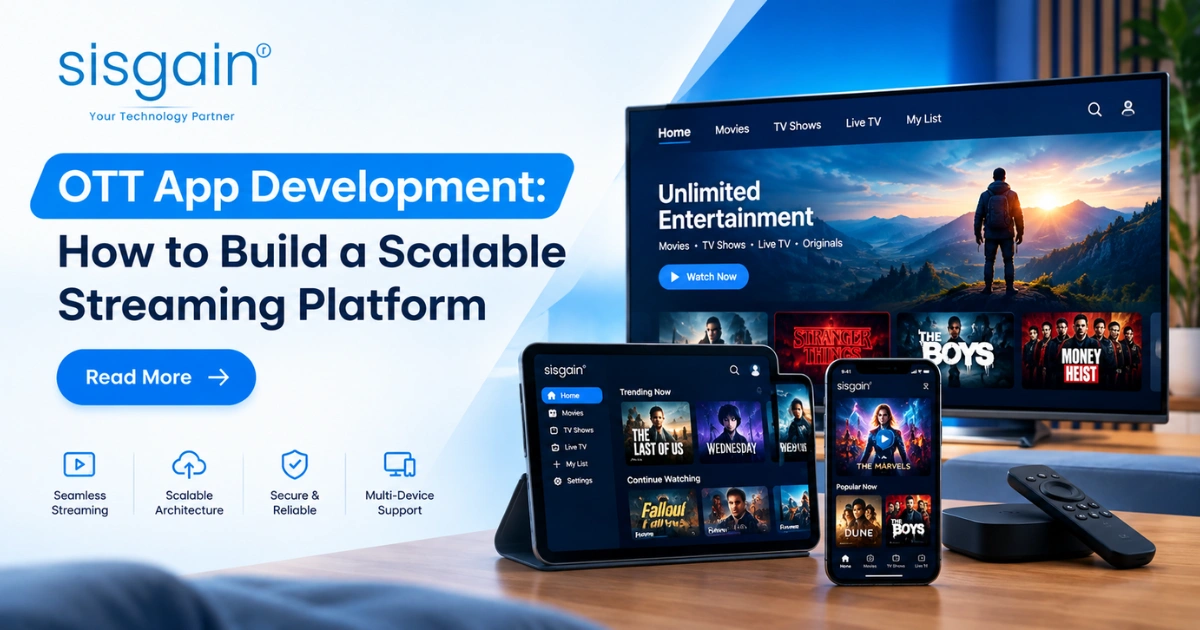

Every media business eventually asks the same question: should we build our own streaming platform, or keep renting shelf space on someone else's? The answer usually comes down to how much control you want over your content, your audience data, and your revenue.
This guide walks through what OTT app development actually involves — the platform types, the architecture behind the scenes, the features that matter at launch versus later, and the factors that really move your budget. If you're evaluating whether to build custom or go white-label, or trying to scope an MVP before you talk to a development partner, this is written for you.
OTT App Development: What Does It Mean?
OTT — "over the top" — refers to delivering video content over the internet, bypassing cable and satellite distribution entirely. An OTT app is what viewers see and tap on their phone, smart TV, or laptop. An OTT platform is the fuller system behind it: the app, the backend, the content pipeline, and everything that gets a video from storage to someone's screen without buffering.
This guide focuses on video streaming — VOD and live — because that's where most of the development complexity and cost live. It won't wander into messaging, VoIP, or unrelated "over the top" services; that's a different build entirely.
Three things make OTT development different from a typical consumer app:
- Multi-device reach. The same content needs to work on mobile, web, and connected TVs, each with its own constraints and, for smart TVs, its own certification process.
- Content and delivery control. You decide how content is licensed, protected, and distributed — not a third-party platform's algorithm.
- Two systems, not one. You're building a customer-facing app and a backend content-delivery system at the same time. Skimp on either and the whole product suffers.
Why Businesses Invest in OTT Platforms
Businesses go direct-to-consumer for a mix of reasons — control, data, and monetization flexibility chief among them. None of this guarantees more revenue on its own. Content rights, acquisition costs, and ongoing operations still shape whether an OTT platform actually pays off.
There's also a real distinction between owning a streaming product and simply distributing content through someone else's platform. The first gives you the audience relationship. The second gives you reach, but the platform owns the data and, often, the terms. Businesses that want to build digital entertainment platforms they actually control tend to land on custom or semi-custom development for exactly this reason.
|
Business objective |
How an OTT platform supports it |
|
Reach audiences |
Distribute content across mobile, web, and connected devices |
|
Monetize content |
Subscriptions, advertising, transactions, or a mix of all three |
|
Understand viewers |
First-party analytics on engagement and retention |
|
Control the experience |
Own the branding, navigation, and content presentation |
|
Expand gradually |
Launch an MVP, then add capabilities as the audience grows |
What Types of OTT Apps and Platforms Can You Build?
Not every streaming product needs the same architecture. The type of platform you're building shapes everything downstream — features, infrastructure, and budget. This is usually the first decision to nail down before scoping OTT Streaming Platform Development in any more detail.
Video-on-demand (VOD) platforms give viewers a library they browse and watch on their own schedule — movies, series, courses, niche programming. Search, categories, watchlists, and playback history do most of the work here.
Live streaming platforms handle scheduled or real-time broadcasts: events, news, sports, creator streams. These need live ingestion, latency management, and real-time monitoring that VOD platforms simply don't require.
Hybrid platforms combine both — useful for a business running scheduled programming alongside an on-demand library.
Niche and enterprise platforms serve specialized audiences: education, fitness, professional training, or internal corporate video with restricted access. These are worth knowing about, but they're not the focus of this guide.
|
Platform type |
Best suited for |
Key requirements |
|
VOD |
Libraries of recorded content |
CMS, encoding, playback, search |
|
Live |
Real-time broadcasts |
Live streaming pipeline, latency controls, monitoring |
|
Hybrid |
Live + recorded content |
Both delivery workflows |
|
Niche |
Specialized audiences |
Audience-specific UX and monetization |
|
Enterprise |
Internal or restricted video |
Access control, permissions, administration |
How Do OTT Platforms Work?
An OTT platform is a pipeline. Content goes in one end — uploaded or captured live — and comes out the other end as a smooth, adaptive stream on whatever device the viewer happens to be holding.
The OTT content delivery workflow, at a glance:
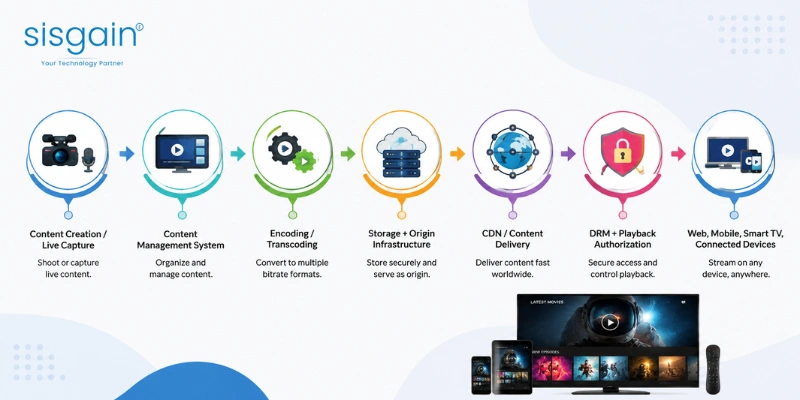
Each stage matters more than it looks:
- Ingestion and storage — where raw video lands and how it's organized before processing.
- Encoding and transcoding — converting video into multiple formats and resolutions so it plays on different devices and network speeds.
- Adaptive bitrate streaming — automatically switching quality up or down based on the viewer's connection, so playback doesn't stall.
- CDN delivery — distributing content from servers close to the viewer, which is what keeps load times low at scale.
- Authentication and access control — verifying who's allowed to watch what.
- Playback and analytics — the last mile, plus the data you collect once someone actually presses play.
None of this is optional plumbing. Skip a stage or under-invest in it, and it shows up later as buffering complaints, blown infrastructure budgets, or content that plays fine on a phone but not on a smart TV.
Essential OTT App Features
Not every feature belongs in version one. The trick is prioritizing by what your audience and content model actually need first, then building out from there.
Viewer-facing: registration and login, user profiles, content discovery and categories, search, watchlist, continue watching, video player, subtitles and captions, parental controls, multi-device support, subscription and payment management.
Content and administration: content management system, upload and metadata tools, content scheduling, user and subscription administration, an analytics dashboard, role-based access, and content moderation where it applies.
Streaming and security: adaptive bitrate streaming, DRM, secure playback, session management, download support where relevant, and monitoring for errors and playback issues.
|
Feature |
MVP priority |
Growth-stage priority |
Why it matters |
|
Video playback |
Essential |
Essential |
Core viewing experience |
|
Search and discovery |
Essential |
Essential |
Helps users find content |
|
User profiles |
Essential |
Essential |
Personalization and account management |
|
Watchlist |
Recommended |
Essential |
Retention and convenience |
|
Adaptive bitrate |
Essential |
Essential |
Playback quality across network conditions |
|
DRM |
Depends on content rights |
Essential for premium content |
Content protection |
|
Analytics |
Essential |
Advanced |
Measures engagement and product performance |
|
Downloads |
Optional |
Depends on use case |
Offline viewing |
|
Advanced recommendations |
Optional |
Recommended |
Discovery and retention |
If you take one thing from this table: build the playback experience and search well before you build anything clever. A polished recommendation engine on top of choppy playback is wasted effort.
OTT App Monetization Models
How you make money should shape the product from day one — not get bolted on after launch.
SVOD (subscription video on demand) relies on recurring access, usually with tiered plans. It suits businesses with a steady stream of content worth returning for, and it requires solid billing and subscription-management infrastructure.
AVOD (advertising-supported video on demand) offers free or cheaper access funded by ads. It needs ad integration and measurement built in, and it changes the user experience — ad breaks are part of the product, not an afterthought.
TVOD (transactional video on demand) charges per view or per purchase. It works well for premium releases or one-off events, and it needs solid catalog pricing and entitlement logic.
FAST and hybrid models blend these approaches — free ad-supported channels, or a mix of subscriptions, ads, and one-off purchases.
|
Model |
Revenue mechanism |
Product considerations |
|
SVOD |
Recurring subscriptions |
Plans, billing, retention |
|
AVOD |
Advertising |
Ad delivery, measurement, user experience |
|
TVOD |
Individual purchases |
Catalog pricing, payments, access rights |
|
Hybrid |
Multiple revenue streams |
Flexible billing and entitlement logic |
|
FAST |
Free ad-supported channels |
Channel scheduling, ad-supported delivery |
How to Build an OTT App: Development Process
- Define the audience, content, and business model. Who's watching, what are they watching, is it VOD, live, or both, and how will you make money from it? Get this settled before touching architecture.
- Plan the MVP. Identify what's essential, pick your first launch platform, and set measurable success criteria. Resist the pull to build every feature at once — that's how launches slip by six months.
- Design the user experience. Information architecture, content discovery, the playback experience, the subscription flow, and responsive behavior across devices.
- Design the architecture and technology stack. Backend, video pipeline, cloud infrastructure, CDN, DRM, analytics, and any third-party integrations.
- Develop and integrate. Frontend and backend build-out, streaming workflows, payment and subscription systems, the CMS, and whatever third-party services you're plugging in.
- Test, deploy, and monitor. Functional testing, device and browser testing, playback and performance testing, security testing, and monitoring once it's live.
- Launch, measure, and improve. Ship the MVP, watch engagement and playback performance, then improve discovery, retention, and monetization based on what people actually do — not what you assumed they'd do.
Timelines vary considerably depending on platform count and feature scope, so treat any general estimate you hear with some skepticism until it's tied to your specific requirements.
OTT App Technology Stack
Technology choices should follow what your product needs to do — not the other way around. Picking a stack first and fitting the product to it is how projects end up over-engineered or under-powered.
|
Layer |
What it handles |
Buyer-level consideration |
|
Frontend |
Viewer-facing apps |
Device coverage, usability, performance |
|
Backend |
Users, subscriptions, content, business logic |
Scalability and maintainability |
|
CMS |
Content management |
Publishing workflow and administration |
|
Video processing |
Encoding and transcoding |
Playback quality and delivery formats |
|
Cloud infrastructure |
Compute, storage, services |
Reliability and operating cost |
|
CDN |
Content delivery |
Global performance and bandwidth |
|
DRM |
Content protection |
Rights and access requirements |
|
Payments |
Billing and subscriptions |
Supported payment methods and compliance |
|
Analytics |
Viewing and business insights |
Retention, engagement, and performance |
|
Smart TV / connected TV |
TV applications |
Device compatibility and certification |
Native vs. cross-platform: cross-platform development can reduce duplicated work across mobile apps, but native development is sometimes worth it for a specific device experience — a smart TV remote-navigation flow, for example. Neither approach is universally better; it depends on your device priorities and team.
Build vs. integrate third-party streaming services: managed streaming services can get you to market faster and remove a lot of infrastructure work. The tradeoff is customization, control, and recurring vendor costs that stack up over time. Whichever way you lean, it's an architectural decision, not just a procurement one — it affects what you can change later.
How Much Does OTT App Development Cost?
Here's the honest answer: it depends, and anyone who gives you a single number without asking about your scope first is guessing. OTT development costs vary widely based on how many platforms you're building for, whether you need live streaming, how complex your feature set is, and what you're integrating with.
Broad market estimates for OTT development commonly range from the low tens of thousands into six figures and beyond, but treat any figure like that as a starting point for a conversation, not a quote. The real number depends entirely on your specific requirements, and it's worth verifying against a defined scope before you budget around it — our general guide to app development cost breaks down the underlying drivers in more detail if you want the fuller picture.
What actually moves the number:
|
Cost factor |
Why it affects cost |
|
Number of platforms |
More apps and device testing increase scope |
|
VOD vs. live streaming |
Live delivery adds infrastructure and operational complexity |
|
Feature complexity |
Advanced discovery, personalization, and admin tools take more work |
|
DRM and content rights |
Premium content may need extra protection and licensing steps |
|
CDN and cloud usage |
Operating costs scale with traffic, storage, and delivery volume |
|
Payment integrations |
Billing, subscriptions, and regional payment support add work |
|
UI/UX complexity |
Custom experiences take more design and development time |
|
Analytics and personalization |
Advanced data and recommendation features increase scope |
|
Integrations |
External systems and services add implementation and testing |
|
Maintenance |
Updates, monitoring, and support continue well past launch |
MVP, growth-stage, or enterprise — the scope determines the budget, not the label:
|
Scope |
Typical characteristics |
|
MVP |
Core playback, limited platforms, basic accounts, essential CMS |
|
Growth-stage |
More devices, monetization, analytics, stronger administration |
|
Enterprise |
Advanced architecture, scale, security, integrations, multi-region needs |
A practical way to estimate your own budget:
- Define your content type and rights situation.
- Choose your launch platforms.
- List your MVP features — and only your MVP features.
- Pick a monetization model.
- Estimate your expected audience and usage.
- Identify the integrations you actually need.
- Separate development cost from ongoing infrastructure and maintenance — these are two different line items, and conflating them is where budgets go wrong.
Custom vs. White-Label OTT Platform: Which Is Right for Your Business?
This is one of the first strategic forks you'll hit, and it's worth more thought than it usually gets.
|
Factor |
White-label platform |
Custom OTT platform |
|
Initial launch |
Often faster |
Requires discovery and development |
|
Customization |
Limited by platform capabilities |
Greater flexibility |
|
Branding |
Usually supported |
Fully tailored |
|
Integrations |
Depends on provider |
Can be designed around business needs |
|
IP ownership |
Depends on agreement |
Greater control over custom software |
|
Scalability |
Depends on provider |
Architecture designed for your requirements |
|
Long-term control |
Provider-dependent |
Greater control over product direction |
|
Cost structure |
May include recurring fees |
Development + infrastructure + maintenance |
White-label tends to make sense when you need fast market validation, your requirements are fairly standard, and heavy customization isn't a priority yet.
Custom development tends to make sense when your content or business model is genuinely different, you need integrations a template can't support, or long-term ownership and scalability matter more than shipping quickly.
Neither is a wrong answer on its own — it's a question of what you're optimizing for right now versus in two years.
AI-Powered Features That Can Improve OTT Platforms
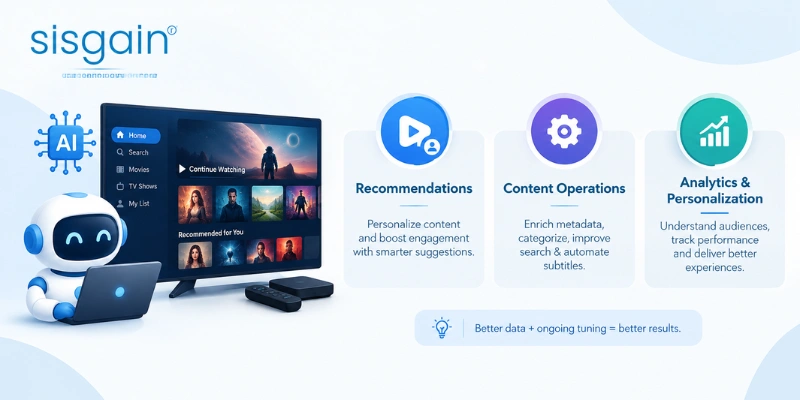
AI shows up in three places on most streaming platforms: recommendations, content operations, and analytics. It's worth treating as a feature layer that supports a strong content strategy, not a substitute for one — no recommendation engine fixes a thin content library. If you're weighing which capabilities are worth the investment, it helps to look at AI-powered apps more broadly, since the same personalization and automation patterns show up well beyond streaming.
AI-powered recommendations personalize content discovery and can improve how relevant suggestions feel to individual viewers, which can influence engagement over time. How well this works depends heavily on the quality of your metadata and how much viewing data you've actually collected.
AI-assisted content operations cover metadata enrichment, content categorization, search improvements, and subtitle or transcription workflows — the unglamorous work that makes a library actually searchable.
AI-driven analytics and personalization support audience segmentation, content performance analysis, and more tailored viewing experiences.
None of this is automatic. Recommendation quality is only as good as the data feeding it, and it needs ongoing tuning — it's not a feature you switch on once and forget.
UI/UX Considerations for OTT Streaming Platforms
Streaming UX has a narrower job than most app design: get the viewer to something worth watching, fast, and keep playback out of their way once they've found it. Getting this right usually calls for design expertise focused specifically on streaming and media interfaces — a UI/UX Design Company in Dubai with that background can save a lot of rework later.
Design for content discovery with clear categories, working search, personalized rows, a continue-watching section, and featured content that actually rotates.
Make playback simple and reliable. Fast access to the play button, clear controls, subtitles and accessibility support, and responsive behavior across screen sizes.
Design for multi-device experiences — mobile, web, smart TV, and connected devices each have different interaction models. A smart TV interface built around remote-control navigation is a different design problem than a touchscreen app, and treating them the same is a common mistake.
Security, Scalability, and Performance in OTT Development
Reliable delivery and content protection aren't nice-to-haves in streaming — they're the product.
Protecting premium content relies on DRM, authentication, authorization, secure playback, and clear content access controls.
Building for scale means cloud infrastructure, CDN capacity, storage planning, monitoring, and realistic traffic and concurrency planning — especially if live events or launches could spike demand unpredictably.
Optimizing playback performance comes down to adaptive bitrate streaming, reducing buffering, device compatibility testing, playback monitoring, and ongoing performance testing rather than a one-time check before launch.
Common OTT App Development Challenges
Building a streaming platform is rarely a straight line. Here's where projects usually hit friction, and what tends to help.
|
Challenge |
Practical mitigation |
|
Content licensing and rights management |
Address rights and geography restrictions before finalizing development scope |
|
Device fragmentation |
Plan compatibility testing across devices and OS versions early, not at the end |
|
Streaming quality and scalability |
Design for traffic spikes and bandwidth demand up front |
|
Monetization complexity |
Choose your primary model early — subscriptions, ads, and transactions need different systems |
|
Content discovery and retention |
A large library means little without search and discovery that actually surfaces relevant content |
|
Ongoing maintenance |
Budget for updates, monitoring, security, and content operations after launch — not just the build |
Content licensing tends to be the one people underestimate most. Rights vary by geography, platform, and content type, and sorting that out after development is already underway is expensive to unwind.
How to Choose the Right OTT App Development Company
A strong portfolio and a low quote aren't enough to judge a development partner on. Here's what actually matters for a streaming project specifically — whether you're evaluating a local team or an OTT App Development Company in UAE with regional and international delivery experience.
Evaluate streaming-specific experience — has this team actually shipped OTT or video-streaming work, across multiple platforms, with real understanding of VOD and live delivery?
Review technical capabilities — cloud and CDN architecture, DRM and security, smart-TV development, analytics integration, and how seriously they take QA and performance testing.
Clarify ownership and support — who owns the source code and IP, who's responsible for third-party services, and what maintenance and post-launch support actually looks like once the contract's initial phase ends.
Ask for a transparent proposal — scope and assumptions spelled out, a realistic timeline, a genuine cost breakdown, the technology choices and why, clear deliverables, and defined success criteria. If a proposal is vague on any of these, that's worth asking about before you sign anything.
Build Your OTT Streaming Platform with SISGAIN
SISGAIN works across the OTT development lifecycle — platform architecture and technology planning, multi-platform application development, UI/UX design, backend and cloud integration, testing and deployment, and maintenance after launch.
Planning to launch an OTT platform? Share your content model, target devices, monetization approach, and MVP requirements, and we can help you evaluate the right architecture, development scope, and next steps.