

Flutter vs React Native for Abu Dhabi Businesses: Which Cross-Platform Framework to Choose in 2026?
Direct answer: neither framework wins across the board. Choose React Native if your team already works in React or TypeScript. Choose Flutter if your product depends on a highly custom, consistent interface and you're starting without a React codebase. For most business apps, such as booking, eCommerce, delivery and CRM, both perform well enough that team skills, scope and the quality of your development partner matter more than the framework logo.
That answer only holds until your requirements say otherwise, so the rest of this guide shows you how to test it against your own project.
Why the Choice Matters for Abu Dhabi Businesses in 2026
Flutter and React Native are the two dominant ways to ship one app to both iOS and Android from a single codebase. Flutter comes from Google and uses the Dart language. React Native comes from Meta and uses JavaScript or TypeScript with React.
Most Abu Dhabi companies go cross-platform for a simple reason: two separate native teams cost roughly twice as much to hire, coordinate and maintain. One codebase means one backlog, one release rhythm and one set of bugs to chase.
The pressure is real across the sectors that shape the emirate's digital economy: startups building their first product, fintech and eCommerce teams racing to launch, healthcare providers digitizing patient journeys, logistics operators tracking fleets, B2B platforms, and vendors building government-facing applications.
Here's the catch. "Which framework is better?" is the wrong first question. Ask these instead:
- What type of app are you building?
- How fast do you need an MVP in users' hands?
- What's your budget, and what does it need to cover besides the app itself?
- Does your team already use React or TypeScript?
- Will you need complex native integrations?
- How central are Arabic and right-to-left (RTL) experiences?
The sections below work through each one, then finish with a decision framework, a cost guide, a partner-selection checklist and an FAQ.
Flutter vs React Native Abu Dhabi: What's the Difference in 2026?
Flutter draws its own interface; React Native maps your code to the platform's native components. That single difference explains most of the trade-offs below. Both frameworks have also changed a lot recently, so older comparison articles can mislead you.
What Is Flutter?
Flutter is Google's open-source UI framework. You write in Dart, one codebase targets iOS, Android, web and desktop, and Flutter renders every pixel itself instead of asking the operating system to draw buttons and lists.
Two things follow from that:
- UI consistency. Your app looks and behaves the same on a new iPhone and a mid-range Android handset, because the same rendering code runs on both.
- Impeller. Flutter's renderer is called Impeller. It's the default on iOS and on Android API 29 and above, and Google's 2026 roadmap says it intends to finish the Android migration and retire the older Skia backend on Android 10+. The stated goal is faster startup and less animation jank.
What Is React Native?
React Native is Meta's open-source framework for building mobile apps with JavaScript or TypeScript and React. Your components map to real native views, so buttons, text inputs and scroll behavior come from the platform itself.
The version you'd start a project on today is not the React Native many articles describe. The old asynchronous "bridge" is gone. Since React Native 0.82 (October 2025), apps run entirely on the New Architecture, built around:
- JSI, which lets JavaScript call native code directly.
- Fabric, the modern rendering system.
- TurboModules, which load native modules on demand.
TypeScript is also the default for new projects. If you read a comparison that leans on "the bridge is slow," check its date.
Flutter vs React Native for Abu Dhabi Startups: What Should Founders Evaluate?
Founders should weigh four things: time to market, hiring, roadmap complexity and the team they already have. Framework benchmarks come well after these. These factors also influence mobile app development cost Abu Dhabi 2026, particularly when you account for development resources, integrations and long-term maintenance.
Time to Market
Either framework can get an MVP into the App Store and Google Play quickly, because both let you reuse one codebase and a library of ready-made components.
What actually sets your launch date:
- How many features you cram into version one
- How experienced the team is with the chosen framework
- How many third-party integrations you need (payments, maps, identity)
- How fast you can make decisions and approve designs
A React team building in React Native and a Dart-experienced team building in Flutter will both beat a mixed team learning on the job. Framework choice rarely rescues a bloated scope.
Flutter vs React Native: Detailed Comparison for UAE Businesses
| Factor | Flutter | React Native |
|---|---|---|
| Language | Dart | JavaScript / TypeScript |
| UI approach | Renders its own UI with Impeller | Native platform components via the New Architecture |
| Performance | Near-native for most business apps | Near-native for most business apps |
| UI consistency | Very strong across devices | Strong, with platform-native look and behavior |
| Development speed | Fast | Fast |
| Developer ecosystem | Growing, with a dedicated community | Large JavaScript/React ecosystem |
| Hiring | Flutter-specific talent | Larger JavaScript/React talent pool |
| Custom UI | Strong fit | Strong fit |
| Native integrations | Supported through platform channels and plugins | Strong, with direct native interoperability |
| Existing React web team | Less direct leverage | Clear advantage |
| MVP development | Strong fit | Strong fit |
| Long-term maintenance | Single codebase | Single codebase |
Read the table carefully: most rows are ties. That's the honest picture. Flutter isn't always faster, and React Native isn't always cheaper. Where the two differ, it's usually about your team and your interface, not raw capability.
Performance: Is Flutter or React Native Faster for UAE Mobile Apps?
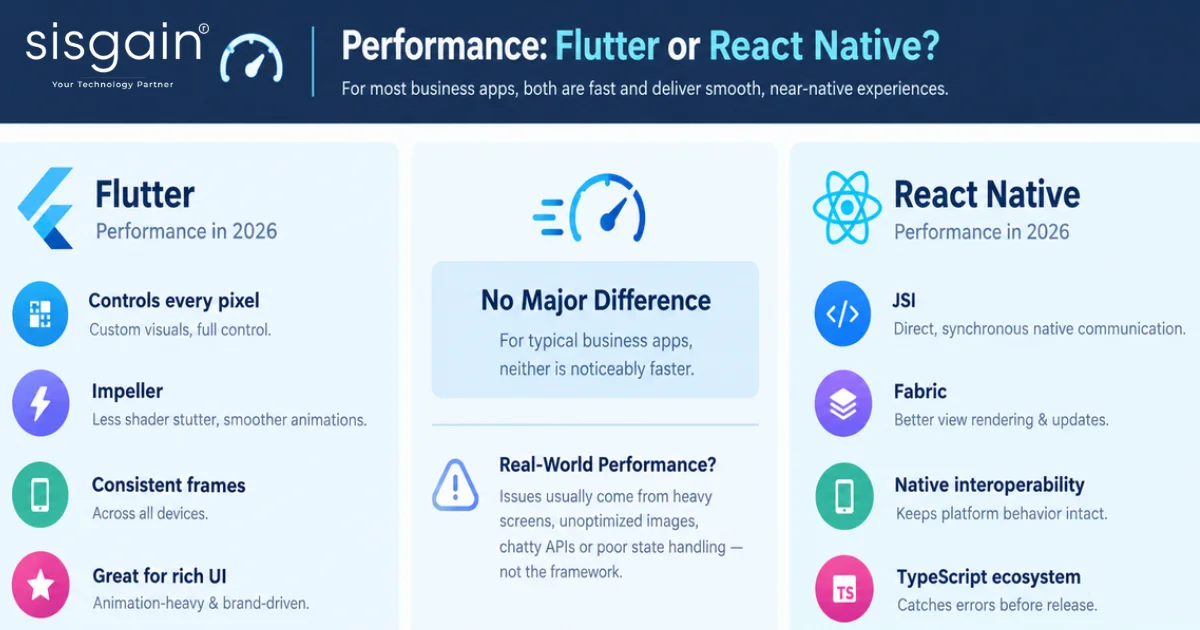
For typical business apps, neither is meaningfully faster in ways your users will notice. Both deliver smooth, near-native experiences when built well. Performance problems in production usually trace back to heavy screens, unoptimized images, chatty APIs or poor state handling rather than the framework.
Flutter Performance in 2026
Flutter's strengths show up in interfaces built around custom visuals:
- A rendering model that controls every pixel
- Impeller, aimed at reducing the shader-compilation stutter that once affected complex animations
- Consistent frame behavior across devices
- Animation-heavy and brand-driven UI
React Native Performance in 2026
React Native's modern architecture removed the main bottlenecks of the old bridge:
- JSI allows direct, synchronous communication between JavaScript and native code
- Fabric improves how views are rendered and updated
- Native interoperability keeps platform behavior intact
- A mature TypeScript tooling ecosystem catches errors before release
Does Performance Actually Matter for Your Abu Dhabi App?
Ask what your app does, not which framework benchmarks better.
Typical business apps run comfortably on either framework:
- Booking and reservations
- eCommerce
- Delivery
- Service marketplaces
- CRM
- Internal business tools
Performance-sensitive apps need extra scrutiny, sometimes native code:
- Advanced graphics
- AR/VR
- Complex real-time camera processing
- Highly intensive animation
- Specialized hardware integrations
If your product sits in the second group, prototype the hardest feature in both frameworks before you commit. A two-week spike costs far less than a rewrite.
Arabic, RTL and UAE-Specific App Requirements
Both frameworks support Arabic and right-to-left layouts. The risk isn't the framework; it's leaving Arabic until late in the project. Global comparisons rarely cover this, and it's where UAE apps quietly lose polish.
Arabic and English App Experiences
Plan for these from the first wireframe:
- RTL layouts. Navigation, back gestures, icons with direction (arrows, progress bars) and swipe actions should all mirror correctly.
- Bilingual navigation. Let users switch languages without restarting the app or losing their place.
- Typography. Arabic fonts need different line heights and sizing than Latin ones. Test real fonts, not defaults.
- Localization. Dates, numbers, currency (AED) and plural forms follow different rules.
- Mixed content. An Arabic sentence containing an English brand name or a phone number is the classic place bidirectional text breaks.
- Testing. Review every screen in both languages on real devices, including small screens, where Arabic text often wraps differently.
UAE-Specific Integrations
Depending on your product, you may need:
- Payment gateways that work in the UAE
- Maps and location services
- Authentication, including UAE PASS, the national digital identity, where relevant to your users
- Push notifications
- Enterprise or government APIs
- Analytics
- Identity and KYC checks
Both ecosystems have community plugins for several of these. UAE PASS, for instance, has Flutter packages on pub.dev, most of them unofficial, and it follows standard OAuth/OIDC patterns with app-to-app redirects that any competent team can implement in either framework. Treat plugins as a starting point and verify them against the official provider documentation before you rely on them. Ask any partner which integrations they've shipped, not just which they've read about.
Security and Data Protection Considerations
Neither Flutter nor React Native makes an app "compliant." Compliance depends on how you design the architecture, what data you collect, where and how you store it, which security controls you apply and which regulations govern your business.
Two points worth knowing:
- The UAE has a federal Personal Data Protection Law (Federal Decree-Law No. 45 of 2021). Businesses operating in the Abu Dhabi Global Market (ADGM) may fall under ADGM's own Data Protection Regulations 2021 instead.
- Details of implementation have been reported inconsistently, so confirm your obligations with a UAE legal or data protection adviser rather than a development agency.
Flutter vs React Native: Which Is More Cost-Effective in Abu Dhabi?
Neither framework is automatically cheaper. Both give you one codebase instead of two, which is where the real saving comes from. After that, cost follows scope, team rates and how clearly the work is defined.
What Determines Mobile App Development Cost in Abu Dhabi in 2026?
Your budget moves with:
- App complexity and number of screens
- Number of platforms
- UI/UX requirements
- Backend development
- APIs and third-party integrations
- Payment integrations
- Authentication
- Arabic/RTL support
- An admin dashboard
- Security and compliance
- Testing
- Maintenance after launch
Published 2026 cost guides for Abu Dhabi vary enormously, because agencies define "simple," "MVP" and "enterprise" differently. Some put simpler apps at around AED 25,000–80,000, with moderate and compliance-heavy projects sitting well above that. Treat any single number you read online as a rough signal, not a quote.
Flutter vs React Native Development Cost
Instead of asking which framework costs less, compare:
- Development effort for your specific features
- Team availability and day rates in your chosen market
- Existing skills, since a team that already knows React avoids a learning curve
- Third-party integration requirements, especially anything that needs native code
- Long-term maintenance, including framework upgrades and dependency updates
A quote that's 20% cheaper because the team is inexperienced with the framework will usually cost more by version two.
App Development Cost 2026: What Should Abu Dhabi Startups Budget?
Use this as a planning frame, not a price list. App Development Cost 2026 can vary significantly depending on the app’s scope, integrations, security requirements, and level of customization:
| App type | Indicative scope | Budget considerations |
|---|---|---|
| Basic MVP | A few core screens and features | Lowest |
| Startup MVP | Backend, authentication, one core workflow | Medium |
| Business app | Payments, APIs, admin functionality | Higher |
| Complex platform | Multiple user roles, integrations, advanced features | High |
| Enterprise / regulated | Security controls, compliance work, custom integrations | Highest |
Get two or three itemized proposals for the same written scope. The gaps between them tell you more than any average.
How to Build a Minimum Viable Product with Flutter or React Native
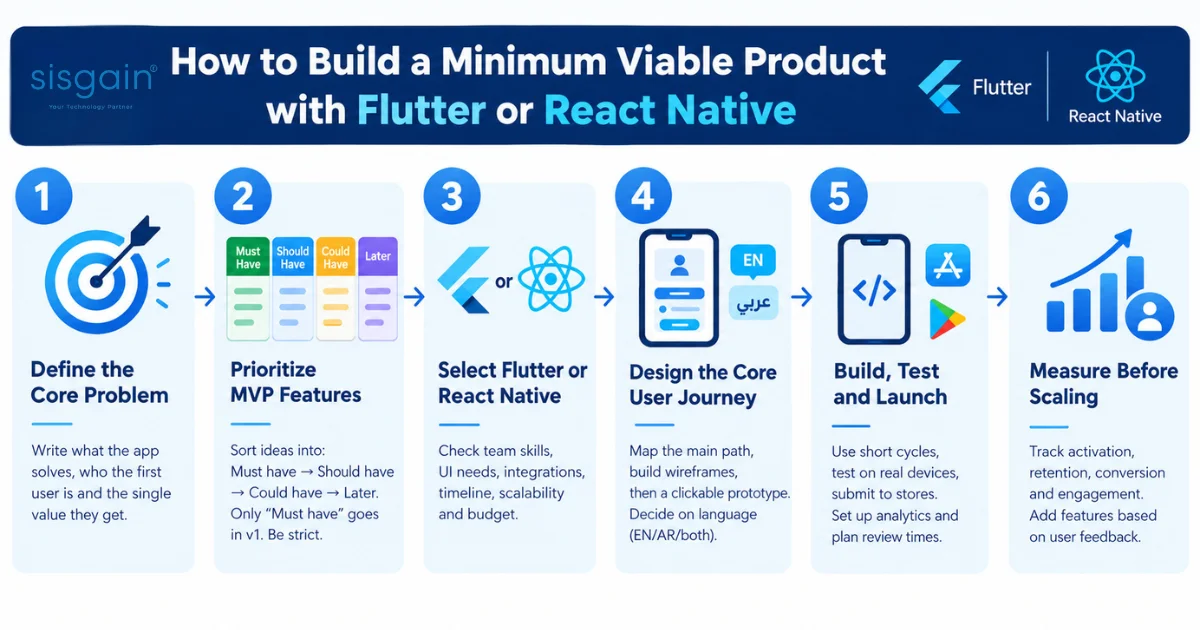
An MVP is the smallest version of your app that proves people want it. It isn't a stripped-down full product. Here's a six-step path.
Step 1: Define the Core Problem
Write down what problem the app solves, who the first user is and what single value they get. If you can't say it in two sentences, the scope isn't ready.
Step 2: Prioritize MVP Features
Sort every idea into four buckets:
Must have → Should have → Could have → Later
Only "Must have" goes into version one. Be strict. Every extra feature adds testing, design and delay.
Step 3: Select Flutter or React Native
Decide using:
- Team skills
- Product UI needs
- Required integrations
- Timeline
- Scalability plans
- Budget
The decision framework further down turns this into a short flowchart.
Step 4: Design the Core User Journey
Map the main path a user takes from opening the app to getting value. Build wireframes, then a clickable prototype. Decide early whether the app launches in Arabic, English or both, and design for both if so.
Step 5: Build, Test and Launch
Develop in short cycles, test on real devices (not just simulators), then submit to the App Store and Google Play. Set up analytics before launch so you have data on day one, and plan for review times on both stores.
Step 6: Measure Before Scaling
Track activation, retention, conversion and engagement, and listen to customer feedback. Add features because users ask for them, not because a roadmap says so.
detailed guide on how to build a minimum viable product.
Which Framework Is Better for Different Types of Abu Dhabi Businesses?
Use case matters more than the winner. Here's how the question plays out across common Abu Dhabi sectors.
Flutter for eCommerce and Consumer Apps
Consumer apps live and die on look and feel. Flutter suits brand-led shopping experiences with custom animation, tightly controlled design and identical behavior across devices. It also handles Arabic/English switching well when localization is planned from the start. React Native can do all of this too; Flutter simply makes a heavily customized interface a more natural starting point.
React Native for Businesses with Existing React Teams
If your company already has a React web application and JavaScript or TypeScript developers, React Native lets that expertise carry over. Hiring is easier, onboarding is faster and engineers can move between web and mobile work more freely.
Flutter vs React Native for Fintech Apps
Security in fintech comes from architecture, not framework. Both can support:
- Strong authentication and biometrics
- Secure API integrations
- Encrypted storage
- Certificate pinning and other hardening measures
Regulatory requirements depend on your license, your data flows and your regulator. When choosing fintech app development services Dubai, prioritize a framework your team can secure and maintain effectively, along with independent security testing before launch.
Flutter vs React Native for Healthcare Apps
Healthcare apps handle sensitive data, so focus on:
- How data is stored and transmitted
- Integrations with existing clinical or hospital systems
- Device capabilities such as Bluetooth or camera
- Accessibility for a wide range of users
For healthcare software development Dubai, these considerations are especially important when building secure, scalable, and accessible healthcare applications that connect with existing clinical systems and devices.
Flutter vs React Native for Logistics and On-Demand Apps
These apps depend on capabilities that sit close to the operating system:
- Maps and real-time location
- Push notifications
- Background processing
- Delivery tracking
Both frameworks handle these through mature plugins and native modules. For a logistics software development company in Dubai, background location is the area to test earliest, because iOS and Android both restrict it tightly and behavior varies by device.
When Should an Abu Dhabi Business Choose Flutter?
Flutter tends to fit best when your project needs:
- A highly customized interface
- Consistent iOS and Android design
- Animation-heavy screens
- A new product with no existing React ecosystem
- One cross-platform team working in a single language
- Rapid MVP development around a distinctive UI
If your requirements line up with this list, the next step is to evaluate an experienced Flutter app development company based on relevant case studies, technical expertise and post-launch support.
When Should an Abu Dhabi Business Choose React Native?
React Native tends to fit best when:
- Your team already uses React or TypeScript
- You have an existing React web product
- JavaScript expertise is already in-house
- The project needs significant native integration
- You want to draw on the wider React ecosystem
If that describes you, look at a React Native app development company that can show live apps, explain how it handles native modules and commit to a maintenance plan.
Flutter vs React Native for Abu Dhabi Startups: A Practical Decision Framework
For Flutter vs React Native Abu Dhabi startups, the right choice depends on your existing team, product requirements, and technical constraints. Work through these questions in order and stop at the first one that applies.
1. Do you already have a React or TypeScript team? → Yes: consider React Native. → No: continue.
2. Is a highly customized UI a major product requirement? → Yes: consider Flutter. → No: continue.
3. Do you need specialized native hardware or API capabilities? → Yes: check each framework's support for the feature and plan native modules. Prototype the riskiest piece first. → No: continue.
4. Are you building an MVP for iOS and Android at the same time? → Yes: both are viable. Compare team fit, partner experience, and proposal quality.
There's no artificial "winner" here, and that's intentional. The answer changes with the team and the product.
How to Choose a Mobile App Development Company in the UAE
Choose on evidence, not on the lowest quote. UAE buyer guides consistently point to case studies, technical capability, communication, post-launch support and contract clarity as the things that separate reliable partners from risky ones. If you're evaluating a mobile app development company Dubai or elsewhere in the UAE, apply the same checks before making a decision.
Check Relevant App Development Experience
Ask for live apps you can download, case studies, experience in your industry and proof of similar integrations (payments, maps, identity).
Verify Flutter or React Native Expertise
"We develop mobile apps" isn't an answer. Ask:
- How many Flutter or React Native apps have you launched?
- Can I see them live in the stores?
- Who will actually work on my project?
- How do you handle native modules?
Understand the Development Process
A credible partner can describe each stage: discovery, UX/UI, development, QA, deployment and maintenance. If the process is vague, delivery probably will be too.
Clarify Ownership and IP
The contract should say plainly who owns:
- Source code
- Design files
- Repositories
- APIs
- Cloud infrastructure
- Documentation
Get this settled before work starts. It's much harder to negotiate after a dispute.
Compare Proposals Beyond Price
Line proposals up on scope, milestones, team, technology, testing, security, support and maintenance. The cheapest quote often leaves things out that show up later as change requests.
full guide to choosing a mobile app development company in the UAE.
Should You Hire a Mobile App Development Company in Dubai for an Abu Dhabi Project?
Often, yes, if the team has real UAE experience. Businesses in Abu Dhabi don't necessarily need an Abu Dhabi-based development team. A mobile app development company in Dubai can be a strong choice when it has relevant UAE experience, dependable delivery processes and the ability to support the app after launch.
Compare the options on:
- Market understanding. Does the team know UAE user expectations, payment habits and bilingual design?
- Availability. How many qualified local teams can you meet in person when it matters?
- Remote collaboration. Dubai and Abu Dhabi share a time zone and are roughly 90 minutes apart by road, so the practical gap is small.
- Technical specialization. Match the team to your stack and sector.
- Communication and support. Clear reporting matters more than a postcode.
- Cost. Rates vary by agency size and seniority more than by emirate.
- Domain experience. A partner who has shipped a fintech or logistics app before will make fewer expensive mistakes on yours.
Cross-Platform App Development Services in Dubai: What Should Businesses Expect?
Cross-platform app development services in Dubai should cover the whole product lifecycle, not just coding. Whether you're working with a team in Dubai, Abu Dhabi or elsewhere, look for:
- Product discovery
- UX/UI design
- Flutter or React Native development
- Backend and API development
- QA and device testing
- Deployment to the stores
- Analytics setup
- Ongoing maintenance
- Security practices
- Cloud integration
The same cross-platform architecture can serve customers in both Dubai and Abu Dhabi. Project requirements, not location alone, should determine the technology stack.
Common Mistakes Businesses Make When Choosing Flutter or React Native
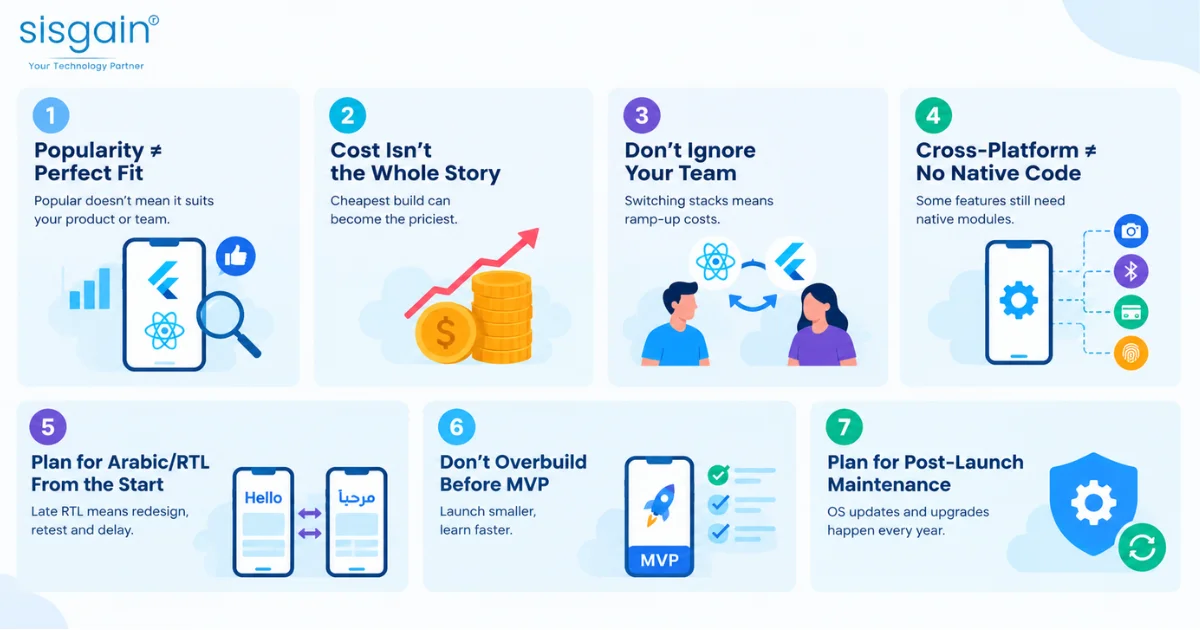
Choosing Based Only on Popularity
A framework being popular doesn't mean it suits your product or team. Check fit against your own requirements.
Choosing Based Only on Development Cost
The cheapest build can become the priciest once you count rework, delays and maintenance.
Ignoring the Existing Team
A React team told to build in Dart, or a Dart team told to switch to React, pays a ramp-up cost that never shows up in the proposal.
Treating Cross-Platform as "No Native Code Needed"
Cross-platform reduces native work; it doesn't eliminate it. Camera features, background tasks, Bluetooth and some payment or identity SDKs may still need native modules.
Ignoring Arabic/RTL Until the End
Retrofitting RTL late means redesigning screens, re-testing flows and delaying launch. Build for it from the first wireframe.
Building Too Many Features Before MVP Validation
Every untested feature is a guess. Launch smaller, learn faster.
Not Planning for Post-Launch Maintenance
Operating system updates, framework upgrades and dependency changes arrive every year. Budget for them from day one.
Flutter vs React Native Abu Dhabi: Final Decision Checklist
- Define your target users
- Define your MVP scope
- Identify required native integrations
- Decide your Arabic/English requirements
- Estimate your development budget
- Assess your existing technical team
- Compare Flutter and React Native for your specific features
- Evaluate development partners
- Review live case studies
- Clarify source-code ownership
- Plan maintenance and scaling
Conclusion
Both Flutter and React Native are mature, production-proven options in 2026. Neither is the universal answer.
What should drive your decision:
- Product requirements come first, then everything else.
- Team expertise shapes speed and long-term maintenance.
- UI needs may tilt you toward Flutter.
- Native integrations deserve an early prototype in either framework.
- Arabic/RTL and UAE-specific requirements belong in the plan from day one.
- Budget follows scope, not framework name.
- An MVP-first approach limits early spending and speeds up learning.
- Your development partner's experience can matter as much as the framework itself.
Planning a mobile app for your Abu Dhabi business? Get clear on your MVP scope, technology stack, requirements, and development roadmap with the right technology partner.

