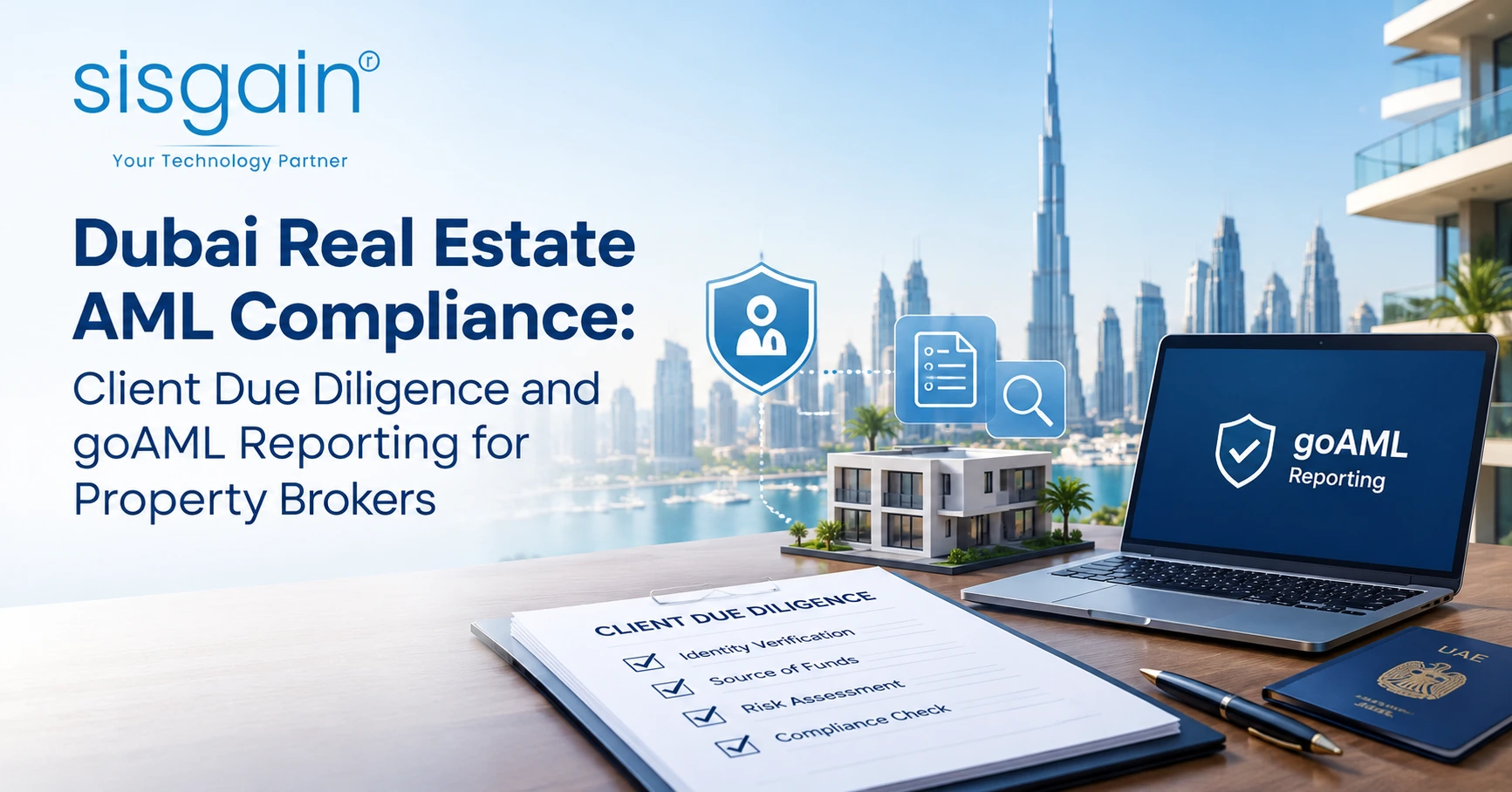

A Dubai property deal can involve a buyer in one country, funds routed through banks in another, a company holding the title and an agent who has never met the person ultimately paying. Add cash instalments or cryptocurrency, and a folder of passport copies no longer shows who is behind the transaction, where the money came from or whether anything should be reported.
Dubai real estate AML compliance means answering those questions consistently: identifying clients and beneficial owners, assessing risk, escalating concerns and filing the right reports through goAML. This guide explains what brokers need to do under current UAE sources, and where well-designed digital workflows can help.
Quick Answer: What Must Dubai Real Estate Brokers Do to Comply With AML Rules?
Brokers supervised as DNFBPs must register on goAML, identify and verify clients and their beneficial owners, assess customer and transaction risk, and apply enhanced due diligence where risk is higher. They must screen against sanctions lists and monitor the relationship. They must file a Real Estate Activity Report (REAR) for qualifying freehold transactions involving cash of AED 55,000 or more, virtual assets, or funds converted from virtual assets. Separately, they must report suspicion through an STR or SAR without tipping off, and retain records for at least five years under a compliance officer’s oversight.
Why Real Estate AML Compliance Matters in Dubai
Why Property Transactions Can Carry Money-Laundering Risks
Property combines high value, portability of wealth and relatively easy cross-border participation. Risk typically arises from overseas funding, layered ownership through companies or nominees, payments from parties who are not the buyer, and newer payment channels such as virtual assets. None of these features is improper in itself. Each is a reason to understand the client, the funding route and the commercial rationale before proceeding.
Who Is Responsible for AML Compliance?
Brokers and agents are designated non-financial businesses and professions (DNFBPs). The Ministry of Economy (now styled Ministry of Economy and Tourism) supervises DNFBPs, including real estate brokers, on the UAE mainland and in commercial free zones.
Arrangements differ elsewhere. Firms inside the DIFC fall under the DFSA’s framework, and ADGM firms under FSRA/ADGM arrangements. Dubai Land Department and RERA regulate broker licensing and market conduct, which is a separate question from AML supervision. Confirm with your own licensing and supervisory authorities which rulebooks apply to your entity.
AML Compliance Is More Than Collecting a Passport
A passport copy proves a document exists. It does not show who controls the buyer, why the funds are arriving from a third country or whether the payer is the contracting party. A reliable process combines identity, ownership, purpose, funding and risk indicators into one assessment that a reviewer can follow later.
Client Due Diligence Requirements for Real Estate Brokers
When Must Client Due Diligence Be Performed?
Apply CDD at onboarding and before the transaction proceeds, whenever suspicion arises, when you doubt earlier information, and when circumstances change materially. The Ministry’s circular for brokers covers sale, purchase and brokerage activity. Treat refreshed information as a trigger: a new payer, a changed ownership structure or a new payment method should reopen the file.
Which Client Documents and Information Should Brokers Collect?
For individuals, the Ministry’s circular, as summarised in its announcement, requires an Emirates ID or passport copy, along with records of receipts, contracts and the sale and purchase agreement. Reporting on the circular adds, for legal entities, the business licence, constitutional documents, the register of real beneficiaries and IDs for each shareholder.
Also record contact details, occupation or business activity and the purpose of the transaction. Distinguish collection from verification. Collection is receiving the document. Verification is confirming it is genuine, current and consistent with everything else you know.
How to Verify Beneficial Ownership of Corporate Buyers and Sellers
Establish who ultimately owns or controls the entity, not only who signs. Obtain the ownership chain, check it against corporate documents, confirm the signatory’s authority and ask directly whether anyone acts on another’s behalf. Beneficial-owner procedures are set out in Cabinet Decision 109 of 2023.
Illustrative example (not a SISGAIN case study): a company incorporated overseas offers to buy an off-plan unit. Its licence names one director, but the shareholder register shows another company as majority owner. The broker asks for that holding company’s ownership details, and the chain ends at two individuals, one holding 60 percent. Only then can the broker identify, verify and screen the real owners and decide whether the structure has a plausible commercial reason.
Source of Funds vs Source of Wealth
Source of funds is where the money for this transaction comes from, such as a named bank account, sale proceeds or a loan. Source of wealth is how the client accumulated their overall assets, such as salary, business profits or inheritance.
Request more evidence when risk, value or payment method warrants it. Useful documents include bank statements, sale agreements, mortgage approvals or audited accounts. Not every client needs every document. The test is consistency: does the evidence fit the client’s profile and the size of the deal?
Enhanced Due Diligence for High-Risk Property Transactions
Politically Exposed Persons and Connected Parties
PEPs and their family members or close associates warrant additional scrutiny. Law-firm analysis of the 2025 Executive Regulations notes an expanded PEP definition and that EDD now expressly includes establishing source of wealth and obtaining senior management approval. Screen buyers, sellers, beneficial owners and payers, not only the person who signs.
High-Risk Countries and Cross-Border Funding
Check client nationality, residence, incorporation and funding route against the Ministry’s current high-risk jurisdiction circulars, for example Circular 1 of 2025. Ask why funds come from a particular country and whether the route makes commercial sense for the client.
Third-Party Payments, Cash and Virtual Assets
Understand who is paying, from which account, by what method and why. A payer who is not the buyer, cash in instalments, or crypto-related funding each need an explanation you can document. Several of these also trigger REAR obligations (see below).
What Should an EDD File Contain?
At a minimum, record:
- the reason EDD applied
- verified identity and ownership
- source-of-funds and, where required, source-of-wealth evidence
- screening results
- senior approval
- any conditions placed on the transaction
- the final decision and rationale
Another reviewer should be able to follow your reasoning without asking you.
goAML Reporting for Dubai Property Brokers
What Is goAML and Who Must Register?
goAML is the UAE Financial Intelligence Unit’s reporting platform. DNFBPs must be registered to file reports, and the Ministry has issued dedicated circulars on goAML registration and reporting requirements, listed on its AML page. Registration normally involves appointing a compliance officer as the main user.
When Is a Real Estate Activity Report (REAR) Required?
Under Circular 5 of 2022, a REAR is due on goAML for freehold sale or purchase transactions where:
- cash payments, single or several, equal or exceed AED 55,000 for all or part of the property value
- payment is made in virtual assets for all or part of the value
- funds were converted from virtual assets into cash for all or part of the value
It applies from July 2022, whether or not suspicion exists. It is not a universal property-transaction filing: it depends on the transaction type and payment method.
REAR Reporting Triggers at a Glance
| Trigger | What the broker must assess | Practical compliance action |
|---|---|---|
| Physical cash totalling AED 55,000 or more towards a freehold sale or purchase (single or linked payments) | Is the deal freehold? Is payment physical cash? Do instalments aggregate to the threshold? | Record payment method at each receipt, keep a running cash tally per deal, escalate to the compliance officer and file the REAR |
| Payment in virtual assets (whole or part) | Is any part paid in virtual assets? The circular summary reports no minimum value, so confirm against the current text | Capture payer, platform and asset details, document the rationale, escalate and file the REAR |
| Funds converted from virtual assets into cash | Does any part of the funding trace to virtual-asset conversion? | Ask about the funding route, collect conversion evidence, consider EDD and file the REAR |
REAR vs STR vs SAR: What Is the Difference?
A REAR reports specified payment methods in freehold deals. An STR reports a suspicious transaction. A SAR reports suspicious activity, which can arise even without a completed transaction. The UAEFIU’s guide to goAML report types also lists other categories, including HRC, PNMR and FFR, which relate to high-risk countries, partial sanctions-name matches and frozen funds. Check which apply to your firm.
A REAR does not satisfy a separately required STR or SAR. A suspicious cash deal may need both. A deal below AED 55,000 may still need an STR or SAR.
What Should Brokers Do When Suspicion Arises?
Escalate promptly to the compliance officer. Do not wait for proof of a crime: the test is suspicion, not certainty. Document what you observed and when, preserve records and let the compliance officer decide on filing. Never tell the client a report is being considered or has been filed. Tipping off is prohibited.
AML Red Flags Every Dubai Real Estate Broker Should Recognise
A red flag calls for assessment. It does not prove money laundering.
Client-related
- Reluctance to provide required information.
- Undisclosed principals or unexplained intermediaries.
- Ownership that cannot be verified.
Transaction-related
- Third-party payments without explanation.
- Unusual urgency or unexplained payment routes.
- Virtual-asset involvement.
- Rapid resale with no apparent commercial rationale.
Documentation-related
- Inconsistent identity details.
- Opaque ownership.
- Mismatches between contracting party and payer.
- Corporate documents that look unreliable.
Illustrative example: a buyer agrees terms quickly, then says a relative abroad will pay the deposit, and later proposes part-payment in cash. Each point may have an innocent explanation. Together they justify EDD, a documented rationale and escalation. The compliance officer then decides whether to file a REAR, an STR or SAR, or both.
How to Build a Practical AML Compliance Workflow
Not every control below is a statutory requirement. The legal minimums are set by the law, regulations and circulars. Treat the rest as a practical design.
Step 1 — Assess the Client and Transaction
Capture client type, nationality, structure, transaction value, payment method and funding source. Assign a documented risk rating.
Step 2 — Verify Identity, Ownership and Funding
Verify IDs and corporate documents, identify beneficial owners, and collect funding evidence in proportion to risk.
Step 3 — Screen and Escalate Potential Matches
Screen all parties against sanctions and terrorist lists, consistent with the Ministry’s Circular 3 of 2025 on screening. Route possible matches to the compliance officer without alerting the client.
Step 4 — Review Payment Methods and Reporting Triggers
Before accepting funds, check for cash, virtual assets and third-party payers, and decide whether a REAR, STR or SAR is needed. Digital tools for managing property transactions can help keep this check tied to the transaction record.
Step 5 — Retain Records and Review the Relationship
Archive the full file and revisit it when circumstances change.
| Step | Responsible role | Evidence to retain |
|---|---|---|
| 1. Assess | Broker / onboarding officer | Risk rating and rationale |
| 2. Verify | Broker, reviewed by compliance | ID, ownership chart, funding evidence |
| 3. Screen and escalate | Compliance officer | Screening results, escalation notes |
| 4. Review payments and triggers | Compliance officer | Payment records, REAR/STR/SAR decision |
| 5. Retain and review | Compliance officer | Complete archived file, review dates |
AML Recordkeeping, Staff Training and Compliance Governance
Which Records Must Be Retained?
The Ministry requires brokers, including those in free zones, to keep records and transaction data for no less than five years. Retain identification, beneficial ownership records, contracts and receipts, source-of-funds evidence, screening results, risk assessments, escalation notes and filing records. Law-firm commentary on the 2025 Regulations suggests the retention clock runs from the most recent relevant event. Confirm this with counsel before setting deletion rules.
What Should the Compliance Officer Oversee?
The compliance officer owns policies, escalation decisions, goAML filings, staff training, access to records, control testing and reporting to management. Management should receive regular summaries and take responsibility for resourcing.
How Often Should Brokers Review Their AML Controls?
No universal review frequency is stated here, and none should be invented. Review controls when risks change: a new product, new payment methods, updated jurisdiction lists or an internal incident. Also test them periodically, in proportion to your size and risk profile.
Can Real Estate Software Help Brokers Manage AML Workflows?
Used well, software makes compliance easier to document, review and audit. It cannot establish compliance, guarantee detection or replace professional judgement. The value comes from clear responsibilities, reliable evidence and exceptions reaching the right person.
Software can help with:
- centralised KYC documents
- beneficial ownership records
- screening-result documentation
- missing-document tracking
- approval and escalation workflows
- payment-method review
- audit trails, access controls and retention workflows
- CRM and transaction-system integrations
SISGAIN builds custom software for property businesses, including real estate app development services in Dubai and software integration services to connect CRM and transaction systems. For wider context, see real estate software systems and their business applications. Any regulated function, such as screening or goAML filing, requires appropriate specialist providers and approval from your compliance function.
Conclusion: Make AML Compliance Part of Every Property Transaction
Reliable AML practice in Dubai property starts with knowing who the client really is, who owns or controls any entity involved and how the deal is being paid for. Build controls around risk, escalate concerns early, file the right report through goAML and retain a clear evidence trail. For brokerages whose files still live in scattered folders and chat threads, better workflows can help teams follow that process consistently, but responsibility stays with the people running it.