
Most telecom operators don't lose customers because their network is bad. They lose them because a customer ordered fiber on Tuesday, got a provisioning error on Thursday, called support on Friday, and was told by three different people that the order "wasn't in the system yet." The network was fine the entire time. The problem was that the systems managing the order, the systems managing the network, and the systems managing the bill weren't talking to each other.
That gap is exactly what telecom BSS/OSS software exists to close.
Operators today are trying to launch 5G network slices, manage IoT fleets with tens of thousands of connected devices, sell private enterprise networks, and still keep prepaid billing running without a hiccup — often on infrastructure that was designed when "digital transformation" meant putting a bill online. The result is a familiar pattern: customer systems, order systems, provisioning systems, and network systems that each work fine in isolation and fail constantly at the handoffs between them.
This guide breaks down what telecom BSS/OSS software actually does, how BSS and OSS fit together, the architecture patterns replacing legacy monoliths, and a practical roadmap for modernizing without ripping out your entire stack in one risky move. It's written for CTOs, CIOs, heads of network operations, and product leaders who need more than a vendor glossary — they need a working mental model they can take into a budget meeting.
Quick Answer: What Is Telecom BSS/OSS Software?
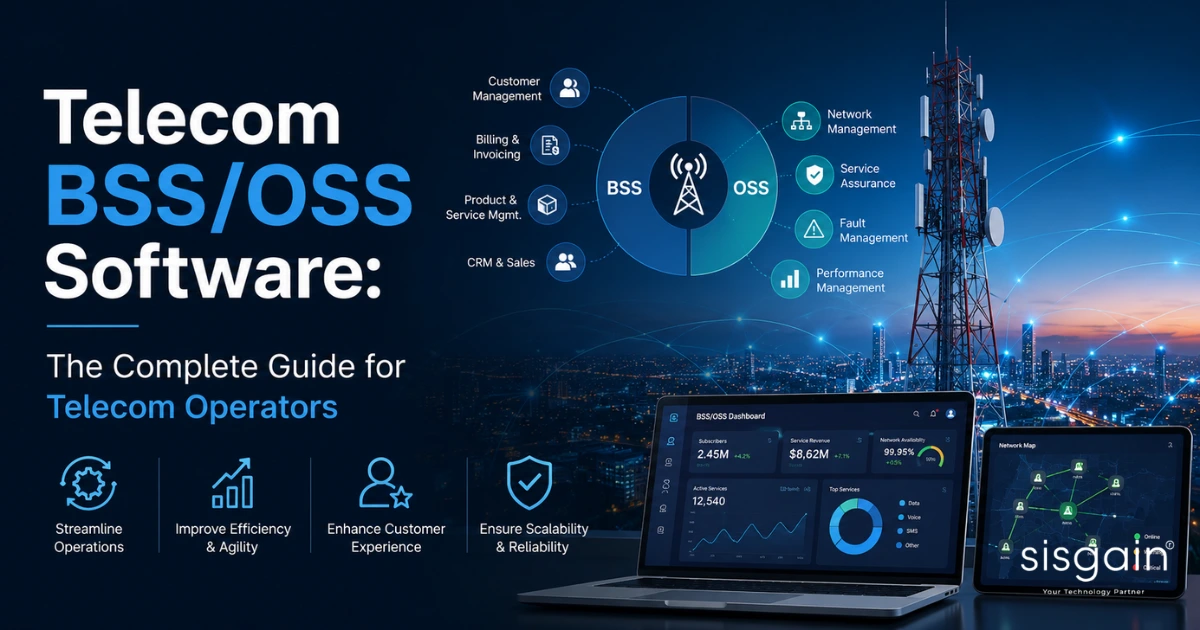
Telecom BSS/OSS software is the combined set of systems that run a telecom operator's business and network operations. BSS (Business Support Systems) manages customers, products, orders, charging, and billing. OSS (Operations Support Systems) manages network resources, provisioning, activation, and service assurance. Together, they carry a request from "customer wants service" to "service is live and billed correctly."
What Is Telecom BSS/OSS Software?
Before getting into modules and architecture diagrams, it helps to zoom out. Telecom software for telecommunications covers a lot of ground: systems that let a provider sell a plan, capture an order, activate connectivity, watch that connection for faults, charge for what was used, send an invoice, and support the customer for as long as they stay subscribed. None of that happens in one application. It happens across a chain of systems, and the strength of that chain is usually the actual differentiator between operators — not who has the newer radio equipment.
Two things drive that chain apart in most established operators. First, these systems were bought, built, or acquired at different points over 10 or 20 years, often from different vendors, sometimes as a result of mergers that stitched together two completely separate stacks. Second, commercial teams and network teams have historically operated with different priorities, different vocabularies, and different systems of record. Sales sees a "product." Engineering sees a "service configuration on three network domains." Neither is wrong, but if those two views of the same thing don't stay in sync, you get order fallout, provisioning delays, and billing errors — the operational friction that shows up as churn six months later.
That friction is why BSS and OSS need to be understood as a connected pair rather than two separate product categories.
What Is BSS in Telecom?
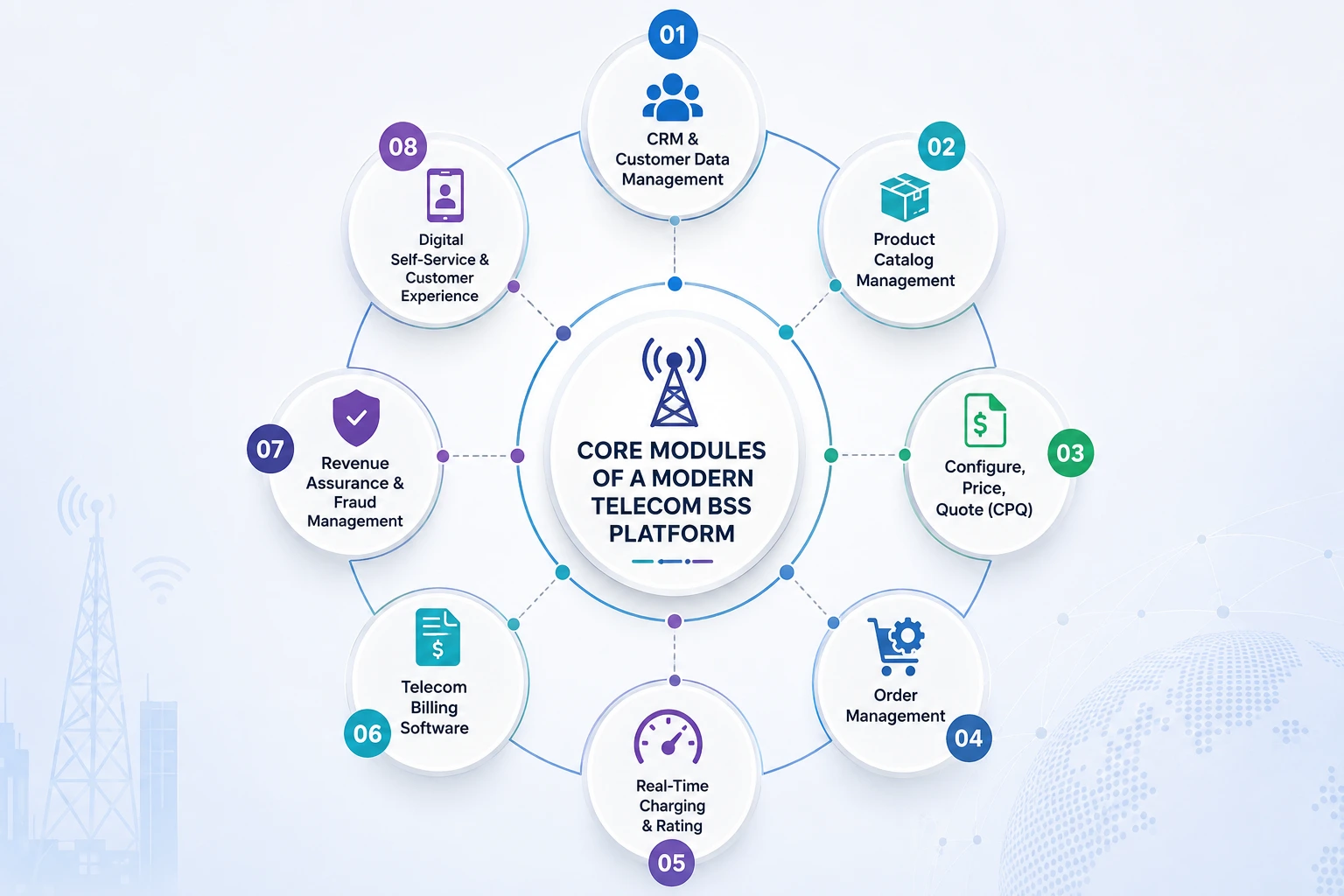
BSS is the commercial and financial engine of the operator. It's the layer responsible for everything that touches money and the customer relationship, including:
- CRM and customer management
- Product catalog
- Pricing and configuration
- Configure, Price, Quote (CPQ)
- Product ordering
- Charging and rating
- Billing and invoicing
- Payments and collections
- Partner settlement
- Revenue assurance
- Digital self-service
If a customer can point to it — a plan, a bill, an app where they check their data usage — it's almost certainly BSS territory.
What Is OSS in Telecom?
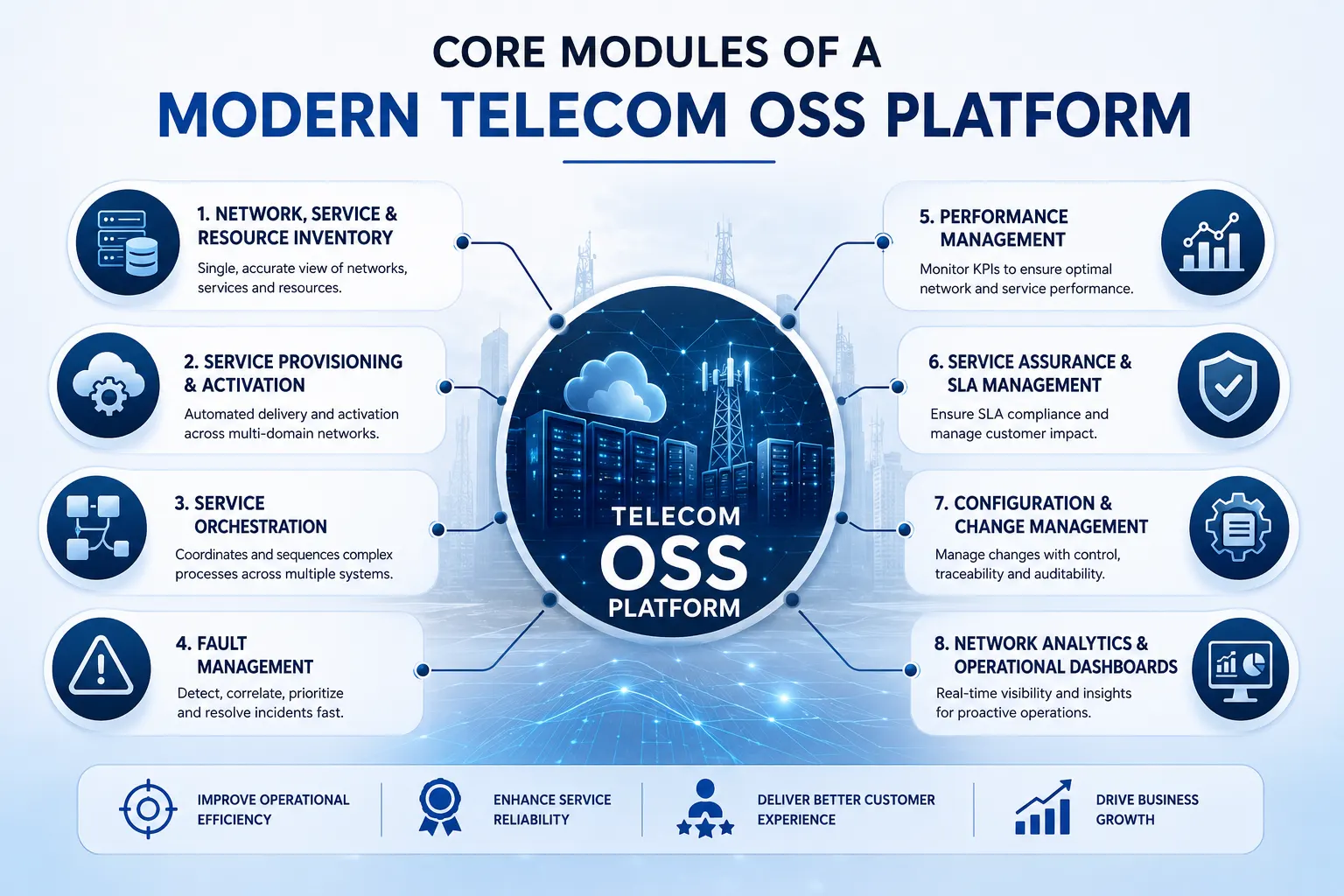
OSS is the operational engine underneath the commercial layer. It doesn't deal with the customer directly; it deals with the resources and processes needed to actually deliver and maintain the service the customer bought:
- Network inventory
- Service inventory
- Resource management
- Provisioning
- Activation
- Service orchestration
- Fault management
- Performance monitoring
- Service assurance
- Configuration management
- Operational analytics
If BSS answers "what did the customer buy and how do we charge for it," OSS answers "how do we actually deliver that, and how do we know it's still working."
BSS vs. OSS: What Is the Difference?
The table below is the fastest way to see the split, but read the row underneath it too — the difference matters less than the connection.
| Area | BSS | OSS |
|---|---|---|
| Primary focus | Customers and revenue | Networks and service delivery |
| Main users | Sales, finance, product, customer care | Engineers, NOC and operations teams |
| Key functions | CRM, orders, charging and billing | Provisioning, inventory, and assurance |
| Core question | What did the customer buy and how is it charged? | How is the service delivered and maintained? |
| Example | Enterprise customer orders SD-WAN | Resources are configured and service performance is monitored |
It's tempting to treat this table as the whole story and stop there. Don't. Operators that build BSS and OSS as genuinely separate silos — different teams, different roadmaps, no shared data model — end up with a commercial system that can sell things the network can't actually deliver on schedule, and a network system that has no idea which faults are hurting revenue-critical customers. The value sits in the handoff:
Customer Intent → Product Order → Service Order → Resource Activation → Service Assurance → Usage Charging → Billing → Customer Support
Everything else in this telecom BSS/OSS software guide builds on that chain.
How Do BSS and OSS Work Together?
This is the part most vendor material skips over, and it's the part that actually determines whether your stack works.
Example: Delivering an Enterprise Connectivity Service
Take something concrete: a mid-size enterprise customer orders SD-WAN across four office locations. Here's what actually has to happen, in order.
Step 1: The customer selects a service. BSS handles the commercial side — product selection, pricing, eligibility checks, and any negotiated contract terms.
Step 2: The product order is created. This captures exactly what was purchased: bandwidth tiers, SLA level, contract length, billing terms.
Step 3: The service order is generated. The commercial order gets translated into technical requirements — which is a nontrivial step, because "50 Mbps SD-WAN with 99.9% uptime" means something very different to a network engineer than it does to a salesperson.
Step 4: OSS checks resources and inventory. The system verifies what's actually available — ports, bandwidth, edge devices, last-mile connectivity — across each of the four locations.
Step 5: Service orchestration and provisioning begin. OSS coordinates across whatever network domains and systems are involved, which for SD-WAN usually means multiple vendors and multiple access technologies at once.
Step 6: The service is activated. The customer's four sites go live.
Step 7: Service assurance monitors performance. Availability, latency, and SLA compliance get tracked continuously — not just at cutover.
Step 8: Usage is charged and the customer is billed. BSS takes over again for ongoing charging, invoicing, and lifecycle management, including any SLA credits owed if performance dips.
Miss a handoff anywhere in that chain — say, OSS activates the service but never confirms back to BSS that it's live — and you get a customer paying for a service that shows as "pending" in their portal, or worse, a customer using a service nobody's billing for. Both happen more often than operators like to admit, and both are symptoms of the same root cause: BSS and OSS that don't share a common view of the order.
Getting these two layers to talk to each other reliably is fundamentally an integration problem, and it's usually where dedicated API integration services in Dubai earn their keep — building the connective tissue between CRM, billing, OSS, and network systems so a status change in one place actually reflects everywhere else, in real time, instead of overnight in a batch job.
Core Modules of a Modern Telecom BSS Platform
CRM and Customer Data Management
Everything downstream depends on this being right. If sales, billing, and support are each working from a different version of "who this customer is," every other module inherits that inconsistency. A unified customer view isn't a nice-to-have dashboard — it's the foundation the rest of BSS sits on.
Product Catalog Management
This covers products, bundles, pricing, eligibility rules, and the commercial rules that govern what can be sold to whom. A well-structured catalog is what lets a product team launch a new bundle in days instead of waiting on a development cycle. A poorly structured one is why so many operators still have "legacy plans" nobody can fully explain, quietly costing money every billing cycle.
Configure, Price, Quote (CPQ)
CPQ matters most for complex enterprise services — the kind with custom bandwidth, multi-site rollouts, and negotiated SLAs — where a simple "add to cart" flow doesn't cut it. Getting quotes accurate and fast here is often the difference between winning and losing an enterprise deal, because competitors are quoting the same opportunity.
Order Management
Order orchestration sounds abstract until you've dealt with order fallout — an order that gets stuck between systems and needs manual intervention to complete. Fallout rates are one of the more honest health metrics for a BSS stack; a high one usually points straight at integration gaps.
Real-Time Charging and Rating
Prepaid, postpaid, usage-based, and enterprise contracts all need to be rated correctly and, increasingly, in real time. A customer burning through data shouldn't find out they're over their limit when the bill arrives three weeks later.
Telecom Billing Software
This is where invoice generation, recurring billing, usage consolidation, and payment workflows live. Billing errors are one of the fastest ways to damage trust — customers tolerate a slow network more readily than they tolerate being overcharged, even by a small amount.
Revenue Assurance and Fraud Management
Revenue leakage tends to happen quietly, in the gaps between network usage, charging, billing, and collections. A session that gets used but never rated. A discount applied twice. These losses rarely show up as a single dramatic event — they accumulate.
Digital Self-Service and Customer Experience
Apps, portals, digital onboarding, usage visibility, and self-service support are now baseline expectations, not differentiators. This is also where a lot of operators quietly lose customers to a competitor with a cleaner app, even when the underlying network is comparable — which is why UI/UX design services in Dubai get pulled into telecom projects specifically to redesign self-service portals around what customers actually try to do, rather than around how the backend systems happen to be organized. Once those portals are built, they still need to hold up under real usage patterns and edge cases, which is where structured software testing services in Dubai come in — validating billing accuracy, order flows, and provisioning logic before a bug reaches a paying customer instead of after.
Core Modules of a Modern Telecom OSS Platform
Network, Service, and Resource Inventory
Inventory accuracy is one of those things that seems boring until it's wrong. An inaccurate inventory record doesn't just cause a reporting error — it causes a provisioning system to try activating a service on a port that's already in use, or that doesn't exist anymore. Everything OSS does downstream depends on this being trustworthy.
Service Provisioning and Activation
This is the automated (or semi-automated) delivery of a service across whatever network domains it touches — fiber, mobile, cloud, enterprise WAN, sometimes all at once for a single order.
Service Orchestration
Orchestration is the coordination layer across systems — the thing that actually sequences provisioning steps correctly instead of firing them all at once and hoping for the best.
Fault Management
Detecting, correlating, prioritizing, and resolving incidents. The correlation part matters most at scale: one fiber cut can generate thousands of individual alarms, and an operations team needs the system to recognize that as one root cause, not a thousand separate problems.
Performance Management
Ongoing monitoring of network and service KPIs — not just "is it up," but "is it performing the way the contract says it should."
Service Assurance and SLA Management
This is where technical performance gets translated into customer impact. A 99.95% uptime figure means very little to a customer until it's tied to their specific SLA and, when it slips, their specific credit.
Configuration and Change Management
Controlled, auditable changes across complex environments — because an untracked configuration change is one of the most common causes of unexplained outages.
Network Analytics and Operational Dashboards
Visibility across services and resources for operational teams, so problems get spotted from a dashboard rather than from a customer complaint.
Telecom BSS/OSS Architecture: From Legacy Systems to Composable Platforms
Architecture is where a lot of BSS/OSS modernization efforts either succeed quietly or fail expensively, so it's worth walking through the progression most operators go through.
Legacy Monolithic BSS/OSS Architecture
The classic setup: tightly coupled applications, long release cycles (sometimes quarterly, sometimes annual), point-to-point integrations built one at a time over years, difficult upgrades, and heavy vendor dependency. It's not that these systems don't work — many run critical operations reliably today. The problem is speed. Launching a new product or changing a billing rule can take months, not because the idea is complicated, but because the system wasn't built to change quickly.
Integrated BSS/OSS Suites
A single vendor's unified suite can make sense for smaller or mid-size operators that want fewer integration points and a single throat to choke when something breaks. The tradeoff is flexibility — you're generally moving at the vendor's pace, not yours.
Best-of-Breed Architecture
Picking the strongest system for each function — billing from one vendor, inventory from another — gives you best-in-class capability everywhere, at the cost of more integration work and more moving parts to maintain over time.
Composable and API-First Architecture
This is where most serious modernization efforts are heading: modular systems built around reusable capabilities that can be replaced individually as better options emerge, rather than replacing the entire stack every time one component falls behind. It's a fundamentally different philosophy from "buy a platform" — it's closer to "buy capabilities and connect them well."
Cloud-Native Telecom Architecture
Containers, microservices, Kubernetes, event-driven architecture, API gateways, observability, and security aren't buzzwords here — they're the practical mechanics that let composable architecture actually deliver on its promise of speed. Getting this right usually spans several disciplines at once: cloud infrastructure solutions in Dubai for the underlying compute and networking, IT infrastructure management services in Dubai to keep it running reliably day to day, enterprise architecture services in Dubai to make sure the pieces actually cohere into a system instead of a pile of microservices, and DevOps consulting services in Dubai to build the release pipelines that let a composable architecture ship changes weekly instead of quarterly.
How Telecom BSS/OSS Software Supports 5G, IoT, and Enterprise Services
5G and Network Slicing
Differentiated 5G services — think a low-latency slice for autonomous vehicles versus a high-bandwidth slice for streaming — require service configuration, automated fulfillment, real-time SLA monitoring, policy management, and flexible charging that can rate usage differently by slice. None of that is achievable with manual, ticket-based provisioning. The volume and speed 5G slicing demands is exactly the scenario legacy OSS wasn't built for.
Private 5G and Enterprise Connectivity
Private 5G deployments bring complex, often custom service configurations that need to be managed across their full lifecycle — not just at initial rollout, but through changes, expansions, and eventual decommissioning.
IoT Connectivity Management
IoT introduces scale that traditional consumer mobile plans never had to deal with: device onboarding at volume, SIM and eSIM lifecycle management, usage monitoring across potentially millions of low-data devices, and policy management that has to work automatically because there's no human reviewing each connection. This is a domain where purpose-built platforms matter — which is why operators increasingly work with a dedicated IoT software development company in Dubai rather than trying to force IoT connectivity management through systems designed for postpaid mobile subscribers.
Cloud and Edge Services
Operators are increasingly managing digital services that go beyond traditional connectivity — edge compute, managed cloud services, and hybrid offerings that blend network and IT infrastructure into a single commercial product.
Wholesale and Partner Ecosystems
Partner onboarding, settlement, product exposure, and multi-party service delivery all add a layer of complexity BSS/OSS needs to handle — because a wholesale partner reselling your network capacity needs its own billing logic, its own SLAs, and its own visibility into service status.
Network API Monetization
Exposing selected network capabilities securely through APIs — location data, quality-on-demand, device verification — is becoming a real revenue line for operators, not just a developer relations initiative. It also raises the stakes on security, since you're now exposing network capability to external parties by design.
The Role of AI in Telecom BSS/OSS Software
AI in telecom gets talked about a lot and delivered on inconsistently. It's worth treating it as an operational capability layered on top of BSS/OSS, not as a separate initiative.
AI for Network Operations
Anomaly detection, incident correlation, predictive maintenance, root-cause analysis, and capacity forecasting are all places where AI genuinely reduces manual effort — largely because these are pattern-recognition problems at a scale humans can't keep up with across thousands of network elements.
AI for Customer Operations
Intelligent customer support, ticket classification, agent assistance, and proactive customer communication (flagging an outage to affected customers before they call in) are areas where AI has moved from experimental to standard practice fairly quickly.
AI for Revenue and Commercial Operations
Revenue leakage detection, churn prediction, demand forecasting, and offer optimization all benefit from AI's ability to spot patterns across large transaction volumes that a human analyst would never catch manually.
Closed-Loop Automation
The pattern underlying most of these use cases is the same: Detect → Analyze → Decide → Act → Validate. The "validate" step is the one operators skip most often, and it's the one that determines whether automation is trustworthy enough to run without a human checking every action.
Why AI Cannot Fix Poor BSS/OSS Foundations
Here's the part that doesn't get said enough in vendor pitches: AI is only as good as what it's built on. It depends on trusted inventory, reliable data, connected workflows, quality telemetry, working APIs, real governance, and human oversight. Point an AI model at inventory data that's 15% wrong, and it won't fix the inventory — it'll just make confidently wrong decisions faster than a person would have. Operators considering AI-Powered Telecom Solutions get far more value investing in data quality and integration first, then layering AI on top, than they do buying an AI tool to paper over a fragmented stack. When the foundation is solid, working with an AI software development company in Dubai to build targeted models — for fraud detection, churn prediction, or assurance — tends to produce results fast, because the hard data-plumbing work is already done.
Common Challenges in Telecom BSS/OSS Modernization
Legacy dependencies. Some systems run critical, revenue-generating operations and are too risky to replace outright, no matter how outdated the code underneath.
Fragmented data. Customer, product, service, and resource data frequently don't align across systems, which is the root cause of a huge share of operational errors.
Inaccurate inventory. Bad inventory data causes provisioning failures that are expensive to trace, because the failure often shows up somewhere completely different from where the bad data lives.
Point-to-point integrations. Custom integrations built one at a time, system by system, over years become a maintenance burden that grows quietly until nobody fully understands the whole map anymore.
Migration risk. Billing accuracy, service continuity, and customer experience can't be compromised during a migration — which is exactly why so many operators delay modernization longer than they should.
Vendor lock-in. Being tied to a single vendor's roadmap and pricing has real commercial and technical costs, especially when that vendor's priorities stop matching yours.
Skills gaps. Modernization requires expertise across telecom domain knowledge, cloud, data, APIs, automation, and security — a combination that's genuinely hard to find and retain in-house.
Security and compliance. Identity, access control, sensitive customer data, API security, and operational resilience all carry more weight now that operators are exposing more surface area through APIs and cloud infrastructure. Given how much sensitive customer and network data flows through BSS/OSS, dedicated cybersecurity services for telecom companies in Dubai are increasingly treated as a modernization prerequisite, not an afterthought bolted on at the end.
How to Choose Telecom BSS/OSS Software
Skip the vendor comparison spreadsheet until you've done this first.
Evaluate the Business Problem First
Get specific answers to:
- Which customer journeys are currently failing?
- Where are activation delays actually occurring?
- Which processes cause the most revenue leakage?
- Where is manual work highest across the organization?
- Which services are hardest to launch, and why?
Assess Architecture and Integration Readiness
Look at APIs, data models, event support, integration patterns, cloud readiness, and security posture — both for the systems you're evaluating and for what you already have.
Evaluate Telecom-Specific Functional Requirements
Assess billing, charging, inventory, provisioning, orchestration, and assurance against your actual use cases, not a generic feature checklist.
Consider Scalability and Deployment Models
Can it handle your projected volume three years out, not just today's? And does the deployment model — cloud, hybrid, on-premises — fit your regulatory and latency requirements?
Review Vendor Lock-In and Extensibility
How hard would it be to replace this component in five years if a better option shows up? If the honest answer is "extremely," that's a real cost, even if it's not on the invoice.
Validate Security and Operational Resilience
Test failure scenarios, not just feature demos.
Build vs. Buy vs. Modernize: Which BSS/OSS Strategy Is Right?
| Strategy | Best suited for | Key advantage | Main risk |
|---|---|---|---|
| Buy an integrated suite | Smaller/mid-size operators wanting speed to deploy | Faster initial deployment, single vendor accountability | Less flexibility, vendor dependency |
| Best-of-breed platforms | Operators with strong integration capability | Best-in-class functionality per module | Higher integration overhead |
| Custom development | Operators with unique, differentiated processes | Full control and fit to specific workflows | Higher cost, longer timeline, ongoing maintenance burden |
| Legacy modernization | Operators with critical systems too risky to replace outright | Preserves stability while improving specific weak points | Can become a series of endless patches without a clear end state |
| Composable architecture | Operators planning for long-term agility | Flexibility to replace components individually over time | Requires strong architecture discipline to avoid sprawl |
There's no universally correct answer here. An operator with strong in-house engineering and a genuinely differentiated product might lean toward composable architecture with select custom builds, often working alongside a specialist software development company in Dubai for the pieces that need custom logic no off-the-shelf platform provides. An operator without that internal capacity is usually better served buying more and building less.
A Practical Telecom BSS/OSS Modernization Roadmap
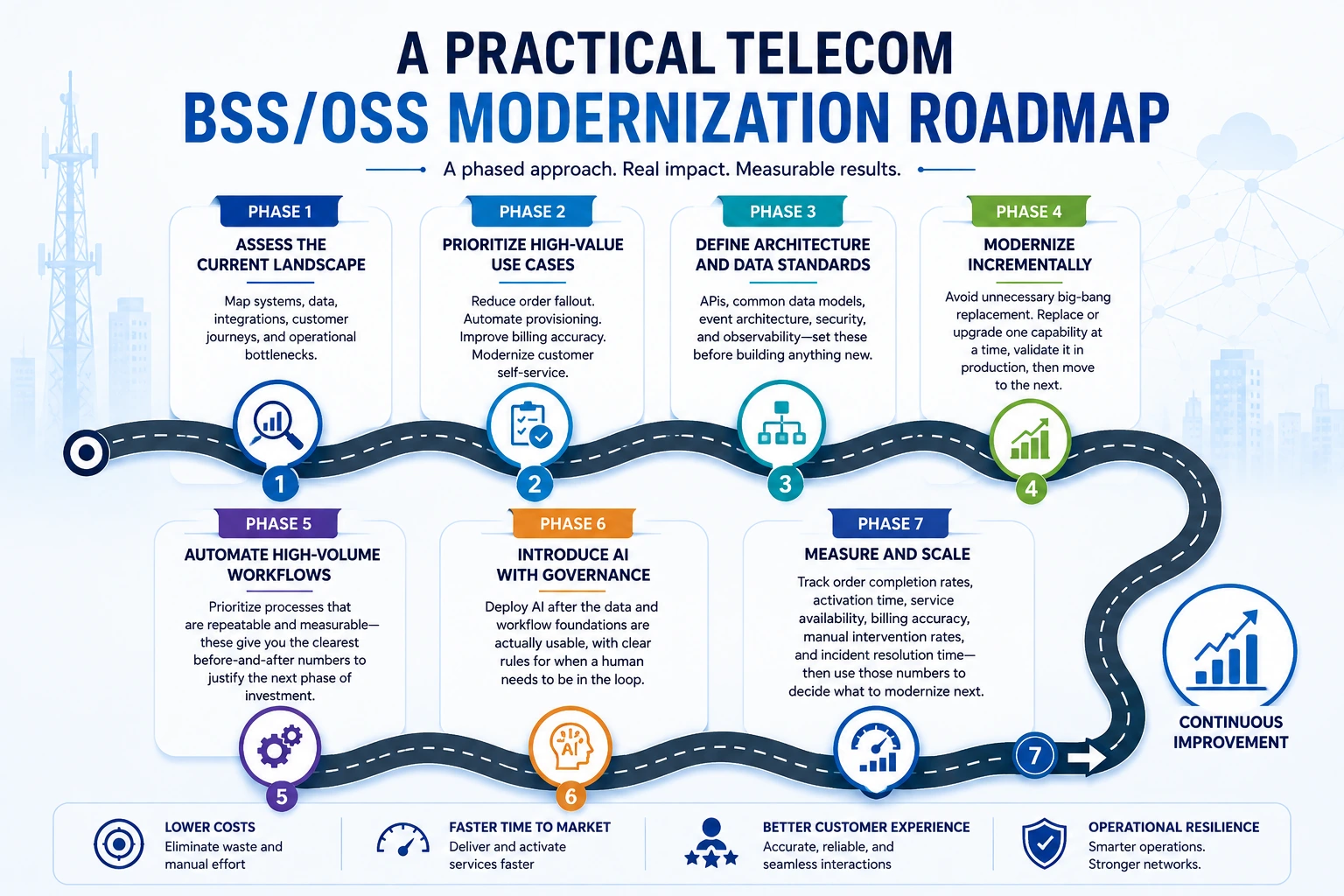
Phase 1: Assess the current landscape. Map systems, data, integrations, customer journeys, and operational bottlenecks. Skipping this step is the single most common reason modernization projects go over budget — you can't fix what you haven't actually mapped.
Phase 2: Prioritize high-value use cases. Reduce order fallout. Automate provisioning. Improve billing accuracy. Modernize customer self-service. Pick the two or three that will move the needle fastest, not the ten that would be nice.
Phase 3: Define architecture and data standards. APIs, common data models, event architecture, security, and observability — set these before building anything new, or you'll end up rebuilding the same integration problems in a newer wrapper.
Phase 4: Modernize incrementally. Avoid unnecessary big-bang replacement. Replace or upgrade one capability at a time, validate it in production, then move to the next.
Phase 5: Automate high-volume workflows. Prioritize processes that are repeatable and measurable — these give you the clearest before-and-after numbers to justify the next phase of investment.
Phase 6: Introduce AI with governance. Deploy AI after the data and workflow foundations are actually usable, with clear rules for when a human needs to be in the loop.
Phase 7: Measure and scale. Track order completion rates, activation time, service availability, billing accuracy, manual intervention rates, and incident resolution time — then use those numbers to decide what to modernize next.
Summary: Building a Future-Ready Telecom Software Stack
Telecom BSS/OSS software is the operating layer that connects customer demand, commercial processes, network resources, and revenue. Treat it as two disconnected system categories and you'll keep seeing the same symptoms — order fallout, billing errors, slow product launches — no matter how much you spend on individual point solutions.
Future-ready operators are building toward connected data, modular architecture, API-led integration, reliable inventory, automated fulfillment, service assurance, cloud-ready infrastructure, governed AI adoption, and modernization that happens in deliberate phases rather than one high-risk leap.
None of that requires replacing everything at once. It requires knowing exactly where your current stack breaks down, and fixing those points in the right order.
Modernize Your Telecom BSS/OSS Architecture Without Replacing Everything at Once
Evaluate your current telecom software stack, identify the highest-value modernization opportunities, and build a practical roadmap covering billing, provisioning, network assurance, API integration, cloud adoption, and AI-driven automation. For the broader context on how these systems fit into the wider telecom technology stack, see our Telecom Software Development Guide.