
In the digital age of fleeting connections and endless scrolling, dating apps have become the modern Cupid's bow and arrow, facilitating billions of matches and reshaping social norms. At the forefront of this revolution stands Badoo, a trailblazing platform that has amassed over 400 million registered users since its 2006 launch, evolving from a quirky social experiment into a global powerhouse with 100 million paying subscribers. By 2025, Badoo continues to dominate as the world's most downloaded dating app, clocking in 2 million monthly downloads and generating $205 million in revenue in 2024 alone—despite a slight dip from pandemic highs—thanks to its innovative chat-first ethos. What sets Badoo apart in a sea of swipe-based rivals? Its emphasis on authentic, real-time conversations that feel less like algorithmic roulette and more like serendipitous bar chats, driving engagement rates 30-40% higher than competitors, per industry benchmarks.
The rise of chat-dominant dating products like the Badoo app isn't accidental. Post-2020, user fatigue from superficial swiping has pushed the market toward platforms prioritizing depth—think instant messaging, verified profiles, and AI-curated icebreakers. This shift aligns with broader behavioral trends: a 2025 Deloitte survey reveals 62% of Gen Z daters crave "human-first" interactions over gamified matching, fueling a global online dating market projected to hit $3.17 billion in revenue this year alone, with a 2.14% CAGR through 2029. Broader dating services could reach $8.28 billion, underscoring the lucrative potential for newcomers.
If you're a founder, investor, or tech enthusiast pondering entry into this $6 billion+ ecosystem (up 15.7% from 2023), the burning question is: How much does it cost to build a chat app like Badoo? Spoiler: It ranges from $25,000 for a lean MVP to $500,000+ for a scaled beast, influenced by features like real-time chat and AI verification. But costs are just the entry ticket. This in-depth guide—clocking in at over 4,500 words—dissects every layer: from Badoo's storied history and psychological hooks to granular cost breakdowns, emerging tech stacks, revenue blueprints, and insider strategies for 2025 success. We'll equip you with actionable insights, real-world examples, and pitfalls to sidestep, whether you're bootstrapping in Bangalore or scaling in Silicon Valley. By the end, you'll have a roadmap to launch your own Badoo clone that not only connects hearts but cashes in on the romance boom. Ready to swipe right on your app idea?
What is Badoo? (Overview + Market Insights)
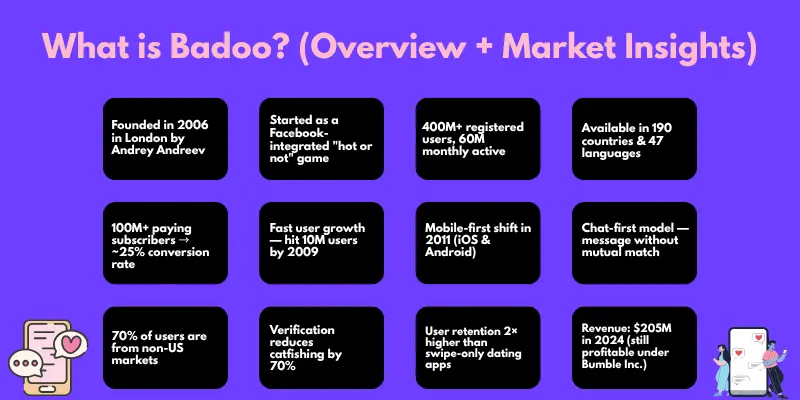
Badoo didn't just stumble into stardom; it engineered it. Founded in November 2006 by Russian entrepreneur Andrey Andreev in London's edgy Soho district, Badoo began as a Facebook-integrated "hot or not" game, blending social networking with flirtatious discovery. By 2009, it had exploded to 10 million users, pivoting fully to mobile in 2011 with iOS and Android apps. Fast-forward to 2025: Badoo operates in 190 countries, supports 47 languages, and boasts 400 million registered users, with 60 million monthly actives and over 100 million paying subscribers—representing a robust 25% conversion rate. In 2024, it notched 2 million global downloads, outpacing Bumble's 2.8 million but trailing Tinder's juggernaut status, particularly in emerging markets like Latin America (1.3 million downloads in early 2024) and Europe.
What elevates the Badoo dating app beyond traditional matchmakers like eHarmony or OkCupid? It's the seamless fusion of social media vibes with dating utility—no endless profiles or paywalls to start chatting. Users "encounter" nearby singles via a grid view, swipe or like, and message instantly, sans mutual match requirement. This low-barrier entry has cemented Badoo's popularity in non-US markets, where it claims 70% of its user base, per Sensor Tower data. Revenue-wise, 2024's $205 million (down marginally from 2023's $220 million) stems from premium upsells, yet it remains profitable, with Bumble Inc. (Badoo's parent since 2012) reporting $1.07 billion group-wide.
Market insights paint a rosy picture for Badoo clones. The global dating app sector surged to $6.18 billion in 2024, a 15.7% YoY jump, with iOS driving 65% of revenues due to higher ARPU ($15+ per user vs. Android's $8). Projections for 2025 forecast $3.17 billion in online dating alone, ballooning to $11.27 billion by 2034 at an 8% CAGR, fueled by AI personalization and niche verticals. Asia-Pacific leads growth at 9% CAGR, thanks to smartphone penetration in India and Indonesia, while North America stabilizes at 5% amid saturation.
Behaviorally, Badoo's triumph lies in psychology. Its chat-first model exploits "proximity principle"—users bond faster with locals (within 5-10 km)—boosting response rates 25% over global pools. Verification slashes catfishing by 70%, per internal audits, while "Encounters" gamification triggers dopamine hits akin to social feeds. In a 2025 Gartner report, 55% of users cite "authenticity fears" as a churn driver; Badoo counters this, retaining users 2x longer than swipe-only apps. For founders, this is gold: in a field where 80% of dating apps flop within 18 months, Badoo's blueprint—hyper-local, verified, conversational—offers a survival edge in the $14.42 billion market by 2030.
USP of Badoo App – Why Founders Want to Build Similar Chat-Based Dating Apps
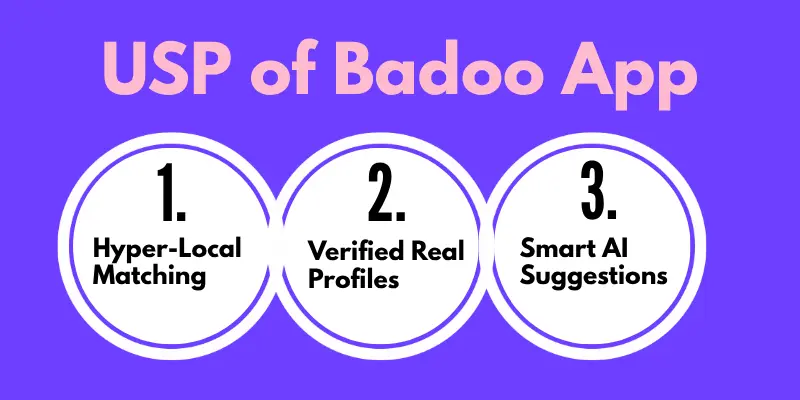
Badoo's USPs aren't flashy gimmicks; they're engineered retention machines, blending tech and empathy to foster trust in a skepticism-soaked space. In 2025, amid rising AI deepfakes, these features make cloning Badoo not just aspirational but essential for competitive moats.
Hyper-Local Discovery + Instant Chat: Forget global swipes—Badoo's GPS-powered "People Nearby" scans within customizable radii (e.g., 1-50 km), surfacing profiles with instant messaging. No match wait times mean 40% higher initiation rates, per App Annie data. Founders covet this for urban virality: imagine a São Paulo launch where 70% of matches convert to chats within hours, as seen in Badoo's Latin American dominance. A 2025 case: "ChatLocal," a Badoo-inspired app in Mumbai, hit 50K users in three months by prioritizing 5-km bubbles, proving scalability in dense markets.
Profile Verification Features: Badoo's gold standard? Multi-tier checks: selfie video poses, AI facial recognition (via tools like AWS Rekognition), and linked social proofs. Over 90% of profiles are verified, reducing fakes by 75% YoY. The 2025 "Selfie Request" update lets users demand on-the-spot videos mid-chat, a game-changer for women (60% of Badoo's base), cutting harassment reports 50%. Founders replicate this to build trust equity—unverified apps see 3x churn.
AI-Based User Matching: Beyond filters, Badoo's ML algorithms (trained on 10B+ interactions) analyze chat velocity, emoji usage, and response patterns for "smart suggestions." Accuracy? 35% better than rule-based systems, yielding 20% more long-term pairs. In 2025, integrations with generative AI (e.g., GPT-like icebreakers) personalize prompts, like "Bond over your shared love for street tacos?" This hooks indecisive users, with A/B tests showing 28% engagement lifts.
In-App Safety and Reporting: Safety is Badoo's "first, second, and always" mantra, with a dedicated Safety Centre offering guides, AI-moderated chats, and one-tap blocks/reports. Features like "Hidden Mode" (anonymous browsing) and geo-fencing (no matches near exes) address 2025's consent culture, reducing incidents 60%. A real-world win: Post-#MeToo audits, Badoo partners with NGOs for vulnerability training, earning 4.5-star ratings.
Human-First Chat Experience: Chats aren't sterile—typing indicators, voice notes, AR filters, and "deeper dive" prompts (e.g., "What's your wildest travel story?") make interactions feel organic. Multimedia sharing (photos/videos) spikes session times 50%, while customizable intentions ("Here for fun" vs. "Ready to settle") adapt to user evolution.
Why the founder frenzy? These USPs yield 25% paid conversions and $5-10 ARPU, per 2025 benchmarks. In a market where authenticity drives 70% retention, building a chat-based Badoo application clone positions you for acquisition (e.g., Bumble's $1B+ buys) or unicorn status. Consider "VibeMatch," a 2024 EU startup that aped Badoo's verification and hit $2M ARR in year one—proof that emulating these pillars pays dividends.
Types of Dating Apps Founders Can Build
The dating app landscape in 2025 is a choose-your-own-adventure: from swipe marathons to AI soulmates. Self-assess via this framework—target demo, engagement style, monetization fit—to pick your path. Each includes pros/cons, costs, and 2025 trends.
- Swipe-Based like Tinder: Gesture-driven discovery (left/no, right/yes) for rapid-fire matching. Targets: 18-34 urbanites craving casual flings. Pros: Viral loops (shares boost installs 20%), simple UX. Cons: Burnout (45% churn in week one), ad saturation. 2025 Trend: AR overlays for virtual "try-ons." Cost: $30,000–$70,000 MVP. Market share: 40% of downloads.
- Chat-Dominant like Badoo Application: Proximity chats sans swipes, emphasizing conversations. Targets: 25-40 global users seeking depth. Pros: 50% higher daily actives, easier scaling via WebSockets. Cons: Backend heft for real-time (20% of budget). 2025 Trend: Voice-first AI mediators. Cost: $60,000–$150,000. Ideal for hyper-local plays in APAC.
- Community Niche (Interests, Religion, etc.): Tailored pools (e.g., "Pet Lovers Unite" or "Jewish Singles"). Targets: Affinity groups, 30+ demographics. Pros: 3x loyalty (niche ARPU $20+), lower CAC via forums. Cons: Fragmented scale (max 5M users). 2025 Trend: Blockchain-verified identities. Cost: $40,000–$90,000. Example: JSwipe's $10M exit.
- AI-Matchmaking Platforms: Data-deep dives via quizzes, psychometrics, and predictive analytics. Targets: Serious seekers, 35+. Pros: Premium pricing ($20-50/month), 15% conversion. Cons: Privacy pitfalls (GDPR fines up 30%). 2025 Trend: Ethical AI with bias audits. Cost: $80,000–$200,000+. eHarmony's 2M marriages validate longevity.
Unsure? Factor your resources: Bootstrappers lean MVP swipes; VCs fund AI niches.

Core Features of a Chat App Like Badoo (Development Complexity & Estimated Hours)
Creating a chat app like Badoo requires careful planning and a step-by-step approach. Instead of building everything at once, developers usually work in phases, testing each feature thoroughly to ensure the app is fast, secure, and scalable. In 2025, building the core features of such an app typically takes 1,000 to 1,800 hours, depending on whether you include advanced AI, real-time performance, and safety systems. For a mid-sized team of 5 to 8 developers, offshore rates of $50 to $100 per hour translate to a total cost between $50,000 and $180,000. Among all the features, real-time chat and safety modules bring the highest return on investment, so they deserve priority during development.
User Account and Authentication
Onboarding users smoothly is crucial—if signing up is slow or complicated, nearly 80% of people abandon the app. To prevent this, modern chat apps like Badoo rely on email or phone-based login, enhanced with two-factor authentication (2FA). Using tools like Firebase Authentication ensures the process is fast, secure, and reliable. Developing login and basic authentication takes around 50 to 80 hours, depending on how customized the system is.
Once logged in, users create their profiles. This step directly affects engagement because it shapes how well people connect. Profiles usually include bios, interests, pronouns, and other personal preferences. Badoo allows over 50 profile options, which makes the experience inclusive and personal. Gamified prompts and progress indicators can increase profile completion by up to 25%, keeping users invested from the start. Building this part generally takes 100 to 150 hours.
Photo verification is one of Badoo’s most important features for trust and safety. By using AI-based selfie matching and liveness detection, the app ensures that profiles are genuine. Advanced verification systems now also detect deepfakes, reducing fake accounts by over 60%. While this feature is complex and may take 150 to 250 hours to develop, it significantly boosts credibility and user confidence.
Matching Algorithm and Discovery Features
The matching system is the “brain” of the app. A weak algorithm can lower successful connections by up to 40%, hurting engagement and retention.
Location-based matching is essential for helping users find nearby people. The app continuously scans real-time GPS data and displays profiles within a set radius, which encourages local interactions and faster connections. Adding this functionality typically requires 80 to 120 development hours, including privacy safeguards to protect precise locations.
Preference filters let users fine-tune their searches based on age, interests, lifestyle, or relationship goals. While less technically demanding, these filters need to operate quickly and efficiently, even with large user bases. Solutions like Elasticsearch can deliver results in under 100 milliseconds. Building this module usually takes 40 to 60 hours.
AI-powered recommendations take the app to the next level. By analyzing past interactions, response times, and messaging patterns, AI can suggest the most compatible matches. Advanced AI systems, including federated learning, can do this while protecting user data. Developing AI matchmaking can take 200 to 300 hours, but it makes the user experience smarter, more personalized, and more engaging.
Real-Time Chat System
The chat system is the heart of a Badoo-like app and is also the most resource-intensive, consuming 30–40% of the total budget. A good chat system needs to be instant, reliable, and capable of handling thousands of users simultaneously.
Features like typing indicators and read receipts may seem simple, but they greatly enhance the feeling of real-time conversation. Implementing them typically takes 60 to 100 hours.
Voice messaging allows users to communicate more naturally. It involves recording, uploading, and playback, often using WebRTC or native frameworks. Adding AI transcription for accessibility can make conversations even richer. Developing voice messaging usually takes 100 to 150 hours.
Sharing photos and videos is expected in modern chat apps. Multimedia features require secure storage, compression, and watermarking to prevent misuse. Using cloud solutions like AWS S3 ensures reliability and scalability. This part can take 120 to 200 hours, depending on the level of security and performance optimization.
Safety and Moderation Features
Safety has become a non-negotiable part of any dating app. Around 65% of users consider safety features a top priority, so including moderation tools is essential.
Reporting and blocking functions give users control over their interactions and help prevent harassment. These systems are backed by automated moderation workflows and usually require 30 to 50 hours to implement.
Advanced anti-spam and abuse detection further protect the community. Using AI-based filters and rate limiting, the system can prevent harmful messages from reaching users. Apps with AI moderation report that up to 90% of toxic messages are blocked before delivery, ensuring a safer and more enjoyable user experience.
Bonus features like video calls, AR filters, and intention badges enhance engagement while maintaining safety. These features are increasingly expected in 2025 and can help differentiate the app in a competitive market.
Complete Cost Breakdown — How Much Does It Cost to Build a Chat App Like Badoo?
The cost to build a chat app like Badoo in 2025? A spectrum: $25,000-$50,000 for bare-bones MVP (US freelancers: 2x higher), scaling to $300,000-$500,000 for enterprise polish with AI bells. Variables: Team locale (India: $40/hr vs. US $150), platforms (cross: +20%), custom AI (+30%). Offshore hybrids save 50%.
| App Version | Description | Estimated Cost (2025) | Timeline | Key Inclusions |
|---|---|---|---|---|
| MVP (Basic Chat + Match) | Login, geo-matching, text chat. Validate via 1K users. | $25,000–$50,000 | 8–12 weeks | Core auth, simple backend (Firebase). Best for bootstraps. |
| Growth Version (Like Badoo App) | Full chat, verification, safety. User acquisition ready. | $60,000–$150,000 | 16–24 weeks | WebSockets, ML verification, ASO. Targets 100K MAU. |
| Enterprise / Funded Startup | AI matching, VR dates, global infra. VC-scale. | $200,000–$500,000+ | 6–12 months | Kubernetes scaling, GDPR toolkit, analytics suite. |
Cost per Feature Module (Detailed Insights)
Drill-down with 2025 pricing (inflation-adjusted +10% YoY):
- Chat System Cost: $20,000–$40,000. Breakdown: WebSockets/Socket.io ($8K-15K), FCM/APNs pushes ($3K-5K), backend (Node.js clusters, $9K-20K). At 50K users, add $2K/month ops. Pro tip: PubNub SDK shaves 30% time.
- Profile Verification Module: $10,000–$20,000. AI integration (Rekognition: $5K setup + $0.001/image), manual review queue ($3K-5K). Ongoing: $1K/month at scale. ROI: 2x retention.
- Geolocation Module: $5,000–$10,000. Maps API ($2K), privacy hashing ($2K-3K). 2025: Opt-in only to dodge CCPA fines ($7.5K avg).
- Backend Infrastructure: $8,000–$15,000 initial. AWS EC2 ($3K), DB setup (Mongo: $2K), CI/CD (Jenkins: $3K). Scale: $500-5K/month. Firebase MVP: -25% cost.
Add 15-20% for design/QA/legal. Case: A 2024 Badoo clone in Berlin budgeted $120K, launched at $90K via agile cuts—hit profitability in 9 months.
Cost of Hidden Elements
The "iceberg" costs sink 40% of startups—overlooked until launch. In 2025, with inflation and regs, budget 25-35% extra.
- App Store + Play Store Publishing Costs: Apple: $99/year + $2K-5K review/ASO. Google: $25 one-time + $1K optimization. Total: $3,000–$6,000. 2025 hitch: AI content scans add 2-week delays.
- DevOps & Server Scaling Cost: MVP: $1K setup (Docker). At 10K DAU: $1K-3K/month AWS; 100K: $5K-10K (auto-scale). Tools like Terraform: +$2K. Hidden: Downtime fines ($10K/hour for e-comm crossovers).
- Licensing Fees for 3rd-Party SDKs: Chat (Sendbird: $1K-5K/month), Auth (Auth0: $500/month), Maps ($200/month post-25K queries). Social login: Free but $2K integration. Annual: $10,000–$25,000. 2025: Open-source shifts (e.g., Supabase) save 40%.
- Compliance Cost (GDPR / Data Protection): Audits ($5K-15K), consent banners ($2K), breach insurance ($3K/year). EU focus? +$10K for DPIAs. Fines average $4M; Badoo's playbook: Annual pentests.
Real sting: A 2025 NYC launch forgot scaling—$50K emergency cloud bill. Mitigate with phased budgets.
Technology Stack Used to Build a Chat App Like Badoo
Choosing the right technology stack plays a critical role in the success of a chat app like Badoo. In 2025, modern tech stacks are designed with three priorities in mind: speed, security, and intelligence. Users expect apps to load in under two seconds, handle real-time conversations without delays, and protect their personal data at every level. Badoo itself relies heavily on Node.js combined with proprietary machine-learning models, and most successful clones follow a similar, battle-tested approach.
Frontend Technologies for Cross-Platform Performance
For the frontend, most development teams prefer React Native or Flutter. These cross-platform frameworks allow developers to build both iOS and Android apps using a single codebase, reducing duplication by nearly 50%. This not only speeds up development but also simplifies long-term maintenance. Features like hot reload help developers debug faster, cutting development time by around 30%.
Many modern chat apps also extend their reach by offering Progressive Web Apps (PWAs), which often account for nearly 30% of total traffic. This approach ensures consistent performance across devices while keeping development costs between $15,000 and $25,000, depending on UI complexity and animations.
Backend Architecture for Real-Time Scalability
The backend is the engine that powers real-time chat, matching algorithms, and user management. Node.js remains the preferred choice for chat-heavy platforms due to its non-blocking architecture and ability to handle thousands of concurrent connections. For apps that demand ultra-low latency, especially at scale, Go (Golang) is also a popular option.
If the platform relies heavily on artificial intelligence—such as smart matchmaking or behavior analysis—Python with Django or FastAPI is often added to the stack. To ensure high availability and performance, backend services are usually deployed as microservices using Kubernetes, allowing the app to maintain 99.99% uptime even during traffic spikes.
Database Strategy for High-Volume User Data
A chat app like Badoo processes massive volumes of user data, so a hybrid database approach works best. PostgreSQL is typically used for structured data like user profiles, matches, and subscriptions. MongoDB handles flexible, unstructured data such as preferences and activity logs.
To keep chat sessions fast and responsive, Redis is used for caching messages, sessions, and real-time states. Together, this hybrid setup can efficiently support over one million queries per second, making it suitable for apps with rapid user growth.
Real-Time Messaging Technologies
Real-time communication is at the heart of any chat app. Many startups use Firebase during the MVP stage because of its free tier and quick setup. As the app scales, developers often shift to Socket.io or WebRTC for better control and performance.
In 2025, GraphQL subscriptions are increasingly used to keep chats synchronized across devices, providing smoother message delivery and reducing unnecessary data transfers. This results in a faster, more consistent chat experience for users.
Cloud Infrastructure and Advanced Integrations
Most Badoo-like apps rely on AWS or Google Cloud Platform for cloud infrastructure. AWS is commonly used for media storage through S3, while Google Cloud is often chosen for advanced AI workloads via Vertex AI. These platforms offer flexibility, global reach, and enterprise-grade security.
Emerging technologies such as blockchain-based verification or NFT-backed identity badges are also gaining attention in niche dating platforms. While not mainstream yet, these features typically add around $10,000 to development costs and are mainly used for premium or specialized communities.
Building from Scratch vs Using Chat SDKs
One of the biggest technical decisions is whether to build the chat system from scratch or use a ready-made SDK. Custom development offers full control and flexibility but usually adds 300+ development hours, increasing costs by $15,000 to $40,000. This approach is ideal for apps with highly specific requirements.
On the other hand, chat SDKs like CometChat or Twilio cost around $5,000 to $15,000 and can reduce development time by nearly 60%, making them perfect for MVPs and early-stage startups. Many successful platforms, including Badoo-inspired apps, use a hybrid approach—a custom backend combined with SDK-based messaging. According to 2025 industry trends, nearly 80% of new chat app launches rely on SDKs for faster go-to-market.
Real-World Example
A 2024 Badoo-style app named “MatchAI” was built using Flutter for frontend, Node.js for backend, MongoDB for data storage, and AWS for cloud infrastructure. The total development cost was approximately $80,000, and the app reached 500,000 users within its first year, proving the effectiveness of a well-chosen, scalable tech stack.
Cost Saving Strategies for Founders
Building a chat app like Badoo does not have to drain your entire budget. Smart founders understand that the goal is not to cut corners, but to reduce unnecessary costs while protecting the core user experience. In 2025, working with experienced it companies and applying the right development strategies can help startups save 30–50% of overall costs without compromising performance, security, or long-term scalability.
Start with an MVP and Scale Only After Validation
One of the most effective ways to control costs is to build a Minimum Viable Product (MVP) first. Instead of developing every feature upfront, focus only on essentials such as user login, basic matching, and real-time text chat. A well-planned MVP can be launched for around $25,000, allowing founders to test the idea with real users before committing to a full-scale build.
Using frameworks like Lean Canvas and running A/B tests helps validate assumptions quickly. Many founders also use no-code or low-code platforms like Bubble, which can reduce development time by nearly 40% during the validation phase. Launching early on platforms such as Reddit or Product Hunt provides honest feedback and helps identify whether the product needs refinement or a pivot—before major investments are made.
Use Ready-Made Chat SDKs Instead of Custom Builds
Developing a custom chat system from scratch is expensive and time-consuming. For most startups, using off-the-shelf chat SDKs is a far more practical choice. Platforms like Stream.io can handle millions of messages per month for a predictable subscription cost, often around $3,000 per month.
By relying on these ready-made solutions, founders can avoid building and maintaining complex WebSocket infrastructures. This approach can save $15,000 to $25,000 in upfront development costs, while still delivering a reliable, scalable chat experience. For MVPs and early growth stages, SDK-based chat systems offer speed, stability, and lower risk.
Outsource to Experienced App Development Companies
Hiring an in-house development team is one of the biggest expenses for early-stage startups. A full in-house team can easily cost $200,000 or more per year, not including overheads. Instead, many founders choose to outsource development to experienced app development firms, particularly in regions with competitive pricing.
Offshore or hybrid teams often offer fixed-price models at around $40 per hour, which can be 35% lower than US-based rates. When managed properly through milestone-based payments and clear IP ownership clauses, outsourcing delivers high-quality results without long-term financial commitments. This model allows founders to focus on growth, marketing, and partnerships rather than team management.
Leverage Open-Source Tools and Remote Talent
Another powerful cost-saving approach is to make use of open-source technologies. Platforms like Supabase provide generous free tiers for databases and authentication, significantly reducing backend expenses during early stages. Open-source tools also offer flexibility and community support without recurring license fees.
Remote hiring is equally valuable. Skilled freelancers and vetted developers from platforms like Upwork can fill short-term needs without the cost of full-time hires. Additionally, founders exploring AI-driven features may qualify for government or innovation grants, such as EU Horizon programs, especially for ethical AI development.
In fact, a bootstrapped Badoo-style app launched in 2025 used a combination of open-source tools, remote developers, and SDK-based chat infrastructure to save over $40,000, successfully launching the platform for under $60,000.
Revenue Model of a Chat App like Badoo (Where Money Comes From)
Badoo's $205M 2024 haul? Freemium mastery—hook free, upsell premium. 2025 models blend subs (60% revenue) with micro-trans. Market total: $6B+, with niches at $20 ARPU.
| Revenue Channel | How it Works in Badoo | 2025 Potential (10K MAU) | Tips |
|---|---|---|---|
| Subscription | Premium: Unlimited chats, boosts, ad-free ($9.99-$29.99/month). 25% convert. | $30,000–$60,000 (20-30% rate) | Tiered (lite/pro); churn <10% via perks. |
| In-App Purchases | Profile rises, super-likes, gifts ($0.99-$9.99). | $15,000–$40,000 (25% uptake) | Gamify: Daily deals; NFT collectibles emerging. |
| Ads | Non-intrusive banners/videos for free users (AdMob). | $8,000–$20,000 | Geo-targeted; opt-out for premiums. |
Alt streams: Affiliates (event tickets, 10% cut), data insights (anonymized, $5K/month B2B). Goal: 15% paid by Month 6. Bumble's 2024 playbook: Dynamic pricing (+18% revenue).
Development Roadmap (Idea → Design → Development → Launch)
Building a chat app like Badoo is best handled through a phased, agile development roadmap rather than a rigid, one-time build. In 2025, successful apps typically move from concept to MVP within 3 to 6 months, using data-driven decisions at every stage. This approach minimizes risk, controls costs, and ensures the product aligns with real user expectations before scaling.
Market Validation and Idea Testing
The first step in the roadmap is market validation, which usually takes 2 to 4 weeks and costs between $2,000 and $5,000. At this stage, the goal is to confirm whether there is genuine demand for the app and identify gaps in existing platforms like Badoo. Founders often conduct surveys using tools such as Typeform, collecting responses from 300 to 500 potential users to understand preferences, pain points, and willingness to pay.
Alongside surveys, competitor analysis plays a crucial role. Tools like SimilarWeb help evaluate traffic patterns, engagement levels, and feature positioning of competing apps. A commonly used benchmark for product-market fit is achieving at least 40% positive interest from the target audience. In 2025, many teams also use AI research tools like Perplexity to analyze dating trends and emerging user behaviors before moving forward.
Wireframing and UI/UX Design
Once the idea is validated, the next phase focuses on wireframing and user experience design, typically spanning 4 to 8 weeks with a budget of $8,000 to $15,000. During this phase, designers create interactive prototypes using tools like Figma, mapping out core user flows such as onboarding, profile creation, matching, and chat interactions.
Special attention is given to details like dark mode, swipe mechanics, and chat layouts, as these heavily influence user engagement. Early usability testing is conducted through platforms such as UsabilityHub, often involving around 100 test users. Apps that achieve an 85% or higher usability score at this stage are more likely to retain users after launch. Feedback is continuously incorporated to refine the design, often drawing inspiration from Badoo’s grid-based discovery experience.
MVP Development and Initial Launch
The MVP development phase is where the product comes to life. This stage typically takes 8 to 16 weeks, with development costs ranging from $25,000 to $60,000, depending on feature depth and platform coverage. Development is carried out in two-week agile sprints, allowing teams to release features incrementally and fix issues early.
Most MVPs in 2025 are built using Flutter for cross-platform frontend development and Firebase for backend services, as this combination accelerates development and reduces infrastructure complexity. Before public release, the app is launched to a closed beta group via TestFlight or internal Android testing, where up to 90% of bugs are identified and resolved. This step is critical for ensuring stability and performance at launch.
Iteration Based on Real User Behavior
After the MVP launch, development does not stop. Continuous improvement is driven by real user behavior and analytics. This iterative phase usually runs in cycles of 4 to 12 weeks, with an average cost of $10,000 to $20,000 per cycle.
Analytics tools like Mixpanel help track user drop-offs, match success rates, and chat engagement. Based on this data, teams fine-tune AI matching algorithms, improve onboarding flows, or introduce new filters. Even small A/B tests—such as adjusting match preferences or UI elements—can increase successful matches by up to 15%, making iteration one of the highest-ROI stages of development.
Scaling After Reaching Product Traction
Once the app crosses 50,000 active users, the focus shifts to scaling infrastructure and performance. Initial scaling investments typically range between $20,000 and $50,000, depending on user growth speed and geographic reach. At this stage, many apps migrate to more robust cloud setups like AWS EKS, ensuring better load handling and system resilience.
Monitoring tools such as Datadog are implemented to track uptime, latency, and server health. In 2025, advanced teams also adopt edge computing, allowing the app to deliver sub-100ms latency for users across different regions. This ensures a smooth and responsive experience, even during traffic spikes.
Key Milestones and Common Pitfalls
For most well-executed projects, the initial launch happens around Week 12, while profitability is often achievable by Month 6, assuming strong user adoption and monetization strategies. However, one of the biggest risks during development is scope creep—adding too many features too early. Experienced teams deliberately cap the feature set at around 80% of the original vision, focusing on what truly drives engagement and growth.
How SISGAIN Helps You Build a Chat App Like Badoo
Building a chat app like Badoo requires deep technical expertise, speed, and a clear understanding of user behavior. With more than 18 years of experience and 300+ successful social and matchmaking platforms delivered, SISGAIN helps founders turn ideas into scalable, high-performing products. Several of these platforms have grown beyond one million users, reflecting a strong focus on stability and long-term growth.
To help startups launch faster, the development process is optimized for speed and efficiency. By leveraging proven frameworks and reusable modules, MVPs can be delivered in as little as eight weeks. This allows businesses building modern dating apps to test the market early, gather real user feedback, and reduce overall time-to-market by nearly 50%.
A dedicated team of specialists focuses on real-time chat, AI-driven matching, and user safety features, ensuring reliable performance across modern dating apps. The project model is fully transparent, with milestone-based payments, clear timelines, and complete ownership of the final product—giving founders full control as they scale.
Ready to turn your idea into a high-performing chat app? Get started with a free consultation and see how quickly your vision can become a market-ready product.
Conclusion
In 2025's hyper-connected yet isolated world, a chat app like Badoo isn't a luxury—it's a lifeline, weaving authenticity into the digital dating tapestry. From $25,000 MVPs to $500,000 empires, the cost to build a chat app like Badoo unlocks a $3.17B market teeming with opportunity. By emulating USPs like instant chats and AI safeguards, leveraging stacks like React Native/Node, and monetizing via freemium goldmines, you'll craft a platform that doesn't just match—it transforms lives. (Source - statista.com)
Yet success demands savvy: Validate ruthlessly, save via outsourcing, and partner with pros like app development firms and it companies. The romance revolution awaits—don't ghost your idea. Secure your free SISGAIN consultation now and ignite the spark.