APP OF THE MONTH
Talabat, Simplifying Food, Grocery And Everyday Delivery Across The UAE And MENA — App of the Month | SISGAIN
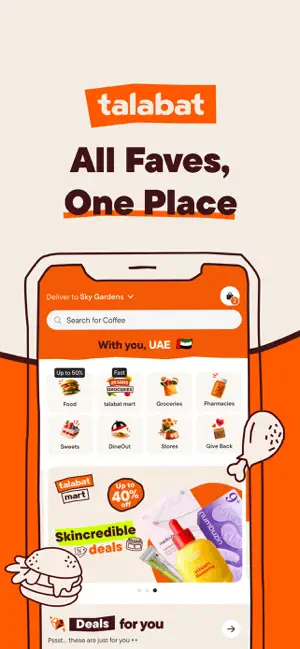
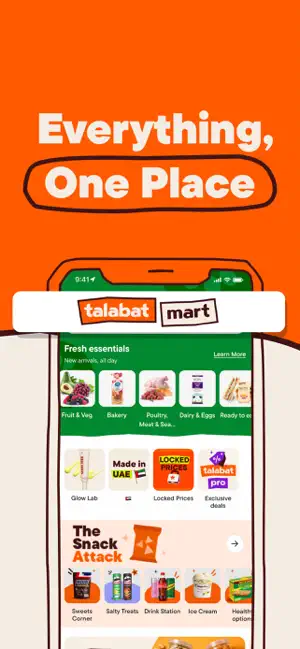
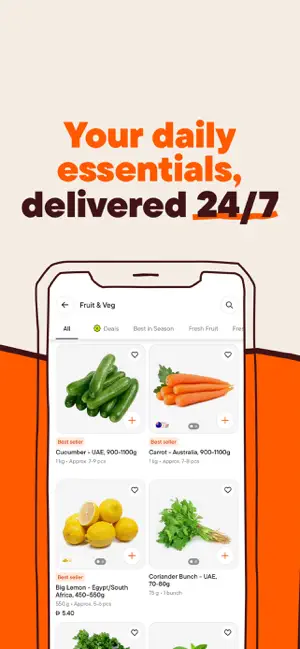
Talabat is the leading on-demand delivery app in the Middle East and North Africa, giving customers restaurant meals, groceries, pharmacy and retail items in one place. By combining food delivery, its own talabat mart dark stores and the talabat pro subscription in an app millions use daily, it turns everyday ordering into a few taps.
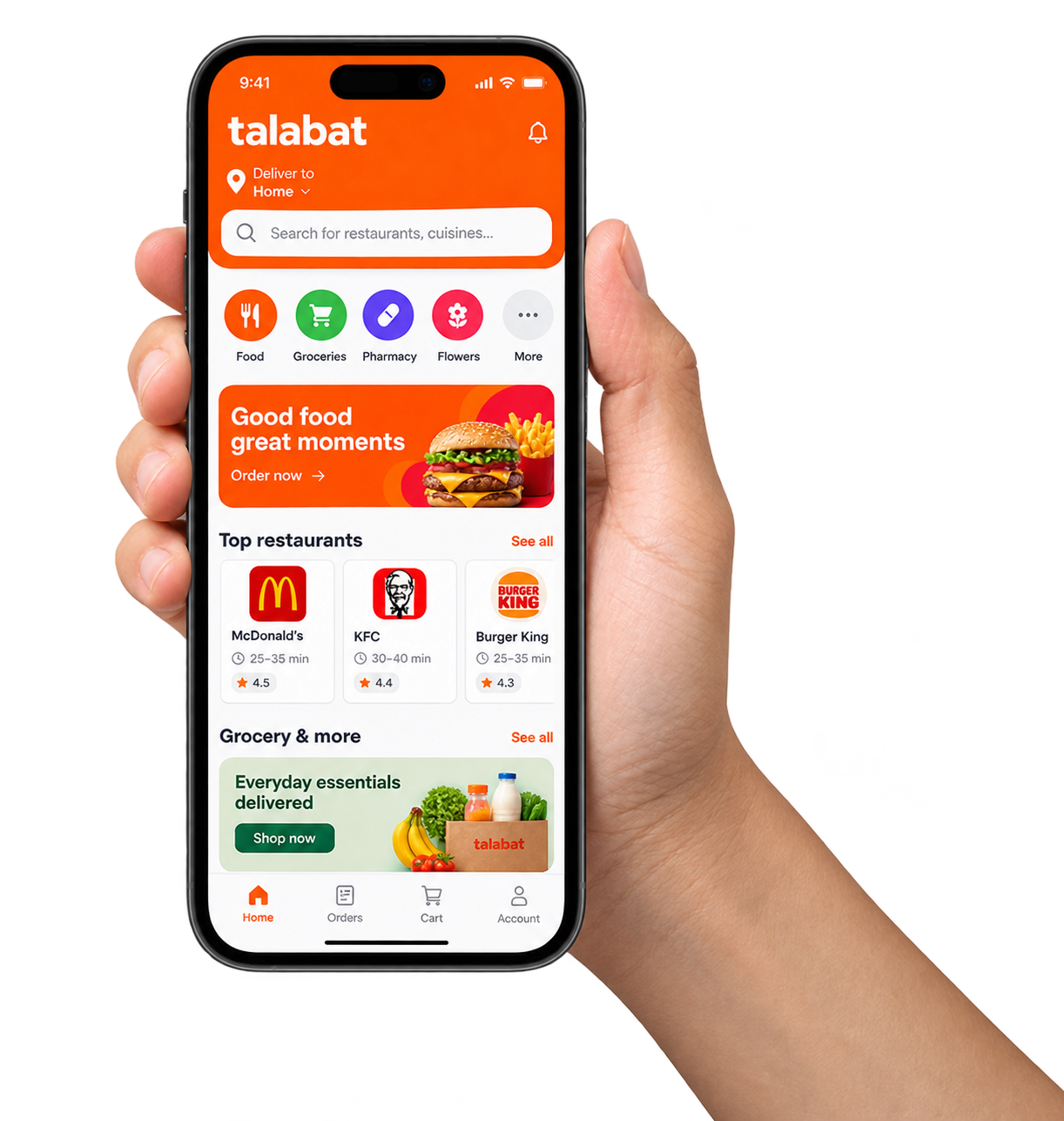
Product snapshot
-

8 markets
talabat operates in the UAE, Kuwait, Qatar, Bahrain, Oman, Jordan, Iraq and Egypt.
-

4.6 / 5
iOS App Store rating for the talabat app, based on roughly 295K ratings.
-

$5.6B GMV
Gross merchandise value in the first half of 2026, up 15% year on year at constant currency.
-

1 in 4+
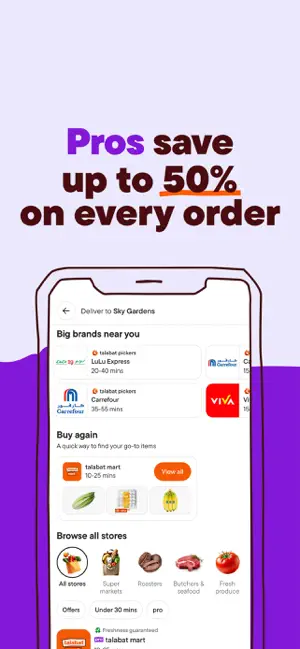
More than one in four active customers subscribe to talabat pro, which drives 51% of platform GMV.
Talabat Growth Insights: Building A Scalable Everyday Delivery App
Delivery platforms grow through connected stages: restaurant ordering brings customers, groceries and retail raise order frequency, and a subscription drives repeat usage. Explore how this growth funnel can evolve across a talabat-like delivery app over nine months.
From A Kuwaiti Food-Ordering Website To A DFM-Listed Everyday App
Talabat was founded in Kuwait in 2004 by Abdulaziz Al Loughani as a web platform for ordering food without calling the restaurant. After being acquired by Mohammed Jaffar in 2010, it grew into one of the GCC's best-known delivery brands. In 2015 Rocket Internet acquired it for a reported $170 million, and it became part of Delivery Hero, whose subsidiary it has been since 2016.
- Founded
- 2004, Kuwaitheadquartered in Dubai, UAE
- Founder
- Abdulaziz Al LoughaniToon Gyssels serves as CEO
- Platform evolution
- Restaurant ordering → Groceries & retail → talabat pro & wallet → DineOut Deals & everyday services
- Core model
- Customers ↔ talabat app ↔ Restaurants, shops, talabat mart & riders
Technology Stack For A Talabat-Like Delivery App
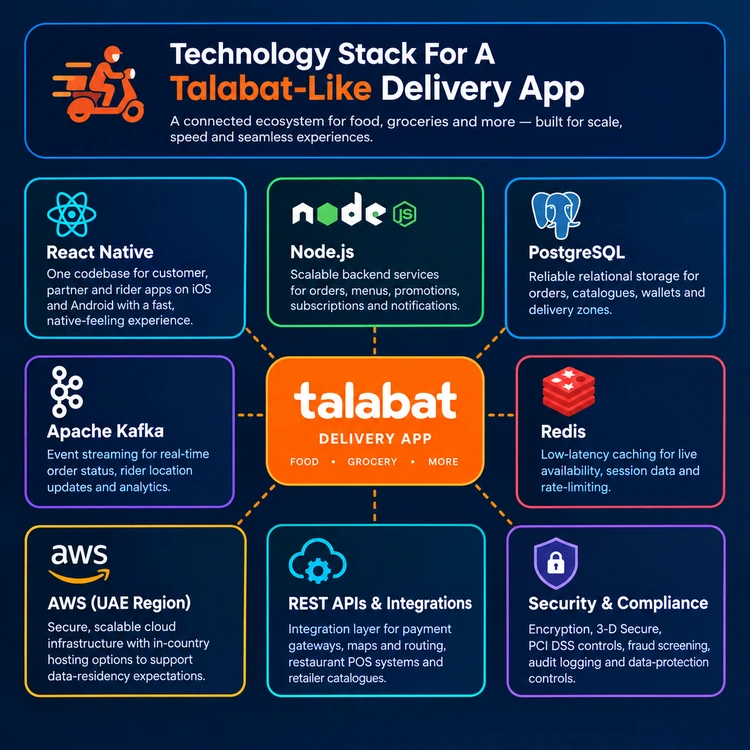
An app like talabat is more than a menu and a checkout screen. It is a connected delivery ecosystem that must handle live catalogues, dispatch, payments, promotions, subscriptions and support at scale.
-
 React Native One codebase for customer, partner and rider apps on iOS and Android with a fast, native-feeling experience.
-
 Node.js Scalable backend services for orders, menus, promotions, subscriptions and notifications.
-
 PostgreSQL Reliable relational storage for orders, catalogues, wallets and delivery zones.
-
 Apache Kafka Event streaming for real-time order status, rider location updates and analytics.
-
 Redis Low-latency caching for live availability, session data and rate-limiting.
-
 AWS Secure, scalable cloud infrastructure with in-country hosting options to support data-residency expectations.
-
 REST APIs & Integrations Integration layer for payment gateways, maps and routing, restaurant POS systems and retailer catalogues.
-
 Security & Compliance Encryption, 3-D Secure, PCI DSS controls, fraud screening, audit logging and data-protection controls.
Want To Launch A Delivery App Like Talabat? Let's Make It Happen.
From strategy to launch, we design, develop and scale delivery platforms with customer, partner and rider apps, live order tracking, grocery integration, subscriptions and in-app payments.
17+ Years of Software Engineering Experience

How Ordering And Delivery On Talabat App Works
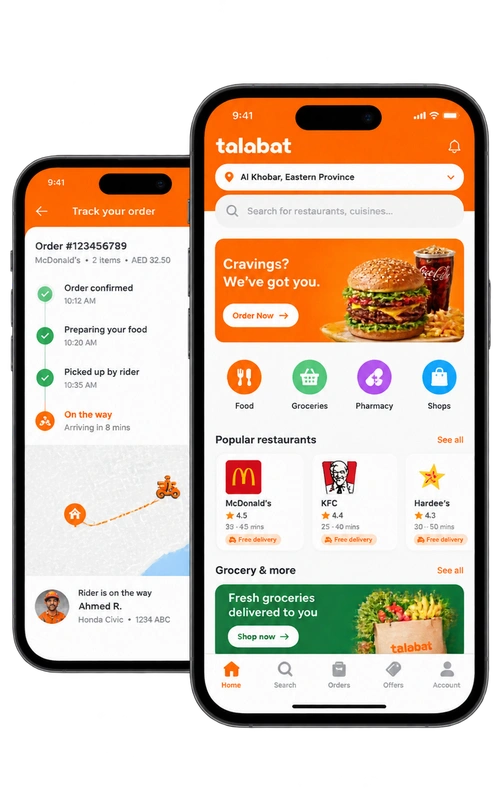
From choosing what you want to tracking it to your door, ordering on talabat takes five simple steps. Select a step to see what the user does and what the platform manages in the background.
-
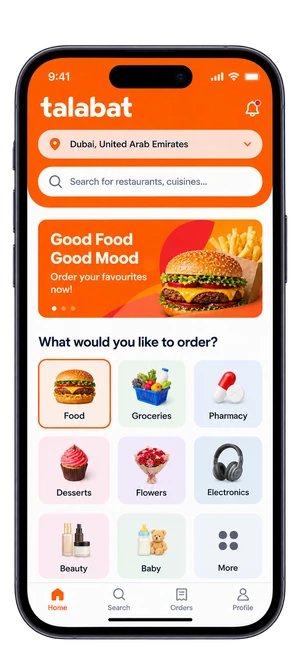
User: Opens the app, sets or confirms a delivery address (or picks one from their saved addresses) and chooses a category such as food, talabat mart groceries, shops or pharmacy. App: Shows the restaurants and stores that deliver to that address, along with the options available in that area, and keeps saved addresses ready so future orders are quicker.
-
Browses menus or aisles, searches for a dish or item, checks the details and adds the products they want to the basket, adjusting quantities as needed. App: Displays prices, delivery fees, minimum order values and estimated delivery times, and highlights available deals and talabat pro eligible partners to help users compare options and choose with confidence.
-
User: Reviews the basket and the order total, applies a voucher or talabat credit, and chooses to pay online by card (including a saved card) or in cash on delivery before confirming the order. App: Calculates the final total with any discounts, applies talabat pro free delivery on eligible orders, processes the payment securely and sends the confirmed order to the partner straight away.
-
User: Follows the order from confirmation to hand-off and receives notifications along the way, so there is no need to keep checking, and can reach out for help if something looks wrong. App: Updates the order status as the partner prepares it and the rider collects and delivers it, with the help centre available inside the app if the user has any questions about the delivery.
-
User: Receives the order, checks that everything is right and can reorder favourites in a couple of taps, or use DineOut Deals when eating out instead of ordering in. App: Stores order history, saved addresses and payment preferences so future orders are faster and more personal, and applies subscription benefits and credit to later orders.
Set Your Location & Choose A Category
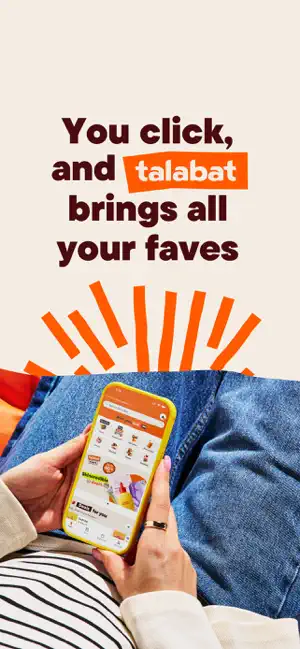
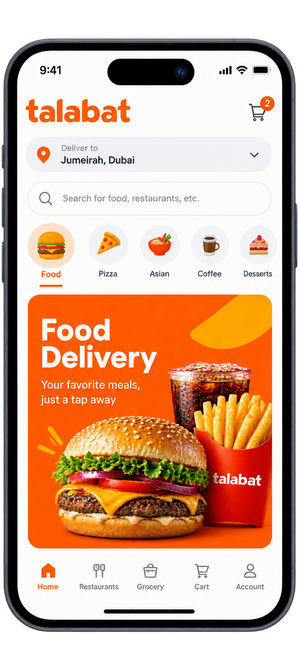
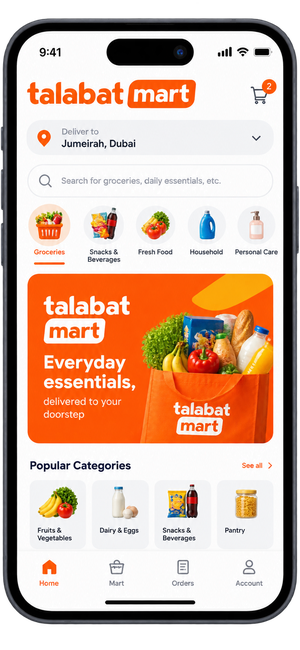
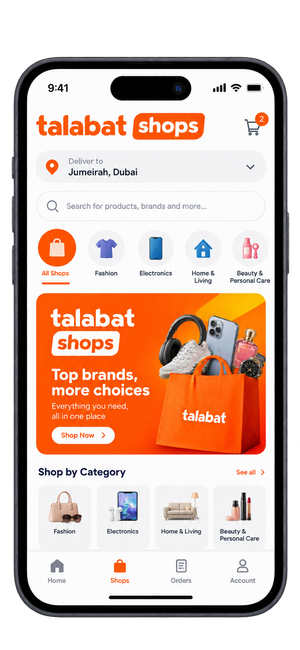
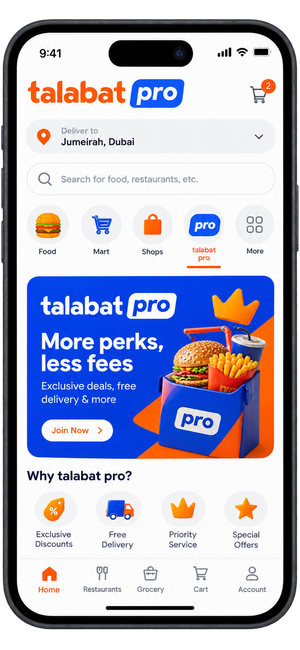
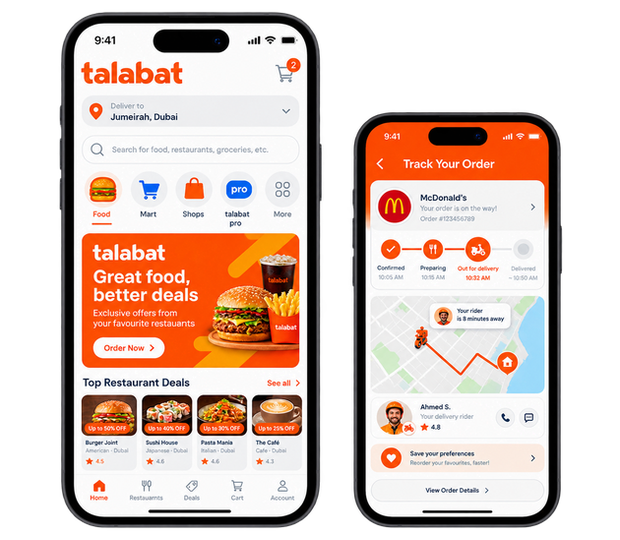
Talabat App Screens & Everyday Delivery User Experience
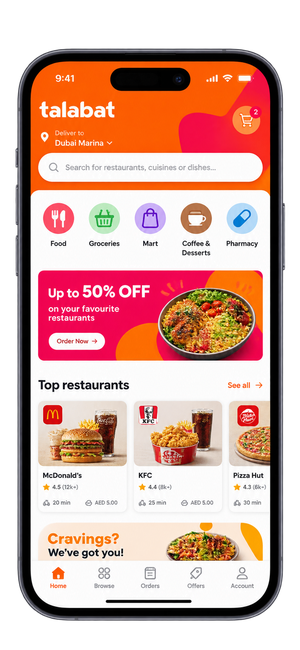
Five screens from the talabat experience. Swipe or drag to explore the user journey, from the home screen and talabat mart to talabat pro, DineOut Deals and live order tracking.
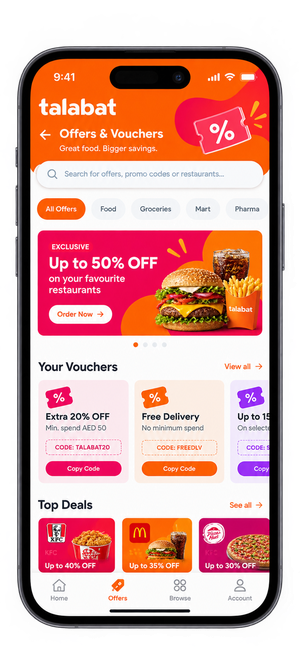
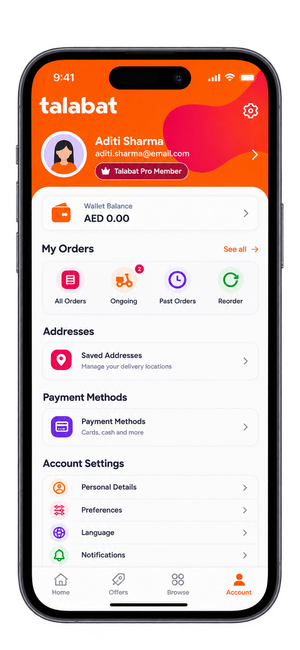
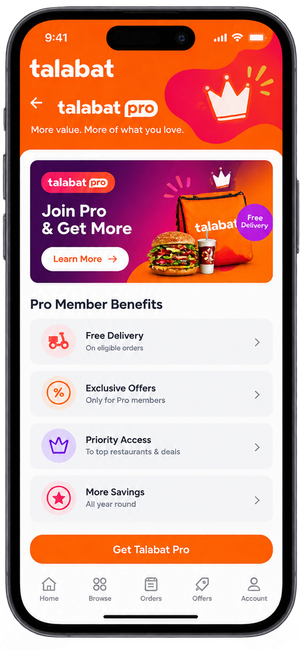
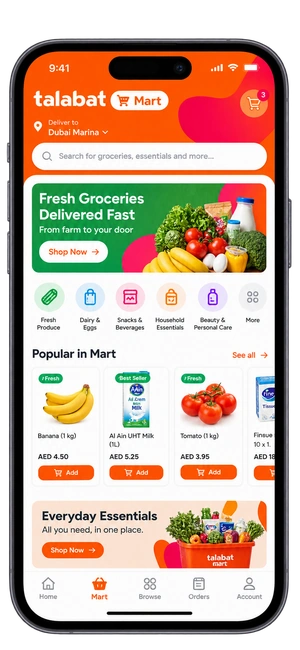
Your Cravings, One Tap Away
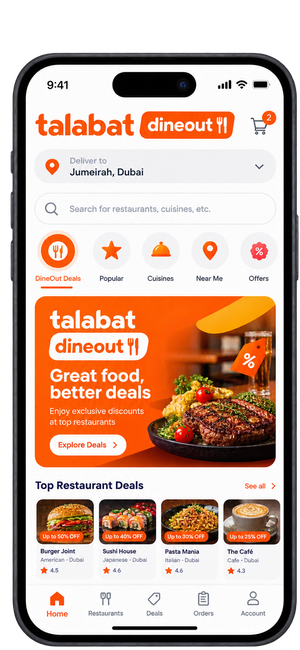
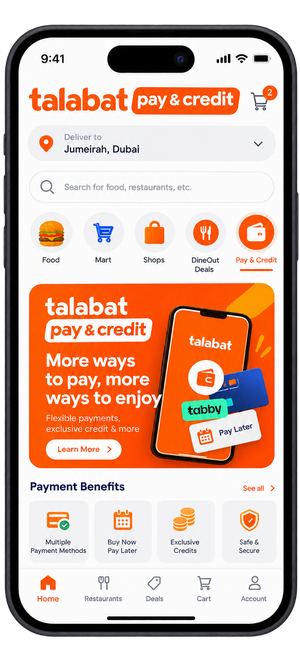
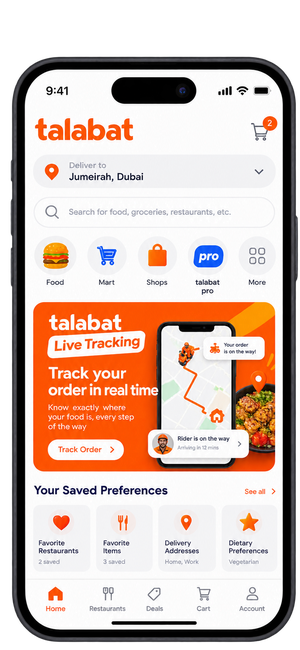
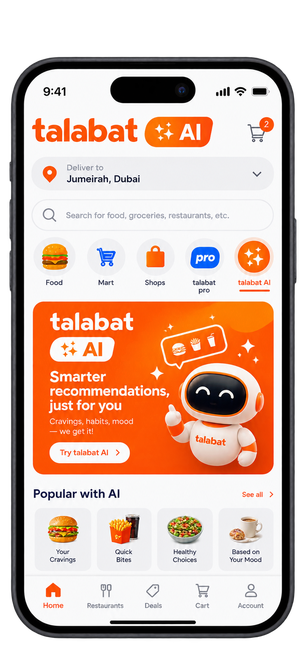
Talabat App Features For Everyday Delivery
Every part of the everyday-needs journey, from a late-night meal to a weekly grocery top-up or a discounted dinner out, is connected through one app. Select a feature to explore how it works.
From idea to launch
Planning Your Own Food & Grocery Delivery Platform? Start Here.
Our team designs, builds and scales platforms like talabat, from customer, partner and rider apps to live tracking, grocery operations, subscriptions and payments.
Popular Talabat Alternatives In UAE Food & Grocery Delivery
The UAE delivery category is competitive and fast-moving. These platforms serve food and grocery orders through different combinations of restaurant delivery, quick commerce and subscription perks.
-
Careem
Everything app
Super app with Careem Food and the Careem Quik grocery service, plus Careem Plus subscription benefits.
-
Deliveroo
Food & grocery delivery
Food and grocery delivery platform, now part of DoorDash, with a subscription option and rapid grocery service.
-
noon Food
E-commerce ecosystem
Food delivery from the noon marketplace, alongside noon Minutes for fast grocery delivery.
-
Keeta
Free-delivery challenger
Delivery platform from Meituan, launched in Dubai in 2025 with free delivery and on-time promises.
-
Amazon Now
Quick commerce
Amazon's fast-delivery service in the UAE for groceries, fresh items and essentials.





How To Develop An App Like Talabat: 10 Key Steps
Ten stages can take a delivery platform idea from validation to a scalable multi-vertical app for restaurants, groceries and subscriptions in the UAE. Scroll the timeline or use the arrows.
-
01
Research & Market Validation
Study UAE ordering habits, competitors, partner commission expectations, delivery zones and the needs of residents across emirates. -
02
Product Strategy
Define the three-sided model (customers, partners, riders), MVP scope, revenue streams (commissions, delivery fees, subscriptions, advertising) and success metrics. -
03
UX/UI Design
Map discovery, checkout and tracking journeys; design fast, bilingual (English/Arabic) interfaces for customers, partners and riders. -
04
MVP Development
Build the essentials (search, menus, basket, checkout, order tracking) to validate demand in one district before expanding. -
05
Backend & Dispatch Engine
Develop order management, rider assignment, ETA calculation, notifications and live location updates. -
06
Partner & Rider Apps
Build the partner dashboard for menus and orders, and the rider app for navigation, earnings and status. -
07
Payments, Wallet & Promotions
Integrate cards and cash on delivery, add a wallet and credit, and build vouchers, discounts and a subscription engine. -
08
Grocery & Inventory Module
Add catalogues, live stock, substitutions and dark-store workflows for quick-commerce orders. -
09
Security, Testing & QA
Test payments, edge cases, failure handling, load and security, with fraud controls and audit logs aligned to UAE data-protection requirements. -
10
Launch, Scale & Optimize
Launch, monitor delivery times and order success, then add categories, markets and loyalty features as usage grows.
New Technologies For A Smarter Talabat-Like Delivery App
A modern delivery app can go well beyond menus and tracking. By combining AI, geospatial intelligence, automation and open integrations, a talabat-like platform can improve speed, reduce cost and open new revenue streams.
-
AI & Machine Learning
- What it does
- Analyzes order history, location and time of day to rank restaurants and products.
- Why it matters
- Customers choose from thousands of options and need relevant results fast.
- How it improves the app
- Personalized home feeds, smarter search, better promotions and more accurate delivery estimates.
-
Generative AI
- What it does
- Understands natural-language requests and responds with helpful suggestions.
- Why it matters
- Shoppers often start with a goal, such as a dish to cook, rather than a product name.
- How it improves the app
- Recipe-to-basket assistants, AI support chat, order explanations and multilingual help.
-
Predictive Analytics
- What it does
- Uses historical order and rider data to forecast demand.
- Why it matters
- Demand spikes around Ramadan, weekends, weather and salary days.
- How it improves the app
- Rider supply planning, stock forecasting for dark stores, promotion timing and churn prediction.
-
Route & Dispatch Optimization
- What it does
- Matches each order with the best rider using live location, traffic and preparation time.
- Why it matters
- Delivery time is the most visible part of the experience.
- How it improves the app
- Faster deliveries, batched orders, fewer idle riders and tighter ETAs.
-
Computer Vision
- What it does
- Reads images from shelves, packages and documents.
- Why it matters
- Dark stores and partners need accurate inventory and quality control.
- How it improves the app
- Catalogue image checks, stock counting and rider document verification.
-
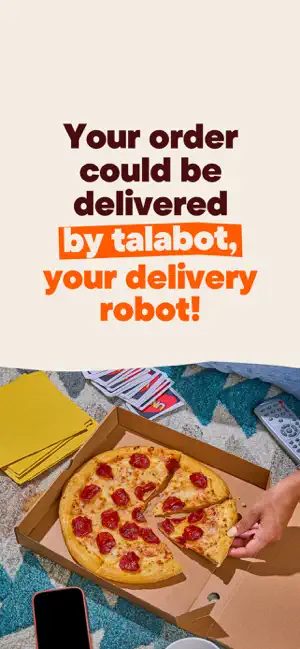
Drones & Autonomous Delivery
- What it does
- Uses drones and autonomous vehicles for selected short-range deliveries.
- Why it matters
- Congestion and rising order volumes put pressure on last-mile capacity.
- How it improves the app
- Pilot routes for lightweight orders, subject to local regulation and operator approvals.
-
Voice AI
- What it does
- Lets users search and reorder through natural voice commands.
- Why it matters
- Voice makes repeat tasks faster and more accessible.
- How it improves the app
- Voice-led "reorder my last order" flows and hands-free search in Arabic and English.
-
Digital Wallets & Instant Payments
- What it does
- Stores credit, cards and balances and connects to real-time payment rails.
- Why it matters
- Checkout friction and payment failures cost orders.
- How it improves the app
- One-tap payments, wallet credit, cashback, split payments and faster refunds.
-
Advanced Cloud & Edge Infrastructure
- What it does
- Uses scalable, observable, multi-zone cloud architecture with automated deployment.
- Why it matters
- Delivery apps must stay available during peak meal times, Ramadan evenings and promotions.
- How it improves the app
- Autoscaling, high availability, disaster recovery and faster response times.
-
AI Fraud Detection
- What it does
- Scores orders and accounts in real time using behavioral and device signals.
- Why it matters
- Promo abuse, payment fraud and fake accounts erode margins and trust.
- How it improves the app
- Anomaly detection, voucher-abuse controls, velocity checks and adaptive limits.
-
Open APIs & POS Integrations
- What it does
- Connects the platform to restaurant POS systems, retailer catalogues and payment providers.
- Why it matters
- Menus, prices and stock live across many partner systems.
- How it improves the app
- Real-time menu sync, inventory updates, faster partner onboarding and embedded loyalty partnerships.
Access Talabat On iOS & Android
Download the talabat app to order food, groceries and more from your phone.


Investment guide
Approximate Cost To Build An App Like Talabat
- Customer app features
- Partner & rider apps
- iOS & Android platforms
- Real-time tracking & dispatch
- Payments & wallet integrations
- Grocery & inventory management
- UX/UI complexity
- Backend architecture
- Security & compliance
- Admin & operations dashboard
- Scalability & infrastructure
- Scope
Frequently Asked Questions
Find clear answers to common questions about developing a talabat-like delivery app, from cost and features to technology, compliance and scalability.