

Key Takeaways
- 1. Generative AI is moving beyond chatbots into business-critical workflows such as contract processing, financial forecasting, and supply chain intelligence.
- 2. Organizations are prioritizing security, compliance, and ROI above all other AI adoption considerations in 2026.
- 3. Industry-specific AI solutions consistently outperform generic implementations in both accuracy and business impact.
- 4. AI adoption costs are becoming more predictable, with modular pricing models and managed deployment services reducing upfront investment barriers.
- 5. Enterprises are investing in scalable and governed AI ecosystems — not one-off tools — to ensure long-term value and regulatory alignment.
Introduction
The generative AI development services market has undergone a dramatic transformation since 2023. What began as an era of experimental chatbots and proof-of-concept demonstrations has rapidly matured into a landscape of enterprise-grade, mission-critical deployments. In 2026, the global generative AI market is projected to exceed $110 billion, driven by accelerating enterprise adoption across every major industry vertical.
Businesses worldwide are no longer asking whether to invest in AI-driven transformation — they are asking how fast and how strategically. From automating knowledge-intensive workflows to building intelligent customer experiences, generative AI development services have become a cornerstone of competitive strategy. Organizations that delay deployment now risk ceding significant ground to faster-moving rivals.
A defining shift in 2026 is the move from experimentation to production-scale enterprise deployment. Decision-makers are no longer satisfied with pilot programs. They demand proven ROI, measurable productivity gains, airtight security, and regulatory compliance — especially in regions with emerging AI governance frameworks like the UAE.
This guide examines the top 12 generative AI development services reshaping business in 2026. Whether you are a CTO evaluating strategic AI investments, a product leader exploring new capabilities, or an enterprise architect assessing implementation partners, this resource will give you the clarity and context to make informed decisions.
Why Generative AI Matters More Than Ever in 2026
Evolution of AI Since 2023
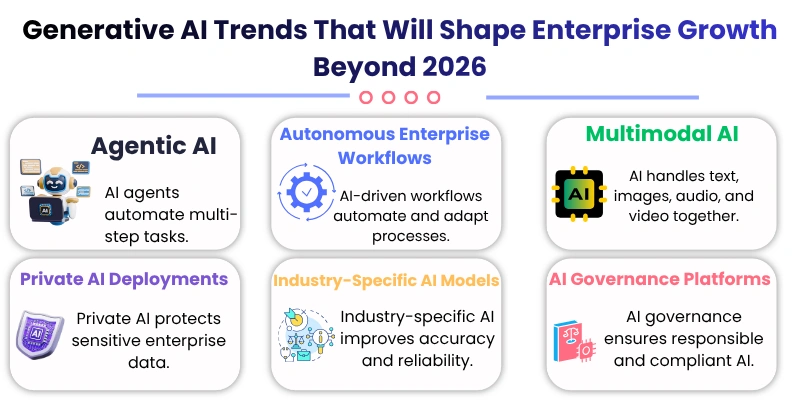
The AI landscape between 2023 and 2026 has been defined by three major waves: the emergence of large language models (LLMs) accessible to mainstream developers, the rapid proliferation of domain-specific fine-tuned models, and the rise of agentic AI systems capable of executing multi-step tasks autonomously. Each wave has expanded the scope of what is commercially viable and strategically important.
Early deployments focused primarily on text generation and basic Q&A interfaces. By 2025, the frontier had shifted toward retrieval-augmented generation (RAG), multimodal AI capable of processing text, images, and documents simultaneously, and sophisticated AI agents that could browse the web, interact with APIs, and manage workflows end-to-end. In 2026, these capabilities are no longer experimental — they are production-ready and enterprise-tested. As organizations evaluate investment strategies, understanding Software Development Costs in 2026 has become increasingly important, particularly as AI-powered solutions require specialized infrastructure, model optimization, security controls, and ongoing maintenance.
Enterprise Adoption Trends
According to recent industry surveys, over 72% of Fortune 500 companies have moved at least one generative AI use case into production. Mid-market adoption is equally accelerating, with SMEs leveraging AI platforms-as-a-service to access capabilities previously reserved for organizations with large R&D budgets. In the Middle East, UAE enterprises are among the most aggressive adopters globally, supported by government mandates and ambitious digital transformation programs.
Key Business Benefits:
Cost Optimization
Generative AI automates repetitive, high-volume knowledge tasks that previously required significant human labor. Document review, report drafting, customer query resolution, and data extraction — when handled by AI — can reduce per-task costs by 40% to 70% while maintaining or improving quality.
Faster Decision-Making
AI-powered analytics and summarization tools compress the time required to process large volumes of information. Executives and analysts who previously spent hours digesting reports can now receive AI-generated summaries with highlighted anomalies, freeing cognitive bandwidth for strategic thinking.
Enhanced Customer Experiences
Conversational AI and personalization engines allow businesses to deliver hyper-relevant, context-aware customer interactions at scale. AI chatbots and copilots can handle complex multi-turn conversations, reducing wait times and improving resolution rates across support, sales, and onboarding functions.
Workforce Productivity
Enterprise AI assistants and copilots act as force multipliers for knowledge workers. Legal teams draft contracts faster, developers write and review code more efficiently, marketers produce campaign assets at unprecedented speed, and HR teams automate candidate screening and onboarding. The productivity gains compound over time as models are fine-tuned to organizational data and workflows.
How We Selected the Top Generative AI Development Services
This list was curated based on a rigorous multi-factor evaluation framework designed to reflect the real-world priorities of enterprise buyers in 2026. Services were assessed across five core dimensions:
Evaluation Criteria:
Business Impact
The degree to which each service directly contributes to revenue growth, cost reduction, or strategic competitive advantage. Services with documented enterprise case studies and measurable outcome benchmarks were prioritized.
Security and Compliance
Given the increasing regulatory scrutiny of AI deployments worldwide, particular emphasis was placed on services that offer data privacy controls, auditability, and compliance with jurisdictions including GDPR, UAE PDPL, and sector-specific frameworks in healthcare and finance.
Scalability
Enterprise-grade services must handle demand spikes, growing data volumes, and expanding user bases without performance degradation. Architectural scalability was a key differentiator.
ROI Potential
Services that offer transparent pricing, rapid time-to-value, and quantifiable productivity or cost benefits ranked higher than those with opaque or unpredictable cost structures.
Industry Adaptability
Generic AI services score lower than those with demonstrated customization capacity and pre-built domain knowledge across verticals such as healthcare, finance, logistics, and government.
Top 12 Generative AI Development Services in 2026
1. Custom Generative AI Solution Development
Custom generative AI development involves designing, building, and deploying AI systems uniquely tailored to an organization’s specific business processes, data architecture, and strategic objectives. Unlike off-the-shelf tools, custom solutions are built from the ground up to reflect domain-specific requirements, integration constraints, and governance policies.
Use cases span a broad spectrum: from custom document intelligence pipelines for legal and financial services firms, to AI-powered product recommendation engines for e-commerce platforms, to specialized clinical summarization tools for healthcare providers. The common thread is a deep alignment between the AI system’s design and the organization’s operational reality.
Industries currently leading custom AI adoption include financial services, healthcare, logistics, manufacturing, and government. The primary driver is not novelty but necessity — organizations in these sectors operate within regulatory environments and competitive pressures that demand precision, auditability, and control that only custom development can provide.
Why it matters: For enterprises in the UAE and broader GCC region, partnering with experts in custom generative AI development services Dubai ensures solutions that reflect local compliance requirements, Arabic language capabilities, and regional business context.
2. Enterprise AI Assistant Development
Enterprise AI assistants are internal-facing intelligent systems that serve as a knowledge layer across an organization. Unlike consumer chatbots, these assistants are trained on proprietary company data — policies, procedures, product documentation, HR handbooks, technical manuals — and are designed to provide accurate, context-aware answers to employee queries in real time.
Applications include internal knowledge management portals that eliminate time wasted searching through fragmented documentation, employee onboarding tools that answer procedural questions instantly, and enterprise search systems that synthesize insights from multiple data repositories. The result is a measurable reduction in support ticket volume and a significant improvement in employee self-service capability.
- Reduce internal support costs by automating repetitive employee queries
- Accelerate onboarding with AI-guided orientation systems
- Improve knowledge retention and accessibility across large organizations
- Enable 24/7 access to accurate, up-to-date institutional knowledge
3. AI-Powered Content Generation Platforms
Content generation platforms powered by generative AI automate the creation of marketing copy, product descriptions, social media content, email campaigns, technical documentation, and long-form articles. In 2026, these platforms go well beyond simple text generation — they incorporate brand voice modeling, SEO optimization, multilingual output, and multi-channel content workflow management.
For marketing teams, the impact is transformative. Campaign assets that previously required weeks of creative development can now be produced in hours, with AI handling first drafts, variations testing, and tone calibration. Brand consistency is maintained through model fine-tuning on approved content libraries, ensuring every output reflects organizational voice standards.
Content workflow automation reduces bottlenecks at every stage of the production pipeline, from ideation and drafting to approval and publication. Integration with CMS platforms, email marketing tools, and social media schedulers creates end-to-end content operations that scale without proportional headcount growth.
4. AI Chatbot Development
AI chatbot development has evolved far beyond simple FAQ responders. Modern enterprise chatbots are sophisticated conversational systems capable of handling complex, multi-turn dialogues, executing transactional workflows, and maintaining context across sessions. They operate across web, mobile, WhatsApp, and enterprise communication platforms through seamless omnichannel integration.
In customer support, AI chatbots handle tier-one and tier-two query resolution with deflection rates that routinely exceed 60%, reducing pressure on human agent teams while maintaining high CSAT scores. In sales, conversational AI qualifies leads, books appointments, and delivers personalized product recommendations based on behavioral signals. Lead generation workflows powered by AI chatbots can operate continuously without fatigue or inconsistency.
Partner consideration: Organizations seeking scalable conversational AI across mobile and web should work with an experienced AI app development company Dubai to ensure robust omnichannel architecture and Arabic language support.
5. AI Copilot Development Solutions
AI copilots are embedded assistants integrated directly into the tools employees use daily — ERP systems, CRM platforms, code editors, document editors, and communication tools. They differ from standalone chatbots in that they operate contextually within existing workflows, offering real-time suggestions, automations, and knowledge retrieval without requiring users to switch applications.
Employee copilots boost operational efficiency by reducing context-switching and providing relevant assistance at the point of need. A legal copilot embedded in a contract management system flags unusual clauses. A customer service copilot suggests responses based on the current ticket context. A procurement copilot surfaces supplier data and historical pricing as a buyer evaluates a new request.
Knowledge retrieval copilots are particularly valuable in organizations where institutional knowledge is distributed across multiple systems. By connecting to document repositories, databases, and communication archives, copilots provide staff with instant access to the most relevant information available at any given moment.
6. Custom LLM Implementation
Custom large language model (LLM) implementation covers the full lifecycle of deploying foundation models within enterprise environments: selecting the appropriate base model, fine-tuning on proprietary datasets, implementing guardrails and safety filters, and deploying with governance controls that meet enterprise security standards. This is a core component of mature llm development services strategies.
Private LLM deployment addresses a fundamental concern among enterprise buyers: data sovereignty. Rather than sending sensitive business data to third-party cloud APIs, organizations deploy fine-tuned models within their own infrastructure — on-premise or in a private cloud — ensuring that proprietary information never leaves the corporate perimeter.
Fine-tuning on domain-specific corpora dramatically improves model performance on specialized tasks. A legal LLM fine-tuned on case law and contract templates outperforms a generic model on legal drafting tasks by a substantial margin. Similarly, financial models fine-tuned on regulatory filings and earnings reports deliver more precise analytical outputs.
Enterprise governance frameworks for LLMs include role-based access controls, audit logging of model queries and outputs, content filtering, and version management — all essential for regulated industries and organizations with strict data handling obligations.
7. AI Knowledge Base Systems
AI knowledge base systems use retrieval-augmented generation (RAG) architecture to combine the language understanding capabilities of LLMs with precise retrieval from organizational document repositories. This is the foundation of best-in-class rag development services and represents one of the most practically valuable AI services available in 2026.
Context-aware response generation is the key differentiator of RAG-based systems. Instead of generating answers from model memory alone — which can be outdated or hallucinated — RAG systems retrieve the most relevant documents from a curated knowledge base before generating a response, grounding outputs in verified, current information.
Document intelligence capabilities extend to unstructured data sources including PDFs, emails, SharePoint documents, Confluence wikis, and database records. AI knowledge bases can process thousands of documents, extract key information, and make it instantly retrievable through natural language queries — transforming passive data archives into active knowledge assets.
For enterprise knowledge management, RAG-based systems reduce reliance on individual experts, preserve institutional knowledge against employee turnover, and ensure consistent, accurate information delivery across departments.
8. AI Agent Development
AI agents represent the frontier of generative AI deployment in 2026. Unlike traditional automation that follows rigid, pre-programmed scripts, AI agents are goal-directed systems that can plan, reason, use tools, and adapt their approach based on feedback. Mature ai agent development services deliver agents capable of executing complex, multi-step business processes with minimal human supervision.
Autonomous workflow capabilities include researching and synthesizing information, drafting and sending communications, interacting with APIs, and making decisions within defined parameters. A procurement agent can monitor inventory levels, identify reorder triggers, research supplier options, and initiate purchase orders — all without human intervention at each step.
Multi-agent systems coordinate specialized agents to tackle complex organizational challenges. A market intelligence system might deploy a research agent to gather data, an analysis agent to identify patterns, a summarization agent to produce reports, and a distribution agent to deliver insights to the right stakeholders — all orchestrated through an overarching coordination layer.
Regional expertise: Organizations in Abu Dhabi and the Northern Emirates can leverage specialized software development in abu dhabi capabilities to build AI agent solutions aligned with local regulatory and operational contexts.
9. Enterprise AI Automation Platforms
Enterprise AI automation platforms integrate generative AI with existing business process automation (BPA) and robotic process automation (RPA) infrastructure to create intelligent, adaptive workflows. Unlike legacy automation that breaks when processes deviate from expected patterns, AI-powered automation handles exceptions, ambiguity, and variability with human-like judgment.
Workflow orchestration capabilities allow organizations to design end-to-end process flows that incorporate AI decision nodes alongside traditional automation steps. Invoice processing workflows, for example, can use AI to extract data from unstructured invoices, apply business rules, flag anomalies for human review, and route approved invoices to payment systems — all within a single orchestrated pipeline.
Cost reduction is the primary driver of enterprise AI automation adoption. By replacing manual, error-prone processes with intelligent automation, organizations typically achieve payback periods of six to eighteen months while simultaneously improving process quality and auditability.
10. AI Vision and Document Intelligence Solutions
AI vision and document intelligence solutions apply computer vision and large multimodal models to extract structured information from unstructured visual and document sources. In 2026, these systems handle complex real-world documents — handwritten forms, scanned contracts, mixed-media reports — with near-human accuracy.
Optical character recognition (OCR) enhanced by large multimodal models can handle document types that traditional OCR fails on: low-quality scans, non-standard layouts, multi-language documents, and forms with complex table structures. The AI layer adds semantic understanding on top of character recognition, enabling extraction of meaning rather than just text.
Contract processing and analysis is one of the highest-value applications. AI systems can review hundreds of contracts simultaneously, flagging non-standard clauses, identifying compliance gaps, extracting key dates and obligations, and generating structured summaries — compressing work that previously took legal teams weeks into hours.
Compliance monitoring applications use AI vision to verify that physical processes, documentation, and product outputs meet regulatory standards. In manufacturing and pharmaceuticals, AI inspection systems can detect defects and deviations with precision that exceeds human visual inspection.
11. Industry-Specific AI Solutions
Industry-specific AI solutions represent the highest tier of generative AI maturity, delivering purpose-built systems that encode deep domain knowledge, regulatory compliance requirements, and sector-specific data models. These enterprise generative ai solutions consistently outperform generic implementations because they are designed to solve the specific challenges that define each vertical.
Healthcare
Healthcare AI solutions address clinical documentation, diagnostic support, patient communication, and regulatory compliance. AI-powered clinical note generation reduces physician documentation burden, while diagnostic AI assists radiologists and pathologists with pattern recognition in medical imaging. Patient communication platforms use generative AI to deliver personalized health education and follow-up care instructions.
FinTech
Financial services AI solutions power fraud detection, credit risk assessment, regulatory reporting automation, and personalized financial advisory services. Generative AI systems analyze transaction patterns to identify anomalies in real time, while NLP systems process regulatory filings and generate compliance reports with minimal human oversight.
Logistics
Logistics AI solutions optimize routing, demand forecasting, warehouse operations, and supplier communication. Generative AI generates natural language updates for supply chain stakeholders, while predictive models anticipate disruptions and recommend mitigation strategies before they impact operations.
Retail
Retail AI solutions power personalization engines, inventory management, customer service automation, and visual search capabilities. Generative AI creates personalized product recommendations and marketing messages at individual customer level, while conversational commerce platforms enable natural language shopping experiences across channels.
Government
Government AI solutions address citizen services, document processing, policy analysis, and regulatory intelligence. AI-powered citizen service portals handle complex queries about benefits, permits, and services in multiple languages, while document intelligence systems accelerate processing of high-volume administrative tasks.
12. AI Model Monitoring and Governance Services
As AI systems become embedded in critical business processes, monitoring and governance have moved from optional considerations to essential infrastructure. AI model monitoring and governance services provide the frameworks, tooling, and expertise to ensure that deployed AI systems perform reliably, fairly, and in compliance with evolving regulatory requirements.
Responsible AI frameworks establish organizational policies for AI development and deployment, covering fairness, transparency, accountability, and human oversight. These frameworks translate ethical principles into operational guidelines that development teams can implement consistently across all AI initiatives.
Model auditing services provide independent assessments of AI system performance, bias, and compliance. Regular audits detect model drift — the gradual degradation of performance as real-world data distributions shift from training data — and trigger retraining or recalibration before business impact occurs.
Risk mitigation encompasses data lineage tracking, explainability reporting, incident response planning, and regulatory change management. For organizations operating in regulated industries, governance services are not a compliance overhead but a strategic enabler — providing the confidence to deploy AI aggressively without incurring regulatory or reputational risk.
Building responsibly: Organizations investing in custom software development Dubai for AI applications should ensure governance and monitoring capabilities are built into the architecture from day one, not retrofitted after deployment.
Generative AI Security, Compliance, and Legal Considerations
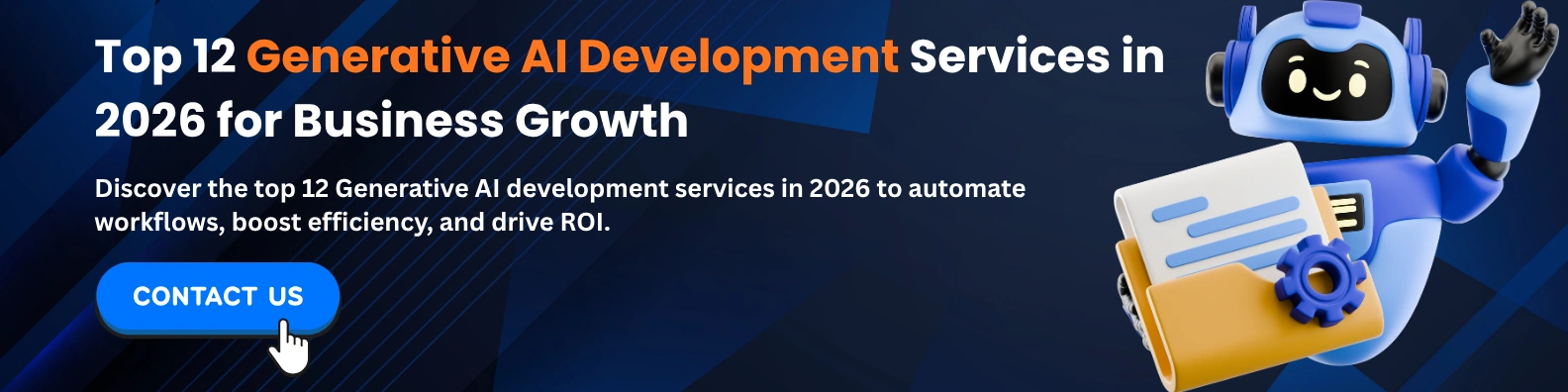
Data Privacy Regulations
Generative AI deployments intersect with data privacy law at multiple points: training data sourcing, inference-time data handling, output storage and logging, and third-party model API usage. Organizations must conduct thorough data mapping exercises to understand what personal or sensitive data flows through their AI systems and ensure that each processing activity has a valid legal basis.
Key data privacy considerations include ensuring that training datasets do not contain personal data without appropriate consent or legal basis, implementing data minimization practices in inference pipelines, establishing retention policies for AI interaction logs, and conducting Data Protection Impact Assessments (DPIAs) for high-risk AI processing activities.
UAE Compliance Requirements
The UAE has established a progressive AI regulatory environment that balances innovation promotion with risk management. The UAE Personal Data Protection Law (PDPL) establishes requirements for data processing consent, cross-border data transfer restrictions, and individual rights that apply directly to AI systems processing personal data. Organizations operating in the UAE or serving UAE residents must integrate PDPL compliance into their AI governance frameworks.
Sector-specific regulations add additional layers of compliance obligation. Healthcare AI systems must comply with Dubai Health Authority and DOH requirements. FinTech AI deployments fall under CBUAE and DFSA oversight. Government AI systems must align with UAE AI Ethics Principles published by the Ministry of AI.
AI Governance Frameworks
Enterprise AI governance frameworks define the policies, processes, and controls that govern AI development and deployment across an organization. Mature frameworks cover model risk management, algorithmic accountability, human oversight requirements, and escalation procedures for AI-related incidents.
Intellectual Property Risks
Generative AI creates novel IP challenges that organizations must address proactively. Questions about the copyright status of AI-generated content, liability for AI outputs that incorporate third-party training data, and ownership of AI models developed on proprietary datasets all require clear legal frameworks and contractual protections.
Ethical AI Implementation
Beyond legal compliance, ethical AI implementation requires organizations to actively assess and mitigate potential harms including bias in AI outputs, exclusionary impacts on vulnerable populations, privacy erosion through inference, and concentration of decision-making power in opaque systems. Ethical AI commitments should be embedded in procurement criteria, development standards, and ongoing monitoring protocols.
Cost Effectiveness of Generative AI Development
ROI Analysis
The ROI case for generative AI investments in 2026 is well-established across multiple deployment categories. Knowledge base and document intelligence systems typically deliver ROI within 6–12 months through labor cost reduction and error rate improvement. Customer-facing AI deployments achieve ROI through increased conversion rates, reduced support costs, and improved customer lifetime value. Enterprise automation platforms generate ROI through process efficiency gains and headcount optimization.
Cost Savings Opportunities
Direct cost savings arise from automation of manual, repetitive tasks: document processing, customer query resolution, report generation, and compliance monitoring. Indirect savings come from error reduction, faster cycle times, and improved decision quality. Organizations that have deployed AI across multiple functions report aggregate cost savings of 15–25% of operational budgets within 18–24 months of initial deployment.
Productivity Improvements
Productivity gains from generative AI deployment manifest across three dimensions: speed (tasks completed faster), quality (fewer errors and revisions), and capacity (existing teams handling higher workloads without additional headcount). Knowledge workers with AI copilot support consistently demonstrate 30–50% productivity improvements on writing-intensive tasks and 20–40% gains on research and analysis tasks.
Long-Term Business Value
The long-term business value of generative AI extends beyond cost reduction to competitive differentiation. Organizations that build AI-native processes and capabilities create structural advantages that are difficult for competitors to replicate quickly. Early AI adopters in sectors like financial services and retail are already demonstrating sustained revenue growth advantages driven by AI-powered personalization, efficiency, and decision quality.
Mobile-first consideration: For organizations building customer-facing AI experiences, working with a mobile app development company in dubai ensures that AI-powered features are optimized for the mobile-first consumption patterns of UAE and GCC consumers.
Understanding AI Development Costs in 2026
Accurate cost planning is essential for AI investments to deliver expected returns. In 2026, the cost structure for generative AI development has become more transparent and modular, though it remains variable based on scope, complexity, and organizational context. Understanding the key cost drivers allows enterprises to budget realistically and avoid common investment pitfalls. For a comprehensive analysis of development investment benchmarks, refer to our guide on Software Development Costs in 2026.
Infrastructure Costs
Infrastructure costs encompass cloud compute, GPU resources for model inference, storage for training data and model artifacts, and networking for low-latency AI service delivery. Inference costs have declined significantly as model efficiency has improved, but high-volume deployments still require careful architecture planning to avoid runaway cloud spend.
Model Training Costs
Custom model training and fine-tuning costs vary dramatically based on model size, dataset volume, and training duration. Fine-tuning smaller open-source models on domain-specific data is accessible at relatively modest cost. Pre-training custom foundation models from scratch remains capital-intensive and is typically reserved for organizations with unique data advantages.
Integration Costs
Integration with existing enterprise systems — ERPs, CRMs, data platforms, communication tools — typically represents the largest cost category for AI deployments. Well-architected API layers and pre-built connector libraries can significantly reduce integration costs, but complex legacy environments require substantial custom development investment.
Maintenance Costs
Ongoing maintenance costs include model monitoring, periodic retraining to address data drift, security patching, and performance optimization. Organizations that underestimate maintenance costs relative to initial development investment often encounter budget surprises 12–18 months post-deployment.
Enterprise Deployment Costs
Enterprise deployment costs encompass user training and change management, helpdesk support for AI tools, compliance and audit activities, and governance program management. These ‘soft’ costs are frequently underestimated but are critical determinants of deployment success and adoption velocity.
AI Development Cost Trends in UAE
The UAE AI development market has matured significantly, with increased competition among service providers, expanded local talent pools, and greater cost efficiency from improved tooling and frameworks. Organizations exploring AI Development Cost in Dubai will find a market that offers competitive pricing relative to Western markets while maintaining proximity to global AI expertise and access to cutting-edge technologies.
Factors Affecting Pricing
- Team composition and seniority mix of AI engineers, data scientists, and domain experts
- Technology stack complexity, including choice of foundation models and cloud infrastructure
- Compliance and security requirements, particularly for regulated industries
- Level of custom development versus configuration of existing platforms
- Ongoing support and maintenance scope
Future of Enterprise AI in the UAE
The UAE is positioned as one of the world’s most forward-leaning AI adopters, driven by explicit government strategy, substantial public investment, and a business environment conducive to rapid technology deployment. The trajectory for AI Software Development in UAE points to sustained acceleration across both public and private sector applications.
Government Initiatives
The UAE AI Strategy 2031 targets positioning the UAE as a global hub for AI innovation and adoption. The strategy encompasses investments in AI research infrastructure, talent development programs, regulatory framework modernization, and public sector AI deployment mandates. Federal and emirate-level AI offices coordinate implementation and provide guidance to private sector organizations navigating the AI adoption journey.
Digital Transformation Goals
UAE government entities have set ambitious digital transformation targets that require AI as a foundational enabler. Smart city initiatives in Dubai and Abu Dhabi, paperless government programs, and AI-powered citizen service platforms are generating substantial demand for enterprise AI development services. The public sector’s AI adoption is also catalyzing private sector investment as vendors build capabilities to serve government contracts.
Industry Adoption Forecast
By 2027, over 80% of large UAE enterprises are projected to have at least one production AI deployment. Financial services, healthcare, and logistics are expected to lead adoption intensity, while real estate, education, and retail are forecast as the fastest-growing sectors. Arabic language AI capabilities are a critical differentiator in the UAE market, and providers who have invested in high-quality Arabic NLP and generation will capture disproportionate market share.
Emerging AI Applications Businesses Should Watch
Beyond the established service categories described above, several emerging AI applications are approaching commercial readiness and warrant strategic attention from enterprise technology leaders. For a broader consumer perspective on AI capabilities, see our guide to the 20 Best Artificial Intelligence Apps reshaping personal and professional productivity.
Autonomous AI Assistants
Next-generation AI assistants go beyond question-answering to proactive task execution. These systems monitor business metrics, identify emerging issues, and initiate corrective actions within defined parameters — effectively operating as digital team members rather than tools. Early enterprise deployments in financial services and operations management are demonstrating significant impact on both efficiency and decision quality.
Autonomous Agents at Scale
Multi-agent AI systems capable of coordinating dozens of specialized agents to execute complex organizational processes represent the next frontier of enterprise automation. Use cases under active development include autonomous market research, competitive intelligence gathering, multi-party contract negotiation support, and end-to-end supply chain optimization.
Multimodal AI Systems
Multimodal AI systems that seamlessly process and generate text, images, audio, and video are unlocking new application categories. In retail, multimodal AI enables visual search and virtual try-on experiences. In manufacturing, it powers real-time quality inspection integrated with production management systems. In media and entertainment, it automates content creation workflows across formats and channels.
Industry Intelligence Platforms
AI-powered industry intelligence platforms aggregate and analyze vast volumes of market data, regulatory changes, competitive signals, and macro-economic indicators to deliver actionable strategic insights. These platforms are particularly valuable in fast-moving sectors like fintech, healthcare, and energy, where decision quality depends on comprehensive situational awareness.
Why Choose SISGAIN for Generative AI Development
Selecting the right implementation partner is as important as selecting the right AI technology. SISGAIN brings a distinctive combination of deep technical expertise, enterprise delivery experience, and domain knowledge that sets it apart in the generative AI development services market.
Proven Industry Experience
SISGAIN has delivered AI and digital transformation solutions across healthcare, financial services, logistics, retail, and government sectors in the UAE, GCC, and globally. This cross-industry experience means clients benefit from best practices and lessons learned across hundreds of enterprise deployments.
Enterprise-Grade Security
Security is engineered into every SISGAIN engagement from the architecture phase. Data encryption, access controls, audit logging, and threat modeling are standard components of all AI solution deliveries. SISGAIN’s security-first approach is particularly valued by clients in regulated industries where AI deployments face heightened scrutiny.
Compliance-First Development Approach
SISGAIN integrates compliance requirements into the development lifecycle rather than addressing them as an afterthought. UAE PDPL, GDPR, sector-specific regulations, and emerging AI governance requirements are factored into solution architecture, data handling practices, and documentation from day one.
Dedicated AI Experts
SISGAIN maintains a dedicated team of AI engineers, data scientists, ML ops specialists, and domain experts who focus exclusively on generative AI development. This specialization translates to faster time-to-value and higher solution quality than generalist development teams can achieve on AI-specific engagements.
End-to-End Delivery
From initial discovery and use case prioritization through architecture design, development, testing, deployment, and ongoing support, SISGAIN manages the complete AI development lifecycle. This end-to-end accountability eliminates the coordination overhead and handoff risks associated with multi-vendor AI programs.
Scalable Architecture Design
SISGAIN architectures are designed to scale gracefully as organizational AI needs grow. Modular component design, API-first integration approaches, and cloud-native infrastructure ensure that solutions built today can accommodate the expanded requirements of tomorrow without costly re-architecture.
Post-Deployment Support
AI deployments require ongoing attention to maintain performance and relevance. SISGAIN’s post-deployment support services include model monitoring, performance optimization, retraining management, and feature enhancement — ensuring that AI investments continue to deliver value long after initial go-live.
Transparent Project Management
SISGAIN’s project management methodology emphasizes visibility, predictability, and stakeholder alignment. Regular milestone reviews, clear escalation paths, and proactive risk identification keep projects on track and clients informed at every stage of the delivery process.
Focus on Measurable Business Outcomes
Every SISGAIN engagement is scoped and measured against business outcomes, not technical deliverables alone. Success metrics are defined collaboratively at project inception and tracked throughout delivery, ensuring that AI investments translate into tangible organizational value.
Conclusion
The twelve generative AI development services profiled in this guide represent the most strategically valuable categories for enterprise investment in 2026. From custom solution development and enterprise AI assistants to autonomous agents and AI governance services, each service category addresses specific organizational challenges and creates measurable business value when implemented thoughtfully.
Evaluating AI opportunities requires a disciplined framework that considers business impact, security, scalability, compliance, and long-term ROI alongside technical capability. Organizations that approach AI investment with this rigor will consistently outperform those chasing technology novelty without strategic grounding.
Selecting the right implementation partner is perhaps the most consequential decision in any AI program. The partner’s ability to understand your business context, navigate technical complexity, manage regulatory requirements, and deliver production-ready solutions reliably will determine whether your AI investment generates competitive advantage or costly distraction.