

In early 2020, the COVID-19 pandemic swept through India and the UAE, exposing vulnerabilities in their healthcare systems. India faced panic with overwhelmed hospitals, shortages of ICU beds, and outdated manual record-keeping. The UAE, despite its advanced infrastructure, also struggled to manage the surge in cases. Digital healthcare became not just an option but a necessity to address these challenges. As of June 2025, with active COVID cases in India still numbering around 5,000–6,000, the role of health tech continues to grow. This blog explores how India’s health tech transformation offers valuable lessons for the UAE and beyond. Learn more about modern Hospital Management Systems that are shaping this new era.
What COVID-19 Revealed About India’s Health Infrastructure

The pandemic laid bare critical gaps in India’s healthcare system. Public hospitals struggled with ICU shortages, lack of real-time bed tracking, and reliance on paper-based records, leading to delays and inefficiencies. The World Health Organization noted that data delays during the second wave in 2021 overwhelmed India’s health systems, with 4.7 million excess deaths linked to the crisis. Even in the UAE, advanced facilities in Dubai faced challenges managing patient surges. These systemic gaps underscored the need for digital solutions to streamline operations and improve patient care.
How COVID Fast-Tracked Health Tech in India

The lockdown in 2020 forced India to embrace digital health solutions at an unprecedented pace. Below are key areas of transformation:
Telemedicine Boom
During the COVID-19 lockdown, India witnessed an unprecedented 500% rise in teleconsultations, especially on platforms like Practo, mfine, and Tata Health. This surge was driven by the need for safe, contactless access to medical professionals, as hospitals became high-risk zones. Telemedicine bridged the gap for millions, enabling patients to consult doctors remotely for both chronic conditions and COVID symptoms. The Ministry of Health also issued official guidelines to standardize telemedicine practices, giving the sector formal recognition and legal clarity. For doctors, it meant flexible work models and reduced burnout; for patients, it offered access to specialists even from rural or underserved areas. The success of telemedicine also triggered software innovation—video consultation features, digital prescriptions, and integration with health records. This momentum continues in 2025, as telemedicine becomes a permanent fixture in outpatient care, creating vast opportunities for custom medical app development and Healthcare Software Services across India and the UAE.
Rise of EMR/EHR Systems
Before the pandemic, many Indian hospitals—especially smaller clinics—relied on paper-based records, leading to inefficiencies, data loss, and fragmented care. COVID-19 forced an urgent shift. Within just a year, hospitals began adopting EMR (Electronic Medical Records) and EHR (Electronic Health Records) systems at scale to streamline care, reduce manual handling, and enable fast, secure data access. This transition allowed doctors and nurses to quickly retrieve patient histories, track oxygen levels, share lab reports, and collaborate across departments—even remotely. Digitization also facilitated better coordination during emergencies, especially for COVID admissions and vaccine administration. Most importantly, EMRs empowered hospitals to start generating valuable analytics—tracking comorbidities, recovery trends, and ICU needs. This data-driven approach marked a leap toward evidence-based, patient-centric care. For healthcare software providers, this became a turning point to customize EMR modules by specialty, integrate with billing and pharmacy tools, and develop scalable solutions for urban and semi-urban India—and even for Hospital Management Systems in the UAE.
Government Push: Ayushman Bharat Digital Mission (ABDM)
India’s Ayushman Bharat Digital Mission (ABDM) is one of the most significant digital healthcare reforms in the world. Launched during the pandemic, the mission aims to build a unified digital health ecosystem by creating unique digital health IDs for citizens, enabling hospitals, labs, and insurance providers to share data securely. As of December 2024, over 71 crore Ayushman Bharat Health Accounts (ABHA) have been created, and more than 3.5 lakh health facilities are registered on the platform. ABDM enables citizens to store and access digital health records, improving care continuity and reducing duplicate tests. For hospitals, it simplifies patient onboarding, consent-based data sharing, and policy integration. The government also launched open-source tools to help software development companies in India build compliant solutions. The mission lays the groundwork for a national health stack, creating a huge opportunity for tech providers to innovate and align with Healthcare Software Services and policy-backed healthtech models—even across borders, including the UAE.
UAE Parallel
While India saw a tech leap driven by crisis, the UAE proactively invested in healthcare digitization as part of its long-term vision for smart governance. During COVID-19, the UAE rolled out drive-through testing centers, health tracking apps (like Al Hosn), and AI-powered diagnostics—enhancing patient safety, efficiency, and speed. The country’s focus on SaaS-based health apps allowed for rapid updates and deployment, mirroring India’s telemedicine and EMR evolution. Dubai Health Authority (DHA) also expanded digital health regulations to encourage cloud-based Hospital Management Systems and Remote Patient Monitoring platforms. UAE hospitals today rely on custom healthcare software solutions for operational efficiency, patient tracking, and pandemic preparedness. There’s strong synergy between India’s healthtech innovation and the UAE’s infrastructure investment, creating demand for cross-border collaborations in EMR, EHR, and medical app development companies. For healthcare software developers, this trend signifies not only regional expansion but also a new benchmark for global healthcare SaaS standards.
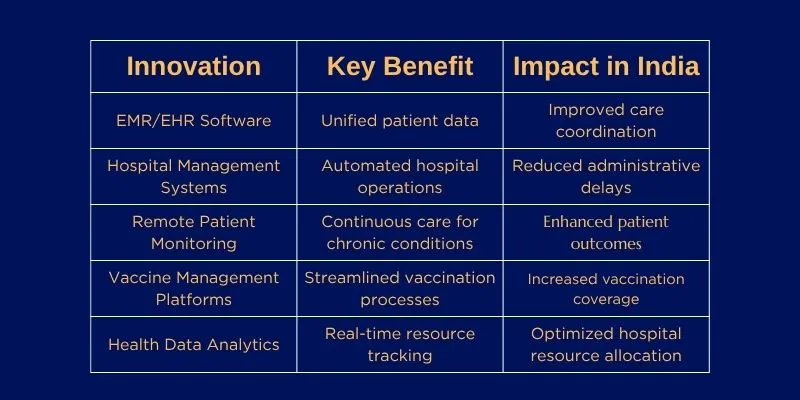
Top 5 Health Tech Innovations Triggered by the Pandemic
The crisis sparked several innovations that transformed healthcare delivery:
-
EMR/EHR Software: Unified patient data across departments for seamless care. Learn about Healthcare Software Types.
-
Hospital Management Systems (HMS): Automated billing, scheduling, and resource management. Discover modern Hospital Management Systems.
-
Remote Patient Monitoring: Enabled continuous care for chronic and COVID-affected patients.
-
Vaccine Management Platforms: Streamlined digital queues and integrated with vaccine passports.
-
Health Data Analytics Dashboards: Provided real-time tracking of patients, ICU beds, and oxygen supplies.
Case Studies: How Indian Hospitals Leveraged Health Tech
India’s health tech adoption yielded tangible results, as shown in these examples:
Mumbai Hospital Success: Cloud-Based HMS Improved Bed Utilization by 37%
During the second wave of COVID-19 in India, one of Mumbai’s leading private hospitals faced a major crisis: severe bed shortages, overwhelming patient queues, and logistical chaos. In response, the hospital rapidly adopted a cloud-based Hospital Management System (HMS) to digitize patient flow, admission records, bed occupancy status, and discharge processes in real time. The system enabled hospital staff to monitor availability across departments, predict discharge timelines, and allocate beds more efficiently—all through a centralized digital dashboard.
Within weeks of implementation, bed utilization improved by 37%. This directly reduced emergency room wait times, optimized ICU occupancy, and minimized paperwork bottlenecks. Doctors and administrators had real-time access to critical data, allowing for faster triaging and resource planning. Most importantly, patient satisfaction scores improved, as critical care became more accessible. This case illustrates how digital tools like HMS are not just convenience upgrades—but life-saving infrastructure during healthcare emergencies.
Rajasthan Rural Clinic: Telemedicine Bridged the Urban-Rural Healthcare Gap
In rural Rajasthan, healthcare access has long been hindered by geographic isolation, lack of specialists, and costly travel to urban centers. During the pandemic, one government-affiliated clinic in a remote village adopted a telemedicine software platform to address these issues. The platform connected rural patients with top urban doctors through video consultations, e-prescriptions, and remote diagnostics.
Over six months, the clinic conducted over 3,000 virtual consultations. Patients reported a 50% reduction in travel costs, and the number of missed appointments dropped sharply. Additionally, the clinic saw a notable rise in follow-up rates, as consultations became more convenient. Chronic disease management (like diabetes and hypertension) significantly improved with regular digital check-ins.
This case demonstrates how telemedicine software development is not only essential in cities but transformative in underserved regions. It bridges the digital divide, promotes healthcare equity, and supports scalable, patient-centered care across India’s vast geography.
These scalable solutions are now inspiring UAE hospitals, particularly in Dubai, to adopt similar tools for pandemic preparedness.
What the UAE Can Learn from India’s COVID Tech Response
India’s health tech innovations provide a framework for the UAE to build resilience. Key lessons include:
-
Invest in Scalable Solutions: India’s rapid adoption of telemedicine and EMR systems shows how digital tools can address resource constraints.
-
Leverage Government Support: The ABDM’s success highlights the importance of policy-driven digital health initiatives.
-
Foster Collaboration: UAE-based medical app development companies can partner with Indian firms to create cost-effective, interoperable solutions.
The UAE’s proactive response, including drive-through testing and AI integration, aligns with India’s approach, suggesting opportunities for cross-border collaboration.
COVID in UAE vs India: Tech Gaps and Gains

The COVID-19 pandemic exposed contrasting realities in India and the UAE’s healthcare systems. India, grappling with massive population density and limited infrastructure, faced challenges such as ICU shortages, manual data entry, and fragmented care coordination. However, these very obstacles pushed India toward aggressive digital adoption. In just months, India rolled out telemedicine platforms, digitized hospital workflows with EMR/EHR systems, and introduced centralized dashboards for tracking bed availability, vaccine status, and patient data. These low-cost, scalable solutions—backed by initiatives like the Ayushman Bharat Digital Mission—proved transformative, especially in public healthcare settings.
In contrast, the UAE entered the pandemic with more advanced hospital infrastructure and better funding. However, the focus was more on system stability than rapid innovation. The crisis revealed gaps in large-scale digital scalability and real-time data analytics. By studying India’s model, the UAE has an opportunity to strengthen its resilience—especially by expanding telemedicine access and integrating predictive analytics across hospitals and government health departments.
The Future of Healthcare Software Development in India (and UAE)
The pandemic has set the stage for advanced health tech innovations:
-
AI-Based Diagnostics: Enhancing early detection and personalized treatment.
-
Blockchain for Patient Records: Ensuring secure, transparent data management.
-
Personalized Health Platforms: Tailoring care to individual needs.
-
SaaS Models: Offering low-cost, scalable solutions for hospitals.
As COVID cases in India in 2025 continue to drive innovation, cross-border partnerships between Indian and UAE software vendors can accelerate global health tech advancements.
Conclusion: From Crisis to Opportunity
The ongoing presence of COVID cases in India today is a clear reminder that the pandemic’s challenges are far from over. Despite a significant decline from the 2020–2021 peaks, periodic surges continue to test the preparedness of healthcare systems. However, these challenges have sparked innovation. India’s rapid digital health transformation—from deploying telemedicine and EMRs to implementing cloud-based Hospital Management Systems—provides a proven model for scalable, tech-driven healthcare. For countries like the UAE, where COVID cases in Dubai have also caused healthcare strain, India’s experience serves as a timely blueprint. By proactively investing in digital infrastructure such as Healthcare Software Services, custom SaaS-based tools, and interoperable hospital tech, both nations can build systems equipped for future pandemics, emergencies, and evolving patient needs. Now is not the time to pause—it’s the time to prepare.
Book a demo or consultation today to explore how tailored healthcare software solutions can future-proof your facility.
